ARC Raiders and the Art of the Extraction Shooter
How ARC Raiders blends third-person combat, PvPvE tension, and retro-futurist style into a distinctive extraction shooter experience.
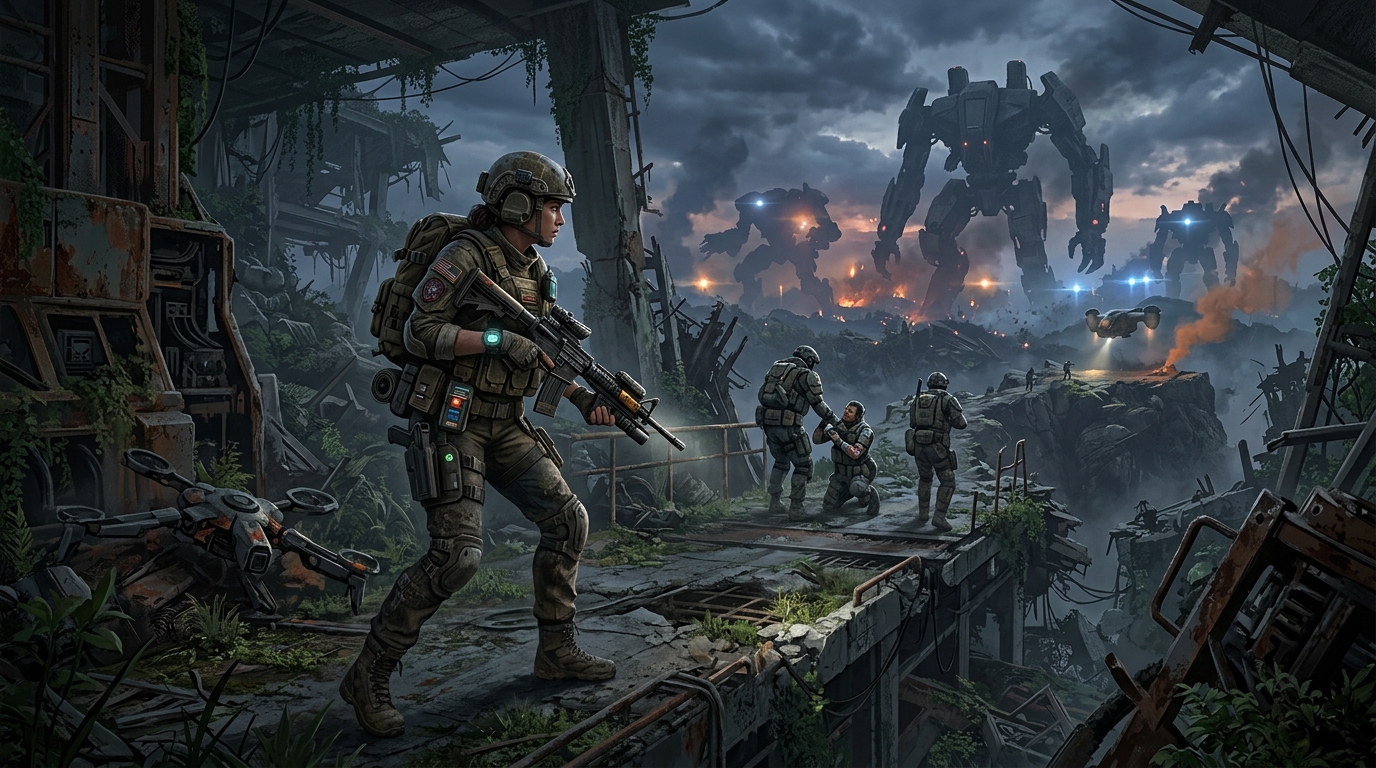
ARC Raiders, from Embark Studios, enters one of the most competitive corners of multiplayer gaming: the extraction shooter. Instead of mimicking the first-person formula popularized by games like Escape from Tarkov, it leans on third-person combat, a striking retro-futurist aesthetic, and a focus on accessible but tense PvPvE sessions. The result is a game that feels familiar in concept — drop in, grab loot, escape alive — yet different in rhythm and moment-to-moment decision-making.
This article explores how ARC Raiders structures its world, the role of third-person perspective, its blend of human and AI threats, and whether it does enough to stand out in a rapidly growing genre.
A Ravaged Earth Built for Raiding
ARC Raiders is set on a devastated Earth where towering machines known as the ARC dominate the surface. Humanity has retreated to underground hubs, sending small groups of raiders topside to scavenge resources, tech, and gear. It’s a familiar post-apocalypse premise, but the game distinguishes itself through tone and presentation rather than lore dumps.
Instead of grim realism, the surface is rendered with a retro-futurist flair – battered satellites, brutalist structures, and analog tech litter fields and ruined settlements. The visual language sells the idea of a future that advanced rapidly, collapsed violently, and never quite recovered.
Why the Setting Matters for Gameplay
The world design isn’t just set dressing. It supports the core extraction loop:
- Open sightlines and verticality make it easier to read distant threats, vital in a game with both AI machines and human players.
- Dense points of interest (POIs) concentrate loot, enemies, and ambush opportunities, naturally creating hotspots of conflict.
- Environmental storytelling — rusted ARC wrecks, abandoned bunkers, ruined comms towers — hints at past battles and subtly communicates where high-value loot or danger might be found.
Embark’s approach reflects a broader trend in multiplayer shooters: using level design not only for balance but as a way to teach players where to expect action without explicit tutorials or markers. Games like Hunt: Showdown and Battlefield have similarly leaned on environmental cues to shape player behavior and battlefield flow.
Third-Person Perspective: Strength or Handicap?
Most prominent extraction shooters rely on first-person perspective to emphasize immersion, limited awareness, and high-stakes tension. ARC Raiders deliberately goes another way with third-person aiming and movement, framing it as a core part of the game’s identity rather than a novelty.
Situational Awareness and Tactical Peeking
Third-person fundamentally changes how players parse information:
- Wider field of view: You see more of your surroundings, including parts of the sky and flanking routes, without needing to swing the camera wildly.
- Camera peeking: You can angle the camera around corners or over cover to gather information while keeping your character model safely behind hard cover.
- Clearer body positioning: Because you constantly see your avatar, it’s easier to understand your exact position relative to cover, sightlines, and enemies.
These traits are especially relevant in a PvPvE game where threats come from multiple vectors at once. Research on human-computer interaction and situational awareness in 3D environments indicates that wider fields of view and external perspectives can substantially improve a player’s perception of spatial relationships and surrounding hazards, particularly in fast-paced scenarios where quick orientation is key.1
Impact on Cover and Gunfights
In ARC Raiders, cover is more than a safety blanket; it’s a tool for information warfare. Because you can decouple camera and character, you can:
- Track enemy movement from behind cover before exposing yourself.
- Set up crossfires and bait shots without fully committing to an angle.
- Coordinate pushes with teammates based on what you see, not just what you guess.
That said, third-person also introduces potential downsides:
- Corner advantage: Players who master camera peeking can hold or check angles with less risk than opponents, a common criticism of third-person shooters.
- Reduced jump-scare tension: You’re less likely to be surprised by enemies right in front of you, which can mute the horror-like suspense many first-person extraction shooters lean on.
ARC Raiders counters some of this with enemies that attack from above or at long distances, leveraging the verticality of the world to keep players on edge.
An Extraction Loop Tuned for Accessibility
At its core, ARC Raiders follows the now-familiar extraction shooter pattern:
- Deploy from a safe hub to a contested surface zone.
- Scavenge resources, complete contracts, and fight enemies.
- Reach an extraction point within a time limit and escape alive.
- Use extracted loot to craft gear, upgrade your base, and prepare for harder runs.
Where it differs from the more hardcore end of the genre is in how approachable the loop feels. While death still stings, the game isn’t designed to be as punishing as Tarkov-style simulations. This aligns with a wider industry trend: recent shooters like DMZ and similar modes aim to bring extraction tension to players who don’t want to study spreadsheets of ammo types or suffer brutal gear wipe cycles.
Risk, Reward, and Time Pressure
Each raid is governed by a timer and escalating risk. As the session progresses:
- AI patrols become more aggressive or numerous.
- Valuable loot becomes a bigger temptation the longer you stay.
- Other players are increasingly likely to converge on lucrative POIs or extraction zones.
This structure echoes core principles from game design research, where dynamic difficulty and timed objectives are used to keep player engagement high without relying solely on raw mechanical challenge.2 By tying better rewards to staying longer in the danger zone, ARC Raiders pushes players to constantly weigh the question: Is this worth risking everything I’m carrying?
| Decision | Potential Reward | Potential Risk |
|---|---|---|
| Pushing to a high-tier POI late in a raid | Rare materials, powerful weapons, unique mods | Increased AI strength and higher chance of PvP ambush |
| Extracting early with modest loot | Guaranteed progression and resource safety | Missed opportunity for high-value gear and contracts |
| Helping another squad in distress | Potential temporary alliance and shared objectives | Betrayal or third-party attacks while distracted |
PvPvE: Machines, Raiders, and Unscripted Stories
ARC Raiders positions itself as a PvPvE game from the outset. On the surface, you face two intertwined threats:
- ARC machines — drones, walkers, turrets, and larger constructs that patrol or guard key areas.
- Other raiders — human-controlled squads with their own objectives, loot, and extraction plans.
ARC Machines as Environmental Pressure
The ARC aren’t just bullet sponges; they’re designed to shape how you move and fight. Some will lock down open fields with suppressive fire, while others patrol sky lanes or flank from unexpected angles. Because these threats are systemic rather than strictly scripted, raids rarely play out the same way twice.
This design echoes approaches seen in games like Left 4 Dead or Warframe, where AI serves as both a direct challenge and an environmental constraint, nudging players into new tactics without explicitly telling them what to do.
Players as the Unpredictable Variable
Human opponents add the unpredictability that AI alone can’t match. In ARC Raiders, other squads might:
- Third-party your fight against ARC machines, hoping to clean up weakened survivors.
- Shadow you from a distance, waiting for you to reveal loot locations or extraction points.
- Offer temporary cooperation against a dangerous machine, only to turn on you after the fight.
Game AI research suggests that combining predictable systems (like patrol routes and spawn logic) with unpredictable ones (human players) creates more memorable emergent stories than scripted sequences alone.3 ARC Raiders leans into this, designing encounters and objectives to be flexible enough to support both stealthy looting and chaotic firefights.
Progression, Loadouts, and Crafting
Outside of raids, the underground hub acts as your long-term anchor. It’s where you manage:
- Weapons and gear: Primary guns, sidearms, gadgets, and armor pieces tailored to different playstyles.
- Crafting and upgrades: Turning scavenged materials into new weapons, mods, or utility items.
- Cosmetics: Visual customization that becomes more meaningful when you can see your character in third person every moment you’re on the surface.
This persistence is crucial to the extraction fantasy. Even failed runs feed into the metagame if you manage to bring back some resources or intel. Design studies on progression systems emphasize that well-paced, visible advancement — new gear tiers, improved base features, expanded loadouts — is key to maintaining engagement in long-term multiplayer games.4
Role Synergy and Teamplay
Although not locked into rigid classes, ARC Raiders encourages informal roles within a squad. Teams benefit from mixing:
- High-damage builds for shredding ARC armor or punishing enemy players.
- Support-oriented kits with healing, defensive gadgets, or crowd control tools.
- Scout-style loadouts focused on mobility and long-range spotting.
Because you can always see your teammates in third person, spatial coordination becomes more intuitive: you can literally see who’s overextended, who’s holding a flank, and who’s pinned down, which encourages tighter tactical play without requiring constant voice communication.
Where ARC Raiders Stands Out — and Where It Risks Blending In
In a busy release schedule packed with shooters, standing out is tough. ARC Raiders makes some clear plays to carve out its niche.
Distinctive Strengths
- Third-person identity: The over-the-shoulder view isn’t just a camera choice; it’s integrated into combat, stealth, and exploration.
- Retro-futurist aesthetic: The blend of analog tech, giant machines, and ruined infrastructure gives the game a visual signature.
- Approachability: It aims to be easier to pick up than simulation-heavy extraction shooters while retaining meaningful stakes.
- Emphasis on co-op play: The game’s design clearly pushes players toward teamwork, echoing broader industry research that cooperative play is a major driver of long-term engagement in online games.5
Potential Weak Spots
At the same time, the game faces several challenges:
- Genre fatigue: Players already invested in other extraction shooters may need compelling reasons to switch.
- Balance between PvE and PvP: If machines are too oppressive, PvP feels secondary; if they’re too weak, the world loses its distinctive danger.
- Long-term progression: Without a robust roadmap of new content, balance patches, and fresh objectives, even the best core loop can grow stale.
Live-service shooters increasingly live or die based on their ability to adapt to player feedback and deliver regular updates; the success of games like Destiny 2 and Warframe underscores how crucial this post-launch support is.6 ARC Raiders will likely face similar pressures.
Tips for New Raiders Entering the Surface
For players curious about jumping into ARC Raiders, a few strategic habits can make your early runs smoother:
- Play the camera, not just the gun: Use third-person peeking to gather intel before committing to fights.
- Manage noise: Firing heavy weapons or engaging ARC machines draws attention; clear areas quickly or move on before other squads arrive.
- Set extraction goals early: Decide before you deploy what you’ll consider a “successful” haul to avoid greed-driven wipes.
- Share roles within the squad: Designate someone to watch the sky, someone to check flanks, and someone to focus on objectives.
- Extract with intention: It’s better to leave with moderate loot than lose everything to a last-minute mishap.
Frequently Asked Questions
Is ARC Raiders more PvE or PvP focused?
ARC Raiders is designed as a true PvPvE experience. ARC machines are a constant environmental pressure, but human squads introduce the biggest unpredictability. Depending on how you play and where you drop, some raids may skew more toward PvE, while others become PvP-heavy firefights.
How punishing is death in ARC Raiders?
Death carries meaningful consequences — you risk losing the gear and loot you brought into or acquired during the raid — but the game is tuned to be more approachable than hardcore simulations. You can still make progress through crafting, contracts, and careful early-game planning.
Why use third person in an extraction shooter?
Third person allows for wider situational awareness, more expressive character animations, and tactical camera use (like peeking around corners). It shifts tension from narrow tunnel vision to broader, more strategic threat assessment.
Can you play ARC Raiders solo?
Solo play is possible but significantly riskier. The game’s encounters and extraction risks are more manageable with at least one or two teammates, who can revive you, watch flanks, and coordinate against large ARC threats.
What makes ARC Raiders different from other extraction shooters?
Its main differentiators are the third-person perspective, the retro-futurist machine-dominated setting, and a design philosophy that mixes extraction intensity with a more accessible, cooperative-focused experience.
References
- Shaker, N., et al. “Procedural Content Generation in Games.” — Springer. 2016-07-15. https://doi.org/10.1007/978-3-319-42716-4
- Hunicke, R., LeBlanc, M., & Zubek, R. “MDA: A Formal Approach to Game Design and Game Research.” — Northwestern University. 2004-03-05. https://users.cs.northwestern.edu/~hunicke/MDA.pdf
- Sweetser, P., & Wyeth, P. “GameFlow: A Model for Evaluating Player Enjoyment in Games.” — ACM Computers in Entertainment. 2005-07-01. https://doi.org/10.1145/1077246.1077253
- Yannakakis, G. N., & Togelius, J. “Artificial Intelligence and Games.” — Springer. 2018-04-30. https://doi.org/10.1007/978-3-319-63519-5
- ESA. “2024 Essential Facts About the U.S. Video Game Industry.” — Entertainment Software Association. 2024-05-01. https://www.theesa.com/resource/2024-essential-facts-about-the-us-video-game-industry/
- De Zwart, M., et al. “Player Engagement in Online Games: A Literature Review.” — Australian Communications and Media Authority. 2017-08-10. https://www.acma.gov.au/sites/default/files/2019-06/Player_engagement_in_online_games.pdf
Similar Articles





Read full bio of Sneha Tete