
ARC Raiders Riven Tides Update Guide
Explore the new Riven Tides shoreline, master beachcombing, outplay ARC Turbines, and maximize rewards in ARC Raiders’ biggest update yet.
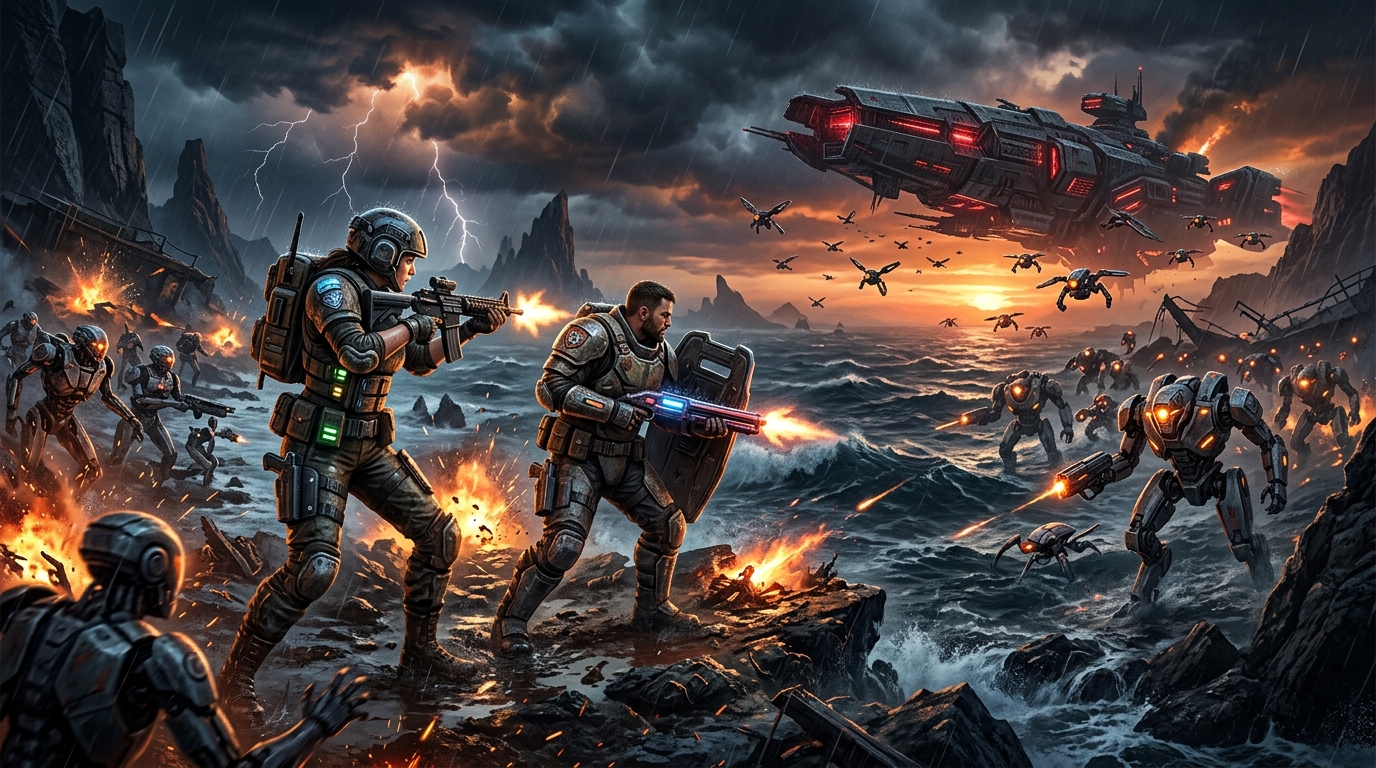
ARC Raiders Riven Tides Update: Complete Guide to the New Shoreline
The Riven Tides update transforms ARC Raiders with a fresh coastal battleground, new activities, and higher-risk combat scenarios that reward smart raiders. This guide walks through the new map, enemies, conditions, tools, and progression systems so you can make the most of your runs without getting wiped out on the sand.
1. What the Riven Tides Update Brings to ARC Raiders
Riven Tides is more than a simple map drop. It is a layered update that changes how you move, fight, and earn rewards across the Rust Belt. While inspired by official patch information and early impressions, this guide re-organizes the key additions into clear, practical categories.
- A new coastal map with distinctive points of interest and traversal challenges.
- A flying large-scale ARC enemy that alters how you think about vertical space.
- A dedicated minor map condition centered on scavenging the shoreline.
- Two new fall-mitigation tools that make risky plays more viable.
- A time-limited progression event with cosmetic and currency rewards.
- A multi-stage in-world project that unlocks new gear and tells a localized story.
If you already understand the basics of ARC Raiders’ extraction-style gameplay, think of Riven Tides as a concentrated shot of risk–reward design. It pushes you toward danger with better loot while constantly reminding you that extraction is all that matters in the end.
2. Exploring Riven Tides: A Shoreline with History
Riven Tides is set along the western coast of the Rust Belt, mixing decayed tourism infrastructure with war-scarred industrial leftovers. The area has been abandoned twice—once during the exodus and again after the first major ARC assault—leaving behind layered ruins and pockets of salvage.
2.1 Key Landmarks and Hotspots
Although every raid plays out differently, several recurring locations act as navigation anchors and high-value zones:
- Hotel Panorama Azzurro – A crumbling seaside hotel overlooking the water, with multiple vertical entry points and plenty of room for ambushes. Expect mid- to long-range engagements on balconies and rooftops.
- Azzurro Beach – An open stretch of sand that becomes far more interesting during beachcombing. Low cover and long sightlines favor marksmen and coordinated squads.
- Tennis Courts – A compact, symmetrical combat space where hard cover is predictable but limited. Ideal for testing new weapons or close-quarters tactics.
- Harbor and Docks – The industrial counterpoint to the tourist areas. Tight corridors, cranes, containers, and ship husks create a maze for ambushes and flanking routes.
2.2 How Riven Tides Feels Different from Earlier Zones
Compared with more inland zones, Riven Tides shifts the balance in several subtle ways:
- More vertical layering via hotels, cranes, and piers, especially when factoring in the powered descender.
- More open, exposed areas on the shoreline where concealment and long-range firepower become crucial.
- More environmental storytelling, with abandoned tourist spots sitting directly beside militarized structures, underscoring the abrupt collapse of normal life.
For ARPG and extraction-game veterans, think of Riven Tides as a midpoint between a traditional resort map and a semi-industrial port—less cluttered than dense urban environments but far more complex than a simple beach.
3. The ARC Turbine: Graceful Menace in the Sky
The update’s headline enemy is the ARC Turbine, a large flying ARC unit that roams the map. At a distance, it may appear almost peaceful—a hovering platform gliding across the horizon—but engaging it flips the mood instantly.
3.1 Behavior and Threat Profile
From official descriptions and early hands-on reports, the ARC Turbine behaves like a roaming environmental boss:
- Roaming presence: It patrols the map rather than sitting in a fixed arena, turning otherwise safe routes into contested airspace.
- Graceful until provoked: It is relatively passive until you commit to attacking it. Then it unleashes aggressive, unique attack patterns.
- Vertical pressure: Its position above the battlefield forces teams to think in three dimensions—cover that worked against ground enemies may be inadequate against elevated fire.
3.2 Tactical Considerations
Fighting the ARC Turbine is optional but rewarding. Before you decide to engage, consider:
- Ammo and durability: Do you have enough resources to commit to a long fight and still extract afterward?
- Squad positioning: Are you in an area with usable hard cover and sightlines that let each raider contribute?
- Third-party risk: Other enemies—and players, if you are in a PvPvE context—may converge on the noise you create.
A sensible strategy is to avoid impulsive aggro. Track the Turbine’s path across several raids, learn typical routes, and only commit when the conditions favor you. Treat it more like a roaming raid boss than just another target.
4. Beachcombing: Turning Sand into High-Value Loot
Riven Tides also introduces a minor map condition called Beachcombing, designed to change how you relate to open spaces. When active, this condition enables a new loop: scanning the shoreline for buried rewards using a specialized tool.
4.1 Dockmaster’s Detector and the Beachcombing Loop
Beachcombing revolves around the Dockmaster’s Detector, a handheld device that functions like a metal detector tuned to anomalies from the ARC conflict. When you have it equipped during the Beachcombing condition:
- You sweep over sandy areas, listening and watching for audio–visual feedback.
- When the signal peaks, you can dig up hidden items ranging from resources to higher-value loot.
- Some buried caches may sit in exposed or contested zones, forcing you to choose between safety and reward.
The Dockmaster’s Detector is tied to a local project chain (see the Avian Alarm section) and acts as a long-term incentive to engage with Riven Tides repeatedly.
4.2 Risk–Reward Design of Beachcombing
Beachcombing highlights a classic extraction dilemma: the longer you stay and the more you collect, the more you stand to lose.
| Choice | Upside | Downside |
|---|---|---|
| Push deeper into the shoreline for more signals | Better chance of rare loot and unique event items | Longer exposure to patrols, players, and the ARC Turbine |
| Extract early with modest finds | Banked progress with minimal risk | Missed opportunities for high-tier rewards |
| Split the squad between scanning and overwatch | Balanced throughput & security | Requires coordination and clear communication to avoid collapse |
Effective teams treat the detector user as a high-value asset. Consider assigning a dedicated bodyguard or rotating detector duties so no single player becomes an easy pickoff while staring at the sand.
5. New Fall-Mitigation Tools: Crash Mat and Powered Descender
To support Riven Tides’ vertical design, the update introduces two new items that change how you approach high ground and risky drops.
5.1 Crash Mat
The Crash Mat is a deployable fall-safety device. While exact stats may vary by tuning, it broadly works as follows:
- Can be placed below a drop point to cushion falls from significant height.
- Enables fast vertical repositioning without taking lethal or crippling damage.
- Promotes aggressive plays from rooftops, crane arms, and elevated hotel floors.
Used well, Crash Mats turn one-way vantage points into flexible nodes. Used poorly, they advertise your position or get wasted on trivial heights.
5.2 Powered Descender
The Powered Descender functions as a controlled downward traversal tool—essentially a quick, safe way to rappel from high points. In practice, this means:
- Faster, safer escapes from elevated positions when the ARC Turbine or enemy squads push your perch.
- More options for flanking: climb a structure, reposition with the descender, and appear where opponents don’t expect you.
- Less reliance on narrow staircases or ladders that often become choke points.
Together, Crash Mats and Powered Descenders encourage a style of play where you claim the high ground aggressively, knowing you have more than one way to get down.
6. Last Resort Event: Time-Limited Progression and Cosmetics
The Riven Tides update is anchored by a limited-time progression event called Last Resort. Running for several weeks (from late April to late May in the original schedule), it adds a structured reward track on top of your normal raiding.
6.1 How Last Resort Works
Last Resort functions like an event pass with harvestable objectives:
- Complete event-related tasks across Riven Tides (and potentially other zones).
- Earn Merits, an event currency used to climb reward tiers.
- Unlock cosmetics, emotes, and raider tokens as you progress.
Instead of raw power, Last Resort leans into style and long-term identity. Raiders who participate heavily during the event window will walk away with visual proof of their time spent on the shoreline.
6.2 Event Ships and Extraction Incentives
Some coverage of the update mentions special event-related ships scattered throughout the zone. These function similarly to collectible objectives:
- Ships vary in rarity and value. Higher-tier ships grant more Merits.
- You only gain their benefit by successfully extracting with them.
- Each ship contributes its reward once, turning collection into a long-term goal rather than a farmable loop.
This system reinforces ARC Raiders’ core message: loot isn’t yours until you leave alive. Event progression is therefore not just about grinding kills—it’s about making disciplined decisions about when to leave.
7. Avian Alarm Project: Building a Shoreline Early-Warning System
Beyond moment-to-moment action, Riven Tides includes a multi-stage local project known as Avian Alarm. This project serves both narrative and mechanical purposes, giving players an evolving reason to return to the coast.
7.1 Multi-Stage Progression
Avian Alarm plays out as a five-stage project:
- Each phase asks you to complete objectives that are physically grounded in Riven Tides—placing devices, gathering components, or interacting with the environment.
- Progress unlocks incremental payoffs, culminating in a functional makeshift security network that senses seismic and atmospheric changes above ground.
- The project encourages you to explore rarely visited corners of the map rather than sticking to high-traffic POIs.
7.2 Unlocking the Dockmaster’s Detector
Crucially, Avian Alarm is how you obtain the Dockmaster’s Detector for Beachcombing. You will need to:
- Complete Avian Alarm stages in sequence.
- Turn in required items or complete environmental tasks tied to each stage.
- Receive the detector as a project reward, enabling you to participate fully in the Beachcombing condition.
Because this tool gates access to a major risk–reward loop, finishing Avian Alarm early in the update cycle is a smart priority for committed players.
8. HUD Options and Quality-of-Life Tweaks
Alongside marquee features, the Riven Tides update makes quality-of-life changes that give players more control over their interface and play style. One notable addition is a crosshair-only HUD option, letting you retain aiming assistance while disabling most on-screen clutter.
This sort of minimalist HUD design echoes trends across modern shooters, where players are increasingly given fine-grained control over what appears on screen. A more focused interface can help with immersion and visual clarity, especially in a visually dense environment like Riven Tides.
9. Survival and Strategy Tips for Riven Tides
To thrive in the Riven Tides update, you need to adjust your tactics in light of new vertical threats, shoreline exposure, and event systems. The following principles can help you adapt quickly.
9.1 Positioning and Movement
- Prioritize high ground near the Hotel and port cranes, but always have a descent plan using crash mats or powered descenders.
- Avoid lingering in open sand unless you are actively beachcombing and your squad has overwatch angles secured.
- Use structures as noise shields: move through interiors or behind large objects to mask sound and line of sight from the ARC Turbine.
9.2 Team Roles and Communication
- Assign a dedicated detector user during Beachcombing and pair them with at least one protector.
- Let one player act as a Turbine spotter, tracking its path and calling out position changes to avoid surprise engagements.
- Coordinate event-ship extraction runs: once you find a high-value ship, shift your objective from looting more to securing a clean exit.
9.3 Resource Management
- Carry extra ammo and repair resources before picking a fight with the ARC Turbine; treat it as a major resource sink.
- Do not deploy Crash Mats for minor drops; save them for emergency exits or planned rapid descents from key vantage points.
- Balance Merit farming with long-term progression. Chasing every ship and cache can lead to overextension and wipes.
10. Frequently Asked Questions
10.1 Is Riven Tides only available during the Last Resort event?
The Riven Tides map itself is a permanent addition to ARC Raiders, while the Last Resort event tied to it is time-limited. Even after the event ends, you should still be able to access the shoreline and its core activities, though specific rewards and event tracks may rotate out according to the game’s live-service schedule.
10.2 Do I have to fight the ARC Turbine every raid?
No. The ARC Turbine is a roaming threat you can choose to engage or avoid. If your squad is under-geared, low on resources, or focusing on extraction and event objectives, it is often wiser to track its path and steer clear rather than forcing a risky fight.
10.3 How important is the Dockmaster’s Detector?
While the detector is not mandatory for baseline progression, it is central to maximizing loot and event gains during Beachcombing conditions. If you plan to invest heavily in Riven Tides, completing the Avian Alarm project early to unlock the detector is a strong priority.
10.4 Are Crash Mats and Powered Descenders limited to Riven Tides?
These tools are introduced in the Riven Tides update, but their usefulness extends beyond the shoreline. Any zone with significant verticality benefits from fall-mitigation tools, making them valuable in a variety of raid scenarios.
10.5 Can I still use a full HUD instead of crosshair-only?
Yes. The crosshair-only option is an additional setting, not a replacement. Players who prefer the traditional HUD can keep it enabled, while those seeking a cleaner screen can experiment with minimalist configurations.
References
- ARC Raiders — Embark Studios / Nexon. Accessed 2026-05-21. https://www.arcraiders.com
- ARC Raiders: Everything you need to know about the Riven Tides update — Epic Games Store News. 2024-04-29. https://store.epicgames.com/news/arc-raiders-everything-you-need-to-know-about-the-riven-tides-update
- Live service games: trends and challenges in the video game industry — UK Competition and Markets Authority. 2023-07-20. https://www.gov.uk/government/publications/video-games-research-live-service-business-models/live-service-games-trends-and-challenges-in-the-video-games-industry
- Game User Experience and Player Engagement — Gamasutra / Game Developer Conference (archival industry analysis). 2019-03-20. https://www.gamedeveloper.com/design/game-user-experience-and-player-engagement
Similar Articles






Read full bio of Sneha Tete