ARC Raiders Skill Trees: Optimal Routes Explained
Learn how Mobility, Survival, and Conditioning skills combine into powerful ARC Raiders builds for solo, co-op, and PvP.
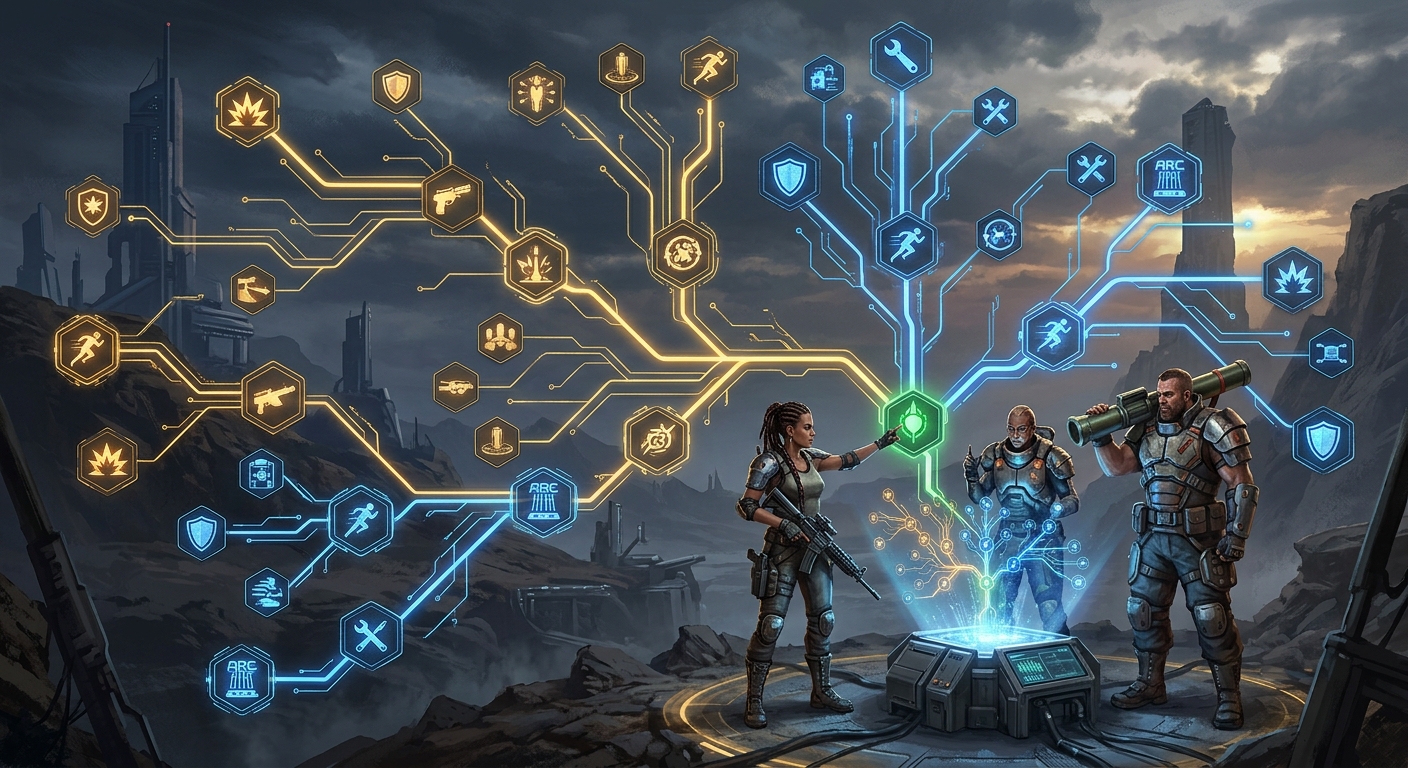
ARC Raiders asks you to make meaningful choices long before you fire your first shot. The three skill trees — Mobility, Survival, and Conditioning — shape how you move, loot, fight, and escape. Because skill points are limited, understanding what each tree actually does and how they synergize is crucial if you want to survive expeditions and progress efficiently.
This guide breaks down the core logic of each tree, explains why certain routes work better for most players, and then offers several complete build concepts (with variations) so you can adapt them to your own playstyle. The aim is to help you think about skills as parts of a system, rather than isolated upgrades.
How the ARC Raiders Skill System Works
Before you decide which skills to buy, it helps to grasp the foundations of ARC Raiders’ progression loop and why certain stats are more valuable than they might first appear.
Skill Points and Progression Basics
You earn skill points primarily by gaining experience, leveling your account, and participating in expeditions. The exact numbers may change with balancing patches, but a few principles stay consistent:
- Skill points are finite: You cannot buy every skill on all three trees, so you must prioritize.
- Nodes have prerequisites: Higher-tier skills typically require you to spend a certain number of points earlier in the same tree.
- Respeccing has a cost: Though respec mechanics can change over time, you should assume that constantly re-rolling your tree is inefficient. Planning ahead matters.
- Some skills are one-point wonders: A few nodes give strong utility with a single point just to unlock deeper, more impactful perks.
Because many skills affect movement, stamina, encumbrance, and recovery, their impact goes beyond pure combat. They determine how quickly you can loot, how safely you can reposition, and how often you can disengage from bad fights.
Why Mobility Is the True Core of Most Builds
In high-pressure, extraction-style shooters, movement and positioning are often more important than raw damage. This is well documented across similar games: for instance, research into player performance in esports and competitive shooters stresses the importance of movement, awareness, and positioning over pure mechanical aim alone.1 ARC Raiders follows a similar pattern.
What the Mobility Tree Really Gives You
Mobility skills typically influence:
- Sprint speed and sprint duration
- Stamina pool and stamina regeneration
- Movement while crouched or ADS (aiming down sights)
- Movement noise — how loud you are when you move or breach
Collectively, these perks let you:
- Cross dangerous open areas quickly
- Flank or disengage before being pinned
- Escape bots or players when a raid goes wrong
- Loot more areas within the same time window
Why Mobility First Is a Strong Default Strategy
Putting early points into Mobility is powerful for three reasons:
- Movement protects you more often than armor. Avoiding damage entirely is better than mitigating it. Many tactical and military training documents emphasize that breaking line of sight and changing position are primary defensive tools, not just gear.2
- Movement improves looting efficiency. The faster you move between points of interest and in and out of fights, the more opportunities you get per raid to earn XP and gear.
- Mobility is universally useful. Whether you are sniping at range, brawling up close, or mainly looting, better movement helps every playstyle.
| Goal | Suggested Focus | Benefit |
|---|---|---|
| Faster traversal and escapes | Sprint speed & stamina pool upgrades | Cross open ground, outrun threats, reposition quickly |
| Stealthier looting | Crouch movement speed, noise reduction | Approach enemies and containers quietly |
| Combat mobility | Stamina regeneration, ADS movement | Dodge incoming fire, strafe and peek safely |
Survival Skills: Extending Your Life and Your Runs
Once your movement feels comfortable, the next most impactful set of upgrades usually comes from Survival. This tree focuses on how much punishment you can take and how quickly you can recover.
What Survival Typically Covers
Common themes in the Survival tree include:
- Damage mitigation (especially against explosives or specific damage types)
- Health regeneration or improved healing efficiency
- Downed-state bonuses (crawl speed, damage reduction, bleed-out time)
- Clutch bonuses that trigger when critically wounded or after kills
In a game where one bad engagement can cost you your loadout, extending your survivability even slightly often translates into multiple extra raids worth of gear.
Synergy Between Mobility and Survival
Mobility and Survival are not competing concepts — they amplify each other:
- Mobility lets you avoid damage; Survival lets you absorb mistakes. You will eventually get caught in the open, misjudge enemy numbers, or run into an ambush. A sturdier character gives you more time to leverage your movement to escape.
- Survival skills are often conditionally triggered. Many perks only activate when you are low on health, under fire, or recently downed. Mobility turns those windows into actual escape opportunities.
- Longer life means more XP per raid. Staying alive longer lets you loot more and kill more, compounding the benefits of your skill tree investments.
Studies on decision-making in high-stakes environments emphasize that resilience and recovery are crucial for sustained performance, not just raw speed or aggression.3 In ARC Raiders terms, that means pairing Survival with Mobility leads to more consistent outcomes over many raids.
Conditioning: Comfort, Carry Capacity, and Late-Game Power
The Conditioning tree is often misunderstood. It rarely gives dramatic power spikes early on, but as your stash fills out and your gear gets heavier, Conditioning becomes the difference between a sluggish tank and a nimble, deadly looter.
What Conditioning Brings to Your Build
Conditioning skills typically affect:
- Encumbrance thresholds — how much you can carry before slowing down
- Weapon weight impact on movement
- Shield capacity and shield-related penalties
- Miscellaneous quality-of-life perks like faster breaching or quieter interactions
These upgrades are more pronounced once you’re bringing heavier weapons, high-tier armor, and multiple items into each expedition. Without them, your Mobility tree benefits are partially wasted because your weight keeps you slow.
When to Invest in Conditioning
Conditioning is generally a mid-to-late game priority:
- Early on, you have few items, low-tier armor, and basic weapons. Carry weight isn’t your main issue.
- As you progress, you’ll want to bring backup weapons, extra consumables, and bulkier protection.
- Conditioning lets you maintain high movement even with heavy gear, preserving the value of your Mobility investment.
Think of Conditioning as the comfort layer of your build. It doesn’t directly change how hard you hit or how fast you move in a vacuum; instead, it allows you to bring more tools into a raid without crushing your mobility.
Recommended Skill Progression Philosophy
Instead of memorizing a rigid list of skills, use a flexible framework for progression:
Stage 1: Establish Core Movement
Spend your early points on Mobility nodes that:
- Increase your stamina pool
- Improve stamina regeneration
- Boost sprint speed or reduce stamina cost for sprinting
Your goal in this phase is to reach a point where you rarely feel winded while rotating between landmarks or running from a bot swarm.
Stage 2: Add Survivability
Once your movement feels reliable, begin investing in Survival skills that:
- Reduce common sources of damage (e.g., explosions, sustained gunfire)
- Improve recovery when critically injured (faster stamina or health regain)
- Extend your downed state or reduce damage taken while down
This stage is about preventing a single mistake from ending a promising run.
Stage 3: Layer Conditioning for Comfort
After you have strong mobility and solid survivability, start picking up Conditioning skills that:
- Increase carry capacity or reduce weapon weight penalties
- Allow you to wear heavier shields or armor without huge movement costs
- Provide utility like faster breaching or more efficient looting
By this stage, you likely have enough experience and gear that the ability to carry more and move comfortably under load is a direct power increase.
Example Builds and Playstyle Templates
The following build templates are conceptual. They focus on order of priority and synergy, rather than listing every single node, because patches can rename or retune specific skills. Treat them as blueprints and adapt to what is available in your current version of ARC Raiders.
1. Solo Survivor — High Safety, High Escape Potential
This build is aimed at players who mainly run solo and want to extract reliably, even if that means sacrificing some peak combat potential.
Priority Order
- Mobility Core
- Maximize stamina pool and regeneration.
- Pick at least one sprint speed or sprint efficiency skill.
- Invest in crouch speed if you prefer stealthy approaches.
- Key Survival Nodes
- One-point wonders that reduce explosive damage or improve healing value.
- Perks that give bonuses when critically injured (such as faster stamina regen).
- Improved downed-state durability, in case you misjudge a fight.
- Light Conditioning
- A few points into carry weight to support looting.
- Basic shield capacity increase if you rely heavily on shields.
Playstyle Tips
- Avoid long, open fights; use your mobility to break line of sight.
- Loot quickly and prioritize extraction once your backpack is filled.
- Use your Survival perks as a buffer: if you get tagged hard, retreat, regenerate, and re-engage on better terms.
2. Squad Support & Utility — Helping Your Team Win Fights
If you play mostly in a coordinated group, your skill tree can lean into a supporting role: absorbing pressure, setting up flanks, and keeping the team alive.
Priority Order
- Balanced Mobility
- Take enough mobility to keep up with the fastest teammate.
- Prioritize skills that improve movement while aiming to help you peek and cover.
- Heavy Survival Investment
- Damage reduction against common threats (bots and explosives).
- Bonuses while critically wounded to keep you active and useful for longer.
- Downed-state improvements, as you may be the one soaking shots for the squad.
- Moderate Conditioning
- Carry capacity for extra ammo, meds, or shields for the team.
- Faster breaching to open routes for allies.
Playstyle Tips
- Position yourself where you can take early damage and call out enemy positions.
- Use your movement not just for yourself but to draw enemy attention away from fragile teammates.
- Carry extra utility items made possible by your Conditioning, such as spare healing or deployables.
3. Aggressive PvP Hunter — High Risk, High Reward
This template assumes you intentionally seek out other players or high-end ARC enemies. It sacrifices some safety in exchange for better combat comfort.
Priority Order
- High-End Mobility
- Max out stamina and sprint-related nodes.
- Invest in movement speed when aiming or crouched for better gunfights.
- Consider noise-reduction skills that help with flanking.
- Fast-Access Conditioning
- Move into weapon weight reduction earlier than in other builds.
- Increase carry capacity so you can run heavy weapons without feeling sluggish.
- Selective Survival
- Focus on skills that give immediate combat value (e.g., reduced explosive damage, better recovery while under fire).
- Skip some of the more niche downed-state perks if you rarely intend to play safe.
Playstyle Tips
- Use your superior movement to dictate engagements: attack from unexpected angles, disengage if the fight goes poorly, and re-enter from a better position.
- Leverage heavy weapons enabled by Conditioning to end fights quickly.
- Don’t overstay in prolonged battles; your edge comes from mobility and positioning, not trading damage in place.
Common Mistakes When Building Skills
Even experienced players sometimes fall into traps when investing skill points.
1. Chasing Damage Too Early
It’s tempting to aim for anything that sounds like raw DPS, but in ARC Raiders your weapons and gear provide most of your offensive output. Skills that keep you alive and mobile almost always yield more value over many raids than marginal damage tweaks early on.
2. Overcommitting to Conditioning at Low Levels
If your loadouts are still light, heavy investment into carry weight and weapon encumbrance can feel wasted. It’s better to focus on mobility and survival first, then respec or branch into Conditioning once your inventory and stash justify it.
3. Ignoring Downed-State Perks Completely
Downed-state skills are easy to skip, but in team-based play they can buy crucial seconds for revives. Game design and trauma-care research both highlight the importance of the “golden minutes” after critical injury.4 In ARC Raiders terms, that extra crawl speed or reduced damage while down might convert a total wipe into a successful extraction.
FAQ: ARC Raiders Skills and Builds
Do I always need to start with Mobility?
No, but it’s generally optimal for most players and playstyles. A few specialized group roles might rush Survival for tanking, but even those benefit from at least some early mobility.
Can I build purely for damage instead?
You can focus your gear and weapon choices on damage, but the skill trees don’t usually offer massive raw DPS bonuses. They’re more about positioning, resilience, and comfort, which indirectly increase your damage output by keeping you in the fight longer.
Is it worth investing in stealth-oriented skills?
If you play solo or prefer avoiding direct combat, skills that reduce movement noise and improve crouch speed are excellent. They let you loot contested areas more safely and reposition without drawing as much attention.
How often should I respec my skill tree?
Respec whenever you make a major shift in playstyle — for example, moving from solo to full-time squad play, or once you unlock much heavier gear that clearly needs Conditioning support. Avoid frequent minor changes; it’s better to learn your build deeply and make deliberate pivots.
Which tree is best for beginners?
Mobility is the most forgiving for beginners because it compensates for inexperience with map knowledge and positioning. Pair it with a solid layer of Survival skills, and you’ll have a build that survives mistakes while you learn the game.
References
- The science of aiming and shooting — Logitech G / University College London. 2018-11-06. https://www.logitechg.com/en-us/news/research/how-to-improve-aim-in-fps-games.html
- U.S. Army Techniques Publication 3-21.8 Infantry Platoon and Squad — U.S. Army. 2016-04-12. https://armypubs.army.mil/ProductMaps/PubForm/Details.aspx?PUB_ID=1006364
- Resilience and Performance Under Stress — NATO Research and Technology Organisation (RTO-TR-HFM-134). 2010-01-01. https://www.sto.nato.int/publications/STO%20Technical%20Reports/RTO-TR-HFM-134/$$TR-HFM-134-ALL.pdf
- Prehospital trauma care systems — World Health Organization. 2005-01-01. https://www.who.int/publications/i/item/924159294X
Similar Articles







Read full bio of medha deb