Blighted: A Cannibal Soulslike in a Psychedelic West
Inside Drinkbox Studios’ brain‑devouring Metroidvania RPG, where cannibal lore, Soulslike combat, and a twisted Western nightmare collide.
Blighted: A Cannibal Soulslike in a Psychedelic Western Nightmare
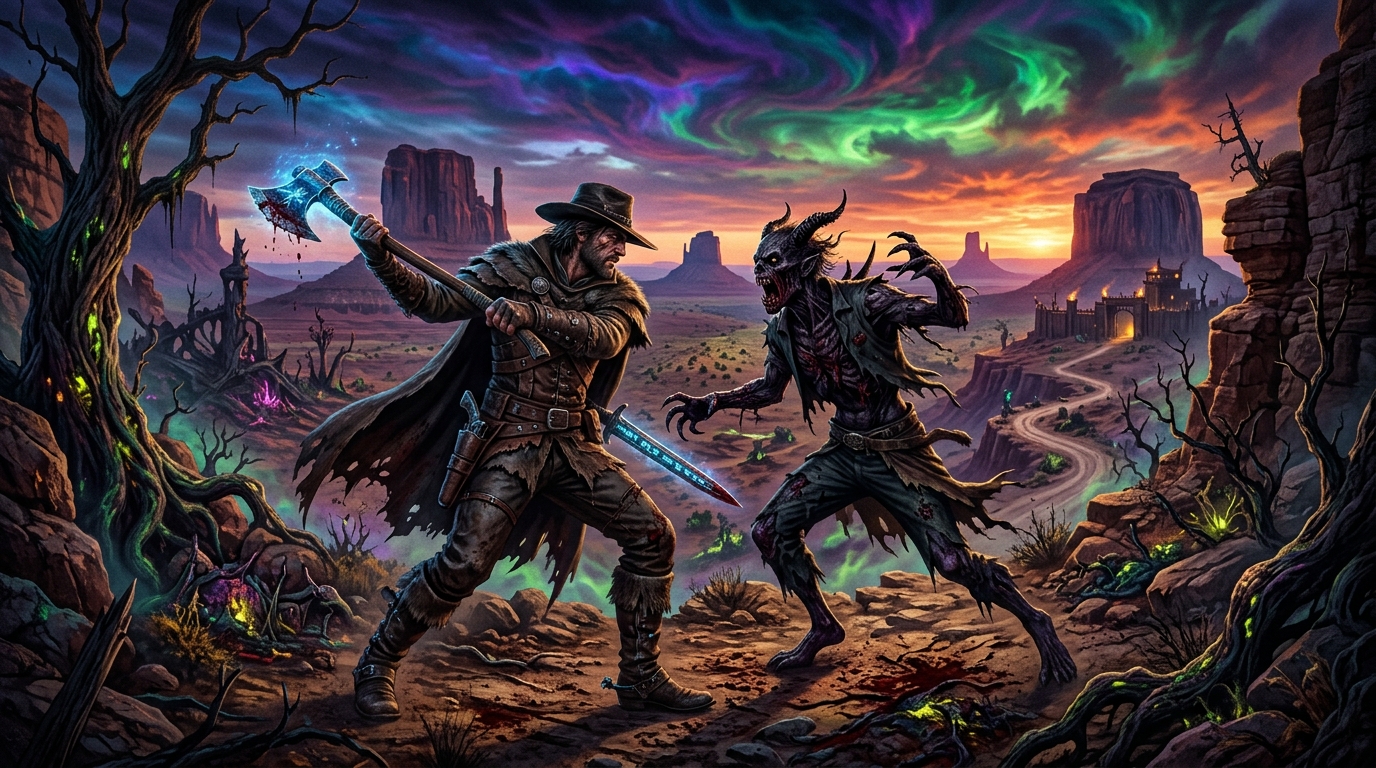
Blighted is the next big swing from Drinkbox Studios, the team behind Guacamelee! and Nobody Saves the World. This time, the studio is stepping away from colorful luchador antics and shapeshifting comedy to craft something far stranger: an isometric Metroidvania action RPG with punishing Soulslike combat, a cannibalism-driven power fantasy, and a world described as a psychedelic Western nightmare.
Rather than simply layering difficult combat over a gloomy setting, Blighted fuses its systems, art direction, and lore into a single grotesque idea: eating brains to reclaim memories and power. The result is a game that feels both familiar and deeply unsettling, blending genre influences into something that’s hard to categorize yet easy to remember.
The World Where Memory Grows on Trees (Until It Doesn’t)
Blighted’s core premise is as bizarre as it is thematic. In this world, when people die, seeds are placed in their skulls. Over time, those seeds grow into trees bearing fruit that contains the memories of the dead. Instead of written records or digital archives, this society quite literally eats its history to remember it.
That fragile cycle is shattered by a villain known as Sorcisto. Rather than patiently waiting for memory trees to grow, Sorcisto takes a brutal shortcut: he devours brains directly, cutting down the trees and consuming knowledge at the source. The result is an apocalypse of amnesia and devastation. Your village is wiped out, the landscape is scarred, and the collective memory of your people rots away.
You play as the last survivor of your village, roaming the ruins of a once-living archive. To defeat Sorcisto, you adopt the same monstrous method he used: consuming the brains of powerful foes to accumulate strength. Every boss you defeat is not just a checkmark on a list but a resource to devour, a twisted inversion of heritage and legacy.
A Psychedelic Western Painted in Nightmares
Blighted’s setting isn’t a standard fantasy realm or a grimdark dungeon crawl. It’s a Western-inflected wasteland pushed through a hallucinogenic filter. Think of empty frontier towns and desert horizons, but warped by impossible colors, chimeric creatures, and surreal environmental designs that make the world feel hostile and dreamlike at the same time.
This approach aligns with broader trends in game design where visual style is used to enhance immersion and emotional tone rather than simply provide realism. Research in media psychology suggests that stylized visuals can heighten emotional engagement and memorability by emphasizing mood and symbolism over literal representation.1 Blighted leans into that principle, translating its themes of decay, memory, and cannibalistic power into environmental art that looks as unstable as its lore.
- Western motifs — derelict settlements, frontier outposts, and rugged landscapes.
- Psychedelic distortion — exaggerated silhouettes, saturated colors, and organic shapes that don’t quite belong.
- Body horror — trees grown from skulls, brain-based rituals, and grotesque silhouettes lurking in the background.
The result is a world that feels ancient and alien, familiar enough to recognize but strange enough to unsettle. This makes exploration more than a mechanical exercise; every new region evokes curiosity and dread.
Soulslike Combat with a Parry-First Mindset
At the heart of Blighted lies Soulslike combat with a particular emphasis on parrying. Instead of relying solely on dodge rolls or shield turtling, the game pushes players toward precision and rhythm. Reading enemy patterns, timing a perfect parry, and exploiting the opening becomes the backbone of each encounter.
The broader Soulslike genre is defined by deliberate pacing, high difficulty, and systems that reward mastery over time.2 Blighted adopts that philosophy but in an isometric view, which introduces its own flavor of combat clarity and positioning challenges.
Core combat characteristics include:
- High-risk parries that can stun or stagger enemies.
- Precise enemy patterns that must be learned and exploited.
- Limited resources (health, stamina, or equivalent) that punish panic and spam.
- Weighty attacks that focus on commitment rather than button-mashing.
By framing parries as a central mechanic, Blighted encourages a proactive, aggressive defensive style: you’re not just avoiding damage, you’re turning danger into opportunity. This design echoes how other high-difficulty action games use parries to deepen engagement by rewarding focused attention and timing.3
Metroidvania Exploration from an Isometric Angle
Blighted is also described as a Metroidvania-style experience, where exploration is driven by abilities gained from key encounters. As you defeat bosses and major enemies, you unlock new powers that open previously inaccessible parts of the world. While the game uses an isometric camera rather than side-scrolling, the foundational loop remains familiar:
- Discover a barrier or obstacle you can’t yet overcome.
- Push forward into new areas with your current toolkit.
- Defeat a major foe and claim a new ability.
- Backtrack to unlock shortcuts, hidden areas, and optional challenges.
This loop is a hallmark of the Metroidvania subgenre, where world design and player progression are tightly entwined. Academic work on level design notes that spatial layout and gating can strongly shape player motivation by providing clear long-term goals and short-term mysteries to resolve.4 Blighted applies these ideas in a top-down format, turning canyons, ruins, and twisted forests into layered labyrinths.
Sample Ability-Driven Progression (Illustrative)
| Ability Type | Combat Effect | Exploration Impact |
|---|---|---|
| Gap-Crossing Dash | Short-range burst to dodge attacks or close distance. | Lets you cross chasms and reach new platforms. |
| Blight-Infused Slam | Area-of-effect attack that knocks back foes. | Breaks cracked floors or walls to reveal secrets. |
| Memory Vision | Highlights vulnerable points on enemies. | Reveals hidden paths linked to ancient memories. |
The specifics may change, but the principle is constant: every major victory reshapes how you move through the world as much as how you fight in it.
The Blight System: Difficulty as a Self-Inflicted Wound
One of Blighted’s most interesting ideas is the Blight system. As you perform well in combat — defeating enemies, avoiding damage, maintaining momentum — a Blight meter fills. As it rises through different tiers, the game gets harder.
This twist makes success a double-edged sword. Your proficiency doesn’t just make you more powerful; it also poisons the world, escalating the danger around you. It turns the act of winning into a form of self-imposed risk management. Systems like this draw on broader game design experiments with dynamic difficulty adjustment, in which the game responds to player performance rather than offering static difficulty modes.5
Possible effects of higher Blight tiers could include:
- Enemies becoming more aggressive or gaining new attack patterns.
- Environmental hazards appearing more frequently.
- Resource scarcity increasing, raising the stakes of each encounter.
The intriguing part is the implied choice: do you manage the Blight meter to keep danger at a comfortable level, or do you embrace escalating risk in exchange for better rewards, faster progression, or unique challenges? While details may still evolve during development, the concept aligns with player-driven difficulty systems seen in other action games but with a thematic twist that matches Blighted’s lore: power is corruption.
Brains as Currency: Cannibalism, Memory, and Power
Blighted leans into its cannibal premise beyond mere shock value. In this world, eating brains is how you grow stronger, especially when it comes to powerful bosses. This transforms victory into a ritual: you don’t just defeat your enemies; you incorporate them.
From a design standpoint, this gives narrative weight to what might otherwise be abstract upgrade points. Instead of XP bars and generic loot, your progression is tied to a macabre, story-embedded resource. It also raises interesting questions about identity: if you defeat a boss, devour their brain, and gain their abilities, how much of them is now a part of you? In a setting built around memory consumption, the line between hero and monster blurs quickly.
Cannibalism has a long cultural history in myth and fiction as a metaphor for absorbing power, knowledge, or spirit. When framed carefully, it pushes into psychological horror rather than shock exploitation, which Blighted’s surreal tone seems suited to explore.
From Guacamelee to Blighted: Drinkbox’s Dark Turn
Drinkbox Studios is best known for energetic, colorful, and often comedic games like Guacamelee!. Those titles blended tight combat, clever platforming, and a distinctive visual style. With Blighted, the studio keeps its focus on mechanical depth and art direction but channels them into something more somber and grotesque.
According to industry reports, iterative experimentation is common in successful indie studios, allowing them to maintain creative identity while exploring new genres and tones.6 Blighted exemplifies this shift: it builds on the studio’s experience with precise, responsive gameplay and bold visuals while embracing a heavier, more oppressive world and more punishing systems.
This evolution may appeal to players who enjoyed Drinkbox’s earlier work but want something with higher stakes, more demanding combat, and a richer atmosphere of dread.
Co-op in a Harsh World
Blighted also supports cooperative play, allowing another player to join the nightmare. Co-op in tough action games can serve multiple roles:
- Accessibility — less experienced players can rely on partners for combat support.
- Replayability — coordinated strategies and different builds keep encounters fresh.
- Emotional buffering — tackling bleak worlds with a friend can reduce frustration and enhance enjoyment.
Well-designed co-op can make difficulty spikes feel surmountable rather than discouraging, a point often underscored in analyses of how cooperative mechanics sustain player engagement in challenging games.7 In a game where death and devouring are constant, the presence of another player may also add interesting narrative and mechanical dynamics: who gets which brains, who takes the risks when the Blight meter runs high, and how do you coordinate parries and positioning from an isometric view?
Key Features at a Glance
- Isometric Soulslike combat built around high-stakes parrying and deliberate attacks.
- Metroidvania progression where boss abilities unlock new exploration paths.
- Psychedelic Western horror art direction that fuses frontier motifs with surreal nightmare imagery.
- Brain-eating progression as a core mechanic, linking power directly to cannibalistic lore.
- Dynamic Blight meter that escalates difficulty as you perform well.
- Co-op support for tackling the twisted world with a partner.
FAQ: Blighted and Its Twisted World
What kind of game is Blighted?
Blighted is an isometric action RPG that blends Soulslike combat with Metroidvania-style exploration. It emphasizes parries, deliberate fighting, backtracking, and ability-based progression.
Why is it described as a “psychedelic Western nightmare”?
The world draws from Western frontier imagery — desolate settlements, rugged landscapes, and outlaw-like figures — then distorts them with surreal colors, bizarre shapes, and body horror elements. The result is a Western that feels like a hallucination rather than a historical setting.
How does cannibalism factor into gameplay?
In Blighted’s lore, knowledge and memory are transferred through consuming fruit grown from skull-seeded trees. After the villain Sorcisto begins eating brains directly to amass power, your character adopts a similar method, devouring the brains of bosses to gain their strength and abilities.
What is the Blight system?
The Blight system is a dynamic difficulty mechanic. As you perform well in combat and defeat enemies, a Blight meter rises. Higher Blight tiers make the game more dangerous, potentially altering enemy behavior or increasing hazards, turning success into a calculated risk.
Is there co-op?
Yes, Blighted can be played in cooperative mode, letting another player join your journey. Co-op helps soften the difficulty curve, encourages coordinated strategies, and adds social energy to an otherwise grim journey.
Who is developing Blighted?
Blighted is being developed by Drinkbox Studios, the independent Canadian studio known for Guacamelee! and Nobody Saves the World. The team is using this project to explore darker themes and more punishing mechanics while retaining their hallmark focus on responsive controls and bold art.
References
- Video Game Design — New York University, Game Center (course overview summarizing core principles of game design, including visual style and player engagement). 2022-09-01. https://gamecenter.nyu.edu/academics/game-design/
- Dark Souls and the Challenge of Difficult Games — The Guardian (analysis of how Soulslike games use difficulty and design philosophy). 2016-05-27. https://www.theguardian.com/technology/2016/may/27/dark-souls-3-and-the-challenge-of-difficult-games
- The Art of Game Design: A Book of Lenses — Jesse Schell, CRC Press (foundational text discussing player experience, challenge, and visual design). 2019-11-21. https://www.routledge.com/The-Art-of-Game-Design-A-Book-of-Lenses-Third-Edition/Schell/p/book/9781138632059
- Game Feel and Player Engagement in Action Games — GDC Vault (talks and resources on responsive combat, parry systems, and satisfying feedback). 2023-03-20. https://www.gdconf.com/gdc-vault
- Dynamic Difficulty Adjustment in Computer Games — Robin Hunicke, ACM SIGCHI (early but widely cited paper on adaptive challenge systems in games). 2005-04-01. https://dl.acm.org/doi/10.1145/1056808.1056891
- Indie Game Development: Case Studies and Best Practices — International Game Developers Association (IGDA). 2022-02-10. https://igda.org/resources/
- Cooperative Gameplay as a Tool for Engagement and Learning — Entertainment Computing, Elsevier (discussion of how co-op mechanics influence engagement and perseverance). 2021-06-15. https://www.sciencedirect.com/journal/entertainment-computing
Similar Articles






Read full bio of medha deb