
Crimson Desert’s Beekeeper Build and the Rise of the Bee Meta
How a swarming “bee build” turned Crimson Desert’s toughest bosses into chew toys through clever item synergies and status effects.
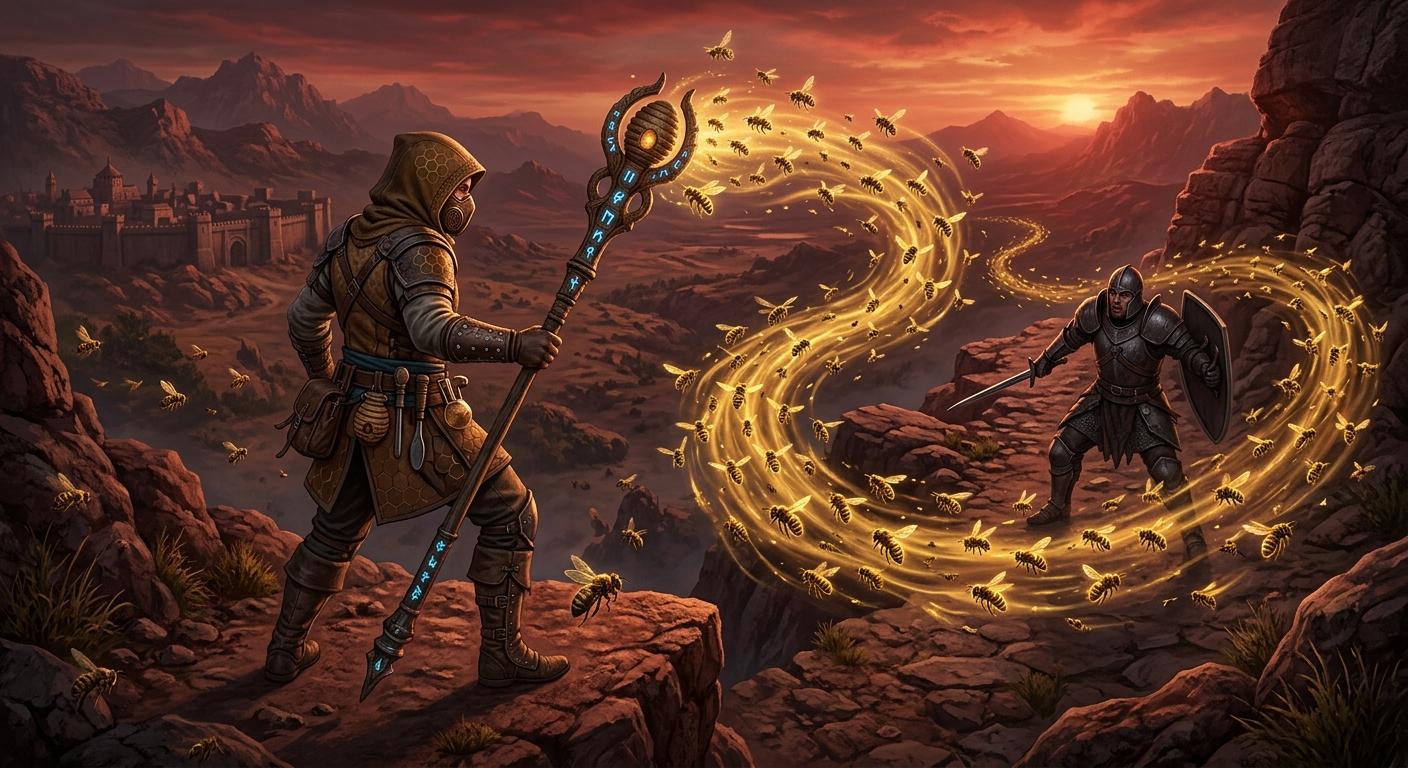
Every new open-world action RPG spawns its own myths: the unbeatable boss, the broken weapon, the bizarre build that should not work but somehow does. In Crimson Desert, that role has been filled by something gloriously ridiculous: unleashing armies of bees on unsuspecting bosses and watching their health bars simply evaporate.
Videos shared by players show the protagonist calmly dodging deadly attacks while clouds of weaponized insects quietly do all the heavy lifting, shredding elite enemies that were clearly designed to be grueling duels. The community has already given this configuration a name: the Beekeeper Build.
This article explores how the bee-focused strategy works, why it is so powerful, how it compares to other “overpowered” builds in modern action games, and what it reveals about the underlying systems driving Crimson Desert’s combat.
What Is the Beekeeper Build, Exactly?
The Beekeeper Build is a community nickname for a playstyle that stacks several bee-related tools and mechanics to create overwhelming, largely automated damage against bosses and tough enemies. Instead of relying on perfect combos and parries, players lean on:
- Bee-themed weapons that spawn swarms on hit.
- Captured bees or beehive items unleashed from the inventory.
- Protective gear that mitigates or negates bee-related self-harm.
- Mobility and dodging to stay alive while the bees slowly strip enemy HP.
The result is a strategy that turns intense boss fights into extended kiting sessions, where the player’s main job is to not die while bees handle the damage. It is both comical and unexpectedly efficient, especially in the early and mid-game when traditional builds may still be underpowered.
How Bees Became a Top-Tier Damage Source
On paper, turning insects into a primary damage dealer sounds like a joke build. In practice, several mechanical factors come together to make the Beekeeper approach remarkably potent.
Damage-over-Time Done Right
Many action RPGs incorporate damage-over-time (DoT) effects like poison, bleed, or burn. When tuned generously, these effects can surpass direct damage because they keep ticking while the player focuses on survival. Academic work on game balancing notes that sustained effects are often perceived as more powerful when players can “set and forget” them, freeing attention for positioning and defense.1
Bee swarms effectively act as a stackable DoT:
- They apply repeated small instances of damage.
- The damage continues even while the player is dodging or retreating.
- Multiple sources of bees can overlap, amplifying the effect.
This structure mirrors what we see in other games where DoT builds become dominant when allowed to stack — such as bleed builds in certain fantasy action RPGs, or burn-focused mages in isometric ARPGs. Developers must carefully tune how many stacks are allowed and whether enemies have specific resistances; if those checks are sparse, DoT strategies frequently become outliers.
Synergy Between Items and Status Immunity
A core part of the Beekeeper Build’s effectiveness is that players can acquire equipment that makes them functionally immune — or at least highly resistant — to their own bees. This echoes a common pattern in game design described in design research: high-risk effects (like self-damaging skills) can be “solved” by obtaining the right supporting gear, flipping them into low-risk, high-reward tools.2
In Crimson Desert, once you combine:
- A weapon that spawns bees on impact, and
- Equipment that heavily reduces damage from those bees, and
- Enemies with limited tools to cleanse or counter persistent effects,
you end up with a configuration where bees barely threaten the player at all but ravage the target.
Boss AI and the Power of Kiting
Boss encounters in modern action RPGs are often tuned around the assumption of active, close-quarters combat. Research on AI design in games describes how many enemy AI packages are optimized to pressure players who stand their ground, not those who kite indefinitely while a passive effect does the work.3
When the player:
- Stays on the move,
- Maintains a moderate distance, and
- Only closes in briefly to refresh bee effects,
some bosses struggle to apply their most dangerous combos. They also lack clear counterplay to persistent environmental-style damage, which is exactly what bee swarms simulate.
Core Components of a Bee-Focused Loadout
While the specific item names and stats will shift with patches, the general blueprint of a Beekeeper-style configuration is consistent. Below is a conceptual breakdown.
| Component | Role in the Build | Key Considerations |
|---|---|---|
| Bee-summoning weapon | Primary trigger for bee clouds on hit. | Often has limited durability; requires farming or backups. |
| Bee-related consumables | Additional bursts of bee damage from inventory. | Best used to front-load damage or maintain uptime in longer fights. |
| Protective or beekeeper-style armor | Reduces or negates self-inflicted bee damage. | Often acquired from thematic locations; may require stealth or theft. |
| Ranged options (bow, spells) | Enable safe triggering of beehives and pulling enemies into bee zones. | Arrow management and positioning matter for efficient farming. |
| Movement abilities | Support kiting and avoiding boss combos. | Stamina economy becomes as important as damage output. |
Why Players Gravitate Toward “Broken” Builds
It is easy to dismiss the Beekeeper craze as simple cheese, but there are deeper reasons these strategies catch fire in communities. Studies on player motivation in online games highlight several recurring themes: mastery, experimentation, social status, and efficiency.4
Mastery Through Creative Problem-Solving
Rather than only perfecting reflex-based combat, players enjoy mastering the game’s systems at a higher, more abstract level. The Beekeeper Build is satisfying because it demonstrates a deep understanding of:
- Item interactions
- Enemy behavior patterns
- Resource acquisition routes
It signals to other players, “I didn’t just get good at dodging; I learned how to break the rules.” That kind of systemic cleverness is a key driver behind build-crafting cultures in games like Path of Exile, Diablo, and Souls-like titles.
Efficiency and Time-Saving
Open-world action RPGs can demand dozens or even hundreds of hours if tackled “straight.” The ability to trivialize certain fights appeals to players who want to progress faster, revisit content on higher difficulties, or farm materials without spending ten minutes per boss attempt.
Game industry reports on player behavior show a strong preference among many players for strategies that reduce grind and optimize progression paths, especially in long-form titles.5 The Beekeeper Build fits this ethos perfectly: once set up, it lowers both the mechanical and time investment required to defeat major threats.
Social Currency: Clips, Memes, and Shared Knowledge
Part of the reason the bee meta spread so quickly is that it looks hilarious on video. A towering knight or monstrous beast slowly collapsing to a buzzing haze is shareable content gold. Clips posted on social video platforms act as viral advertisements for the build, encouraging more players to try it — and refine it — creating a feedback loop of discovery and optimization.
Bee Farming and Progression Considerations
While this article is not a precise step-by-step farming guide, understanding the general progression is important for evaluating balance. Players typically engage with three intertwined tasks:
- Locating beehives in forests and wooded areas, often returning to spots with dense clusters.
- Optimizing hive resets by using fast travel, saving and loading, or other in-game methods that refresh the world.
- Managing durability and drop rates, since bee weapons tend to be rare and finite-use.
This means the Beekeeper Build is not free power. It trades mechanical difficulty for logistical planning. You invest time into learning spawn patterns, navigating terrain, and micro-managing resources so that you can breeze through combat later.
Strengths and Limitations of the Beekeeper Approach
Although the bee strategy looks unstoppable in highlight reels, it does have trade-offs.
Where the Build Shines
- Long, single-target encounters: Bosses and mini-bosses with large health pools are ideal, as bees maximize their sustained damage advantage.
- Predictable AI patterns: Fights where you can reliably maintain medium range while bees tick down HP.
- Early to mid-game content: Before enemies gain heavy resistances or exotic mechanics, bees often outpace standard weapons.
Where Bees Start to Struggle
- Highly mobile enemies: Bosses that leap constantly or leave bee clouds behind reduce effective uptime.
- Swarm or add-heavy fights: Single-target bee damage may be overkill on one enemy while others overwhelm you.
- Resource depletion: Durability and limited drops mean you can’t rely solely on bees in extremely long sessions unless you commit to long farming loops.
These weaknesses suggest that while the Beekeeper Build is spectacular for specific scenarios, it is best used as one configuration in a broader toolkit rather than a universal solution.
What the Bee Meta Reveals About Crimson Desert’s Systems
Whenever a quirky strategy becomes unexpectedly dominant, it reveals something about the design priorities and assumptions under the hood.
Emphasis on Systemic Interactions
The bee strategy only exists because the game allows multiple systems to interact in flexible ways: world objects (beehives), item drops, status effects, equipment bonuses, and durability. This aligns with a wider industry trend towards “systemic design,” where simple mechanics combine into a wide design space of emergent outcomes.6
From a player’s perspective, this is good news. It means the game rewards experimentation. Today it’s bees; tomorrow it might be a physics-based build, a weather-based exploit, or a synergy between mounts and ranged attacks.
Difficulty Tuning and Edge Cases
On the other hand, the bee meta also highlights how challenging it is to tune difficulty around every possible edge case. Developers have to decide whether outliers like this are:
- A charming, emergent feature that makes the game memorable, or
- A balance problem that undermines intended challenge and needs a patch.
Some studios have embraced “broken” builds as part of the fun, only gently adjusting them if they completely erase challenge. Others take a stricter approach, rapidly nerfing anything that trivializes content. How Crimson Desert’s developers respond to the Beekeeper craze will say a lot about where the game falls on that spectrum.
Tips for Using Bee Strategies Without Ruining the Fun
If you are tempted to try bees but do not want to drain all tension from the game, you can treat the Beekeeper Build as a tool instead of a lifestyle choice. Some practical guidelines:
- Reserve bees for roadblock bosses: Use them when you are truly stuck, not for every minor encounter.
- Mix playstyles: Swap between a bee loadout and a more traditional melee or ranged build to keep combat varied.
- Set personal rules: For example, limit yourself to a certain number of bee consumables per fight.
- Focus on learning mechanics first: Attempt new bosses “honestly” before resorting to bees, so you still experience their intended patterns.
Handled this way, the Beekeeper Build becomes a safety net and a creative experiment rather than a shortcut that hollowes out the experience.
Frequently Asked Questions About the Beekeeper Build
Does the bee strategy work on every boss?
Bee-focused tactics are extremely strong against many large, single-target bosses, especially earlier ones. However, their effectiveness can drop if a boss moves frequently, has long invulnerability windows, or summons adds that force you to stay aggressive instead of kiting. Treat bees as strong against most traditional bosses, but not a guaranteed win button everywhere.
Is the Beekeeper Build likely to be nerfed?
It is always possible. Modern games frequently receive balance patches that tone down outlier builds once they dominate community discussion. Whether that happens depends on developer philosophy: some teams embrace wild builds as part of the fun, while others aim for a more level playing field. Keeping an eye on official patch notes and community news is the best way to anticipate changes.
Do I need specific armor to use bee weapons safely?
Specialized gear that reduces or negates bee-related damage makes the build far more comfortable to play, especially in tight arenas where you may end up inside the swarm. You can technically use bee weapons without that protection, but you will need to position far more carefully and may find it frustrating. Investing in thematic armor is a core step in fully committing to a Beekeeper-style loadout.
Is this build good for new players?
It can be, with caveats. On the one hand, bees reduce the need for perfect timing and combos, giving newer players a more forgiving way to tackle difficult bosses. On the other, setting up the build requires some knowledge of the world, resource farming, and loadout planning. New players who enjoy experimentation and exploration will likely find it rewarding; those who want a straightforward path might prefer more conventional melee or ranged setups first.
Will relying on bees make me worse at combat?
If you use bees for every encounter, you may not develop as much skill with parries, spacing, and combo routing as someone who fights purely with standard weapons. The best approach is to treat the Beekeeper Build as one tool in your toolbox: lean on it when you need a boost, but continue to practice core combat so you can handle situations where bees are less effective.
From Joke to Meta: Bees as a Design Success Story
What started as a funny discovery — that you can throw thousands of bees at bosses — has evolved into a full-fledged meta build in Crimson Desert. The Beekeeper phenomenon showcases the strengths of systemic, flexible game design: when designers give players overlapping tools with consistent rules, surprising strategies naturally emerge.
Whether the bee craze remains an enduring part of the game or a snapshot of a pre-patch era, it has already done something valuable: it has invited players to think about why certain strategies work, not just how to execute them. It encourages experimentation beyond standard swords and spells, and it turns a visually absurd tactic into a surprisingly deep lesson in combat systems design.
And, at the end of the day, few things are as memorable as watching a towering, armored monstrosity crumble — not to legendary blades or world-ending magic — but to a determined swarm of extremely angry bees.
References
- Game Balancing in Action Role-Playing Games — M. Haugen et al., in Entertainment Computing. 2022-03-15. https://doi.org/10.1016/j.entcom.2022.100488
- Designing Game Mechanics for Skill and Mastery — M. Sicart, MIT Comparative Media Studies/Writing. 2019-09-01. https://cmsw.mit.edu/designing-game-mechanics-for-skill-and-mastery/
- Artificial Intelligence in Games: A Review — H. Hosseini et al., IEEE Access. 2023-01-10. https://doi.org/10.1109/ACCESS.2023.3235527
- Digital Games and Their Players: Motivations and Experiences — ESA (Entertainment Software Association). 2023-07-01. https://www.theesa.com/resource/2023-essential-facts-about-the-video-game-industry/
- Emergent Gameplay: Systems, Mechanics and Possibility Spaces — M. Cook, Queen Mary University of London. 2021-11-05. https://games.ai/blog/emergent-gameplay-systems-mechanics
Similar Articles








Read full bio of Sneha Tete