Dead by Daylight 2v8 Mode Guide
Discover how Dead by Daylight’s 2v8 mode reshapes core mechanics, teamwork, and strategy for both Killers and Survivors.
Dead by Daylight 2v8 Mode: Complete Overview and Strategy Guide
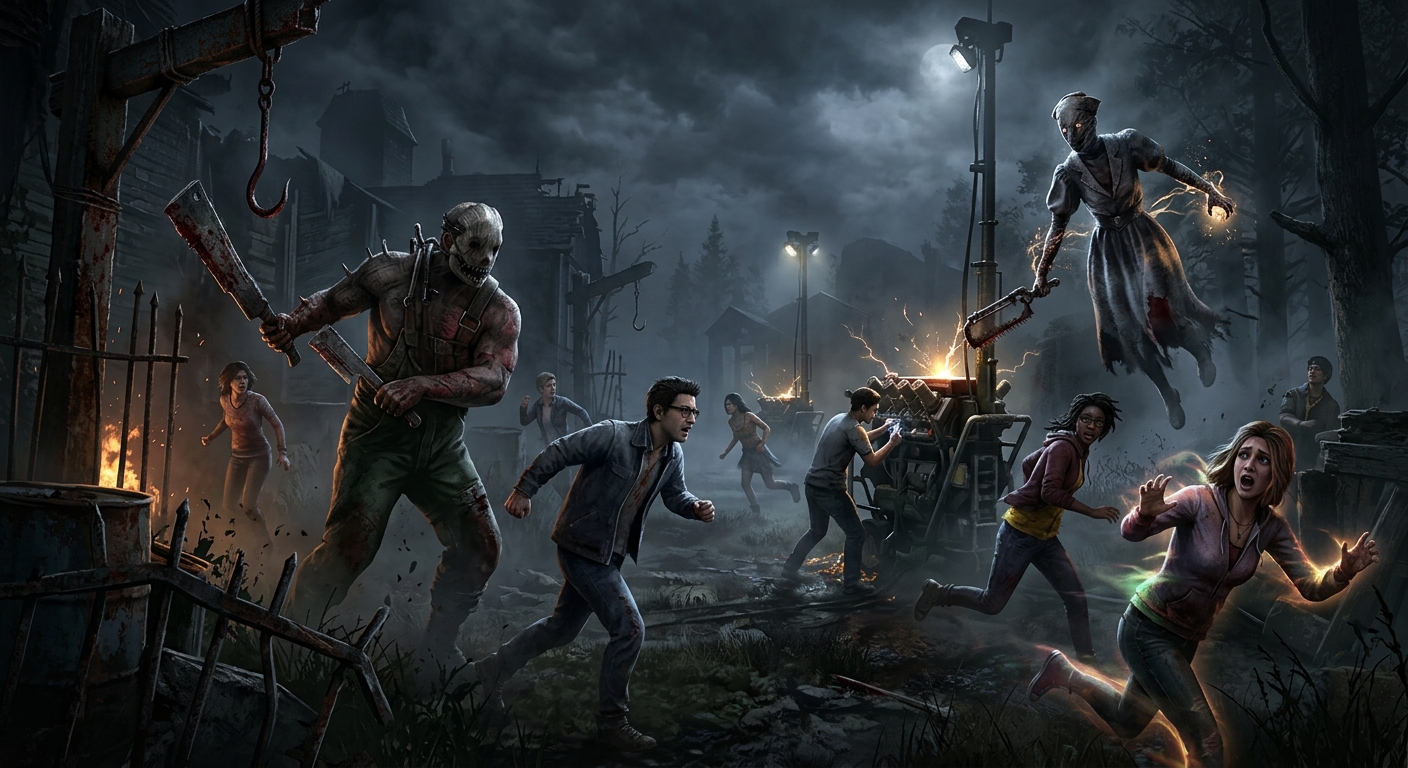
Dead by Daylight’s 2v8 mode takes the familiar cat-and-mouse horror formula and dials it up by adding an extra Killer and doubling the number of Survivors. Instead of the classic 1v4 structure, matches become ten-player brawls with revised objectives, altered rules, and new tools to keep the chaos under control. This guide walks through how the mode works, what changes from standard Trials, and how you can adapt your strategies on both sides of the Fog.
What Is 2v8 and Why It Matters
In the traditional Dead by Daylight experience, one Killer hunts four Survivors who must repair generators and escape. The 2v8 mode is a limited-time variant that dramatically increases player count and overhauls mechanics to stay playable and readable.
Key ideas behind 2v8 include:
- More players, faster pace: Two Killers versus eight Survivors means more constant action and fewer quiet moments.
- Reduced complexity per character: To keep things balanced, the mode removes perks and replaces them with streamlined classes and skills.
- Remixed objectives: Generator and hook systems are modified so that the map and HUD don’t become overwhelming clutter.
The mode also acts as a showcase for the game’s ongoing experimentation with matchmaking, events, and limited-time rule sets. Behaviour Interactive has used prior events and modifiers to test balance ideas before promoting or adapting them to the core game, and 2v8 fits into that trend.1
How 2v8 Changes the Core Rules
Even if you’re a veteran of the standard 1v4 mode, stepping into a 2v8 Trial feels different right away. Here are the most important gameplay changes you’ll notice.
Player Count and Team Composition
- Two Killers work together, sharing the same map and pool of Survivors.
- Eight Survivors must coordinate to complete objectives and escape.
- All ten participants are human players (no bots), which increases unpredictability.
The shift from five to ten players significantly alters the pacing. There are more chases happening simultaneously, more bodies on generators, and a higher chance of overlapping pressure across the map.
No Perks, But Classes and Skills Instead
Perks are a defining feature of standard Dead by Daylight, but in 2v8 they are removed entirely for both Killers and Survivors. In their place, each side uses a simplified system of classes and skills designed to be easier to balance with ten players on the field.
This approach parallels broader industry trends, where live-service games introduce special modes with limited loadouts or predefined roles to maintain clarity and reduce power creep during events.2
Objective and Hook Adjustments
With eight Survivors, a standard five-generator objective and the usual three-stage hook system would either end too quickly or become unmanageable. The 2v8 mode therefore adjusts:
- The number of objectives Survivors must complete.
- The durability of Survivors on hooks.
- How information is surfaced via the HUD so players can track teammates without chaos.
While the exact numbers can vary with balancing patches, the intent is to keep matches around a similar length to standard Trials while accommodating the doubled roster.
Survivor Side: Classes, Roles, and Strategy
Every Survivor character is available in the mode, but their individual perk loadouts are replaced by four streamlined classes. You pick your favourite cosmetic, then assign one of these functional roles.
The Four Survivor Classes Explained
Each Survivor class comes with its own active skill set, cooldowns, and synergy potential. While names and specifics may shift over time, the roles they fill tend to fall into these archetypes:
- Guide (Support/Information)
Focuses on map awareness and coordination, sharing information that helps the team avoid danger and prioritize objectives. - Medic (Healer)
Specializes in healing and recovery, reducing downtime after hits and helping the group bounce back from mistakes. - Escapist (Objective & Evasion)
Geared toward generator progression and slipping away from chases, often with tools that improve vaulting or sprinting. - Scout (Recon/Stealth)
Excels at gathering intel on Killer positions and totems or probing high-risk areas, enabling safer plays for others.
In practice, a balanced team might include:
- 2–3 Medics to sustain the group.
- 2 Guides or Scouts to keep tabs on Killer movement.
- 3–4 Escapists to drive generator and exit progress.
How Skills Replace Perks for Survivors
Instead of building personalized perk combinations, you’ll rely on a smaller number of clearly defined skills tied to your class. These skills often feature:
- Guaranteed value: Less dependence on niche conditions.
- Shorter cooldowns: So they can be used frequently in the chaotic environment.
- Team-oriented effects: Many abilities provide information or buffs to multiple Survivors at once.
This design reduces the chance of overpowering synergies that may arise from ten players, making the mode more approachable for newcomers who might otherwise be overwhelmed by perk knowledge requirements.3
Survivor Tips for 2v8
- Play the numbers: With eight Survivors, trading health states to secure key objectives is often worth it, especially when Medics are nearby.
- Don’t overstack roles: Too many Scouts or Guides and you’ll lack generator speed; too many Escapists and you may fall behind on healing.
- Call out both Killers: If your group uses voice or pings, always identify which Killer is where; two Killers collapsing on one area can wipe a stack of Survivors quickly.
- Rotate objectives: With multiple chases happening, be ready to abandon a contested area and resume work where Killer pressure is low.
- Value safe unhooks: Unsafe rescues in a mode with two Killers often snowball into multiple downs and mass hooks.
Killer Side: Duo Dynamics and Character Selection
On the Killer side, 2v8 might feel like a power fantasy, but the Surviors’ numbers add significant pressure. You go in as one of five featured Killers, each with their own power but no perks or add-ons. Learning how to coordinate with your co-Killer is vital.
Featured Killers in 2v8
The debut version of the mode highlights a lineup of classic Dead by Daylight Killers, chosen for their iconic powers and synergy potential. The roster includes:
- The Trapper – Area denial with bear traps.
- The Wraith – Cloaking and ambush potential.
- The Hillbilly – High-speed chainsaw mobility.
- The Nurse – Teleporting blinks through obstacles.
- The Huntress – Ranged pressure via hatchets.
This curated selection allows for combinations that cover both mobility and zoning, creating a dynamic threat profile across different parts of the map.
No Perks for Killers: What That Means
Killers in 2v8 don’t have access to their extensive perk pools, nor can they equip add-ons. Instead, they rely on innate powers and a smaller set of mode-specific tools and modifiers that keep them competitive against the larger Survivor team.
The absence of perks:
- Removes the possibility of oppressive slowdown stacks, which would be overwhelming with ten players.
- Makes each Killer’s base kit more important and easier to evaluate.
- Simplifies balancing, since designers only need to tune numbers around a few defined variables.
Division of Labor Between Two Killers
Coordination between Killers can make or break a 2v8 match. Common approaches include:
- Zone Split: Divide the map into rough halves, each Killer patrolling their side to maintain constant pressure without stepping on each other’s toes.
- Role Split: Assign one Killer as the Chaser (e.g., Hillbilly, Nurse) and the other as Control (e.g., Trapper, Huntress), focusing on slowing objectives and defending key areas.
- Collapse Strategy: When the game nears the end or a pocket of Survivors is identified, both Killers converge to secure multiple downs.
Killer Tips for 2v8
- Communicate hooks and priorities: Let your co-Killer know who is on death hook or which area is critical to defend.
- Avoid redundant patrol paths: Constantly circling the same generators wastes precious time when eight Survivors can be working elsewhere.
- Capitalize on snowball moments: When multiple Survivors are injured or down, push aggressively; eight players mean they can recover quickly if you back off.
- Use mobility wisely: High-mobility Killers should focus on putting out fires across the map rather than tunneling one Survivor.
Maps and Layout Adjustments
Ten-player Trials require more space and clearer lines of sight than typical 1v4 matches. To address this, 2v8 uses modified versions of existing maps rather than entirely new arenas.
What Changes on 2v8 Maps
Map variants are adjusted to reduce visual clutter and make navigation easier. Typical changes include:
- Removed or simplified tiles to reduce excessively strong loops and bottlenecks.
- Tweaked generator and hook placement to distribute objectives evenly for ten players.
- Adjusted lighting and sightlines to help both Killers and Survivors read situations amid the chaos.
| Aspect | Standard 1v4 | 2v8 Variant |
|---|---|---|
| Player Count | 1 Killer, 4 Survivors | 2 Killers, 8 Survivors |
| Tile Complexity | Varied, some highly complex loops | Streamlined to maintain readability |
| Objective Distribution | Balanced around 5 gens & 4 Survivors | Scaled for more Survivors & two Killers |
| Hook Pressure | Focused, 1 Killer controlling space | Shared coverage between 2 Killers |
Adapting to the New Layouts
Since these are familiar realms with altered layouts, both sides should:
- Explore early: Survivors should identify strong loops and safe areas; Killers should quickly locate generator clusters.
- Learn new landmarks: Some recognizable reference points may shift; keep an eye out for changed tile configurations.
- Expect tighter encounters: More players naturally lead to more shared chases and overlapping plays in the same areas.
Rewards, Progression, and Event Tomes
2v8 is not just a novelty mode; it ties into Dead by Daylight’s progression systems with event-specific rewards. During the 2v8 windows, players can access a special Event Tome with challenges unique to the mode.
Event Tome Challenges
Event Tomes in Dead by Daylight typically introduce limited-time challenges that reward players with:
- Bloodpoints for upgrading characters.
- Charms and cosmetics themed around the event.
- Lore entries that expand on the game’s story.
In the context of 2v8, challenges might encourage:
- Playing both Killer and Survivor roles in the mode.
- Using specific classes or achieving multi-player feats (e.g., saving multiple teammates in a single Trial).
- Experimenting with different Killers from the featured roster.
Cosmetics and Crossovers
Behaviour Interactive often pairs major modes and events with crossover cosmetics, such as limited-time outfits or charms inspired by other franchises.4 While 2v8 can appear with different thematic wrappers (for example, anime or horror crossovers), the core gameplay remains focused on the 2v8 structure, with cosmetics serving as a thematic bonus.
Matchmaking, Queues, and Play-While-You-Wait
One challenge of asymmetrical multiplayer games is keeping queue times manageable across different roles. Dead by Daylight has historically struggled with Killer vs Survivor queue balance, a common issue for asymmetrical games broadly.5
2v8 as a Queue Management Tool
To mitigate wait times, Behaviour introduced features that interact directly with 2v8, most notably a “Play-While-You-Wait” option. This allows some players to take part in 2v8 Survivor queues while maintaining their place in the standard Killer queue.
The idea is to:
- Provide meaningful gameplay instead of idle waiting.
- Encourage more players to try the 2v8 mode.
- Gather data on match duration, player behaviour, and balance.
Limited-Time Availability
2v8 is framed as a limited-time mode that returns in specific windows rather than being always available. This helps:
- Maintain healthy player concentrations when it’s active.
- Give the developers room to tweak parameters between runs.
- Position the mode as a special event rather than a replacement for the core experience.
How 2v8 Fits into Dead by Daylight’s Future
Even if 2v8 remains a recurring event rather than a permanent playlist, it offers valuable insight into the direction of Dead by Daylight’s design. The mode shows Behaviour experimenting with:
- Role-based loadouts instead of highly customizable perks.
- Higher player counts and more chaotic match structures.
- Dynamic map variants that adjust to new rule sets.
Changes that test well in 2v8 could influence future balance changes or new modes, while player feedback helps refine what works and what doesn’t in large-scale Trials.
Frequently Asked Questions about DBD 2v8
Is 2v8 a permanent mode in Dead by Daylight?
No. 2v8 is designed as a limited-time mode that appears during specific event periods. It may return multiple times with updates and tweaks, but it is not currently a permanent queue.
Can I use my normal perks and add-ons in 2v8?
Perks and add-ons are disabled for both Killers and Survivors in 2v8. Instead, Survivors select from predefined classes with unique skills, and Killers rely primarily on their base powers.
Do I keep progression and Bloodpoints earned in 2v8?
Yes. Matches in 2v8 contribute to your overall progression and can reward Bloodpoints, experience, and event currency where applicable, just like other official game modes.
Is cross-play supported in 2v8?
Dead by Daylight supports cross-play across multiple platforms for its core modes, and limited-time modes generally use the same cross-play infrastructure. Specific platform availability can vary with updates, so it is best to check the current official patch notes.
Can I choose which Killer my partner plays?
You can select your own Killer from the featured roster, but teammate selection depends on matchmaking and party composition. If you queue with a friend, you can coordinate which Killers you both pick to create effective combinations.
Is 2v8 balanced for solo queue Survivors?
The mode is designed to be playable in solo queue, with classes and HUD tweaks helping solo players stay informed. However, premade groups with good communication will naturally have an advantage, as in the base game.
Will more Killers and classes be added to 2v8?
Behaviour Interactive has not committed to a fixed long-term roster for 2v8, but the mode’s structure makes it easy to swap in additional Killers, class tweaks, or skill reworks in future iterations, especially when tied to themed events or crossovers.
References
- Dead by Daylight’s 2v8 Mode: Everything To Know — Behaviour Interactive. 2024-06-13. https://deadbydaylight.com/news/2v8-mode-everything-to-know/
- Dead by Daylight’s 2v8 Is Back, Launching “Play-While-You-Wait” — Behaviour Interactive. 2024-09-10. https://deadbydaylight.com/news/2v8-play-while-you-wait/
- Dead by Daylight: 2v8 — Official Dead by Daylight Wiki (Fandom). 2024-08-29. https://deadbydaylight.fandom.com/wiki/2v8
- Attack on Titan x Dead by Daylight — Behaviour Interactive. 2022-07-19. https://deadbydaylight.com/news/attack-on-titan-collection/
- Balancing Asymmetric Multiplayer Games — Game Developers Conference (GDC). 2020-03-20. https://www.gdcvault.com/play/1026715/Balancing-Asymmetric-Multiplayer-Games
Similar Articles



Read full bio of Sneha Tete