Definitive Guide to the Best CRPGs Right Now
Explore story‑rich computer RPGs, from modern epics to timeless classics, and find the perfect party‑based adventure for you.
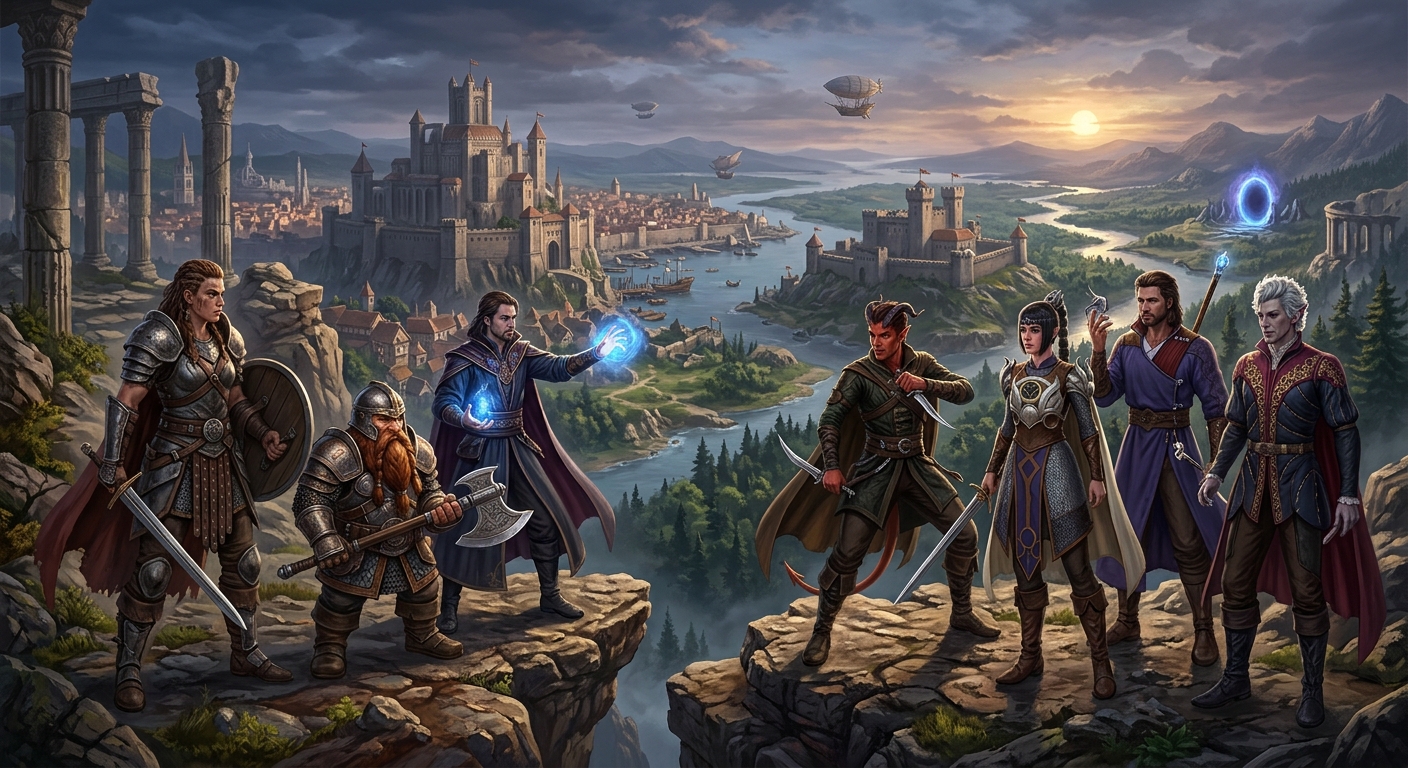
Computer role-playing games (CRPGs) are where deep storytelling, tactical combat, and intricate character builds come together. Whether you are coming from tabletop RPGs like Dungeons & Dragons or discovering the genre for the first time, the current landscape of CRPGs is richer than ever. This guide highlights some of the standout games that define the genre today, explains why they matter, and helps you decide which adventure to dive into next.
What Makes a Game a CRPG?
“CRPG” originally meant computer role-playing game, often used to differentiate PC-focused, stat-heavy RPGs from console-style action RPGs. Over time, it has come to describe a certain style rather than just a platform.
Typical hallmarks include:
- Rich character systems: Attributes, skills, feats, and classes that meaningfully affect how you play.
- Branching narrative: Choices that influence dialogue, factions, and sometimes entire story arcs.
- Party-based gameplay: You often control several characters, not just one hero.
- Tactical combat: Turn-based or real-time-with-pause combat that rewards planning and positioning.
- Text-heavy storytelling: Extensive dialogue and descriptive writing, often influenced by tabletop traditions.
These design elements are historically rooted in early computer adaptations of tabletop RPG rulesets, such as D&D, and still shape the narrative and mechanical focus of CRPGs today.1
Modern Flagships: CRPGs Defining the Current Era
Some recent releases have pushed CRPGs back into the mainstream, thanks to strong writing, cinematic presentation, and refined mechanics. The titles below are often the best entry points for new players.
Baldur’s Gate 3 – Cinematic D&D on a Grand Scale
Baldur’s Gate 3 adapts the Dungeons & Dragons 5th Edition ruleset into a lavish, fully voiced campaign. Developed with input from the tabletop rules and lore owners, it offers a faithful but flexible digital take on the system.2
Why it stands out:
- Highly reactive story where your origin, class, and choices shift scenes and outcomes.
- Cinematic presentation: motion-captured performances and detailed environments.
- Turn-based combat with verticality, environmental interactions, and improvised tactics.
- Robust co-op play that feels like a digital tabletop campaign.
Best for: Players who want a modern production with classic CRPG depth, fans of D&D 5e, and groups looking for a long co-op campaign.
Divinity: Original Sin 2 – Sandbox Tactics and Co-op Freedom
Divinity: Original Sin 2 combines systemic combat with playful problem solving. Its rules encourage experimentation, from combining elemental effects to creatively using skills outside of battle.
Highlights:
- Highly interactive battlefields: surfaces (fire, poison, water, ice) can be combined in unexpected ways.
- Flexible character builds that let you mix and match archetypes.
- Game Master mode for running your own campaigns.
- Drop-in/drop-out four-player co-op with minimal compromises to depth.
Best for: Players who enjoy experimentation, tactical puzzles, and shared storytelling, especially in co-op groups.
Disco Elysium – Role-Playing as Inner Conflict
Disco Elysium radically de-emphasizes combat and instead turns internal monologues and dialogue into the core gameplay loop. Inspired by noir fiction and political theory, it is closer to a narrative RPG than a combat-focused dungeon crawler.
Notable features:
- Skill checks that trigger conversations with aspects of your own mind.
- Dense, politically charged writing with multiple ideological paths.
- “Thought Cabinet” system that lets you internalize beliefs and traits with mechanical effects.
- Multiple endings shaped by your investigative approach and moral compass.
Best for: Players who value writing over combat, enjoy reading, and want to explore a uniquely literary approach to role-playing.
Wasteland 3 – Post-Apocalyptic Squad Strategy
Wasteland 3 delivers tactical combat with a grim yet often darkly humorous take on a frozen, post-apocalyptic Colorado. It follows in the tradition of isometric squad RPGs that emphasize cover, flanking, and careful resource management.
Key elements:
- Turn-based combat blended with environmental hazards and vehicular elements.
- Morally ambiguous quests where no option feels entirely clean.
- Base-building systems that evolve as you recruit and make decisions.
- Online co-op support for the full campaign.
Best for: Players who like combat-focused CRPGs, branching questlines, and a tone that swings between bleak and absurd.
Immersive Worlds and Player Choice
Some CRPGs put particular emphasis on world-building and player-driven storytelling, giving you space to inhabit a role rather than simply complete quests.
Vampire: The Masquerade – Bloodlines – Cult Classic Urban Horror
Vampire: The Masquerade – Bloodlines adapts the World of Darkness tabletop setting into a cult favorite CRPG. Despite a troubled launch, its depiction of modern undead politics and subcultures has kept it relevant for years.
Why it’s still influential:
- Multiple vampire clans with distinct playstyles and social dynamics.
- Urban hubs that feel lived-in, with overlapping factions and hidden stories.
- Strong emphasis on dialogue and social maneuvering rather than pure combat.
Best for: Players who prefer urban fantasy, narrative complexity, and role-playing through dialogue choices and faction allegiances.
Pillars of Eternity Series – Spiritual Successor to Infinity Engine Classics
The Pillars of Eternity games were built to capture the feel of late-1990s isometric CRPGs while modernizing interfaces and rules. While they use a proprietary ruleset instead of D&D, they channel similar party-based, quest-driven gameplay.
Series strengths:
- Detailed original setting exploring souls, faith, and colonization.
- Party banter and companion quests that evolve over long campaigns.
- First game: real-time-with-pause combat; second game: optional turn-based mode added later, reflecting broader interest in tactical turn-based design.3
Best for: Players who miss the feel of Infinity Engine games like Baldur’s Gate or Icewind Dale and want a fully realized new world to explore.
Classic and Retro-Style CRPG Pillars
Many of the most respected CRPGs remain older titles whose design philosophies continue to shape modern games. Some have received enhanced or remastered editions, making them more accessible to new audiences.
Planescape: Torment – Story Over Combat
Planescape: Torment is renowned for prioritizing dialogue and philosophical exploration over combat. Set in the surreal D&D Planescape universe, it focuses on identity, memory, and redemption.
Defining traits:
- Heavily text-driven, with many conflicts resolved through conversation.
- Companions with unusual metaphysical backstories.
- A protagonist defined more by past choices than future power levels.
Best for: Players who don’t mind reading extensively and want a narrative where combat is often optional rather than mandatory.
Fallout & Fallout 2 – Isoometric Wasteland Foundations
Before the series moved to first-person, the original Fallout games defined post-apocalyptic CRPGs with their turn-based battles, open-ended character builds, and dark satire. They are still often cited as prime examples of choice-driven design.4
| Aspect | Fallout 1 & 2 | Later 3D Titles |
|---|---|---|
| Perspective | Isometric | First/third person |
| Combat | Turn-based, action points | Real-time with pause/VATS |
| Tone | Bleak satire, dark humor | Mix of pulp adventure and satire |
| Role-play focus | Skill checks, reputation, endings change dramatically | Still choice-driven, but more action-oriented |
Best for: Players who can handle dated interfaces in exchange for systemic depth and a strong sense of consequence.
Arcanum: Of Steamworks and Magick Obscura – Unusual Hybrid
Arcanum blends Victorian-inspired steampunk with high fantasy. Its systems allow for radically different builds, from mage scholars to gun-toting technologists, and the world reacts to your chosen path.
Why it’s notable:
- Technology vs. magic tension affecting equipment and social reactions.
- Multiple approaches to quests, including stealth, diplomacy, and brute force.
- Expansive character creation and skill-based progression.
Best for: Players who enjoy experimenting with offbeat character concepts and navigating a setting where mechanics strongly reinforce the fiction.
Comparing CRPGs by Strengths
The best CRPG for you depends on what you value most: narrative, combat, co-op potential, or old-school authenticity. The table below summarizes typical strengths for some representative titles.
| Game | Story & Writing | Combat Depth | Accessibility | Co-op |
|---|---|---|---|---|
| Baldur’s Gate 3 | ★★★★★ | ★★★★☆ | ★★★☆☆ (D&D complexity) | Yes |
| Divinity: Original Sin 2 | ★★★★☆ | ★★★★★ | ★★★☆☆ | Yes |
| Disco Elysium | ★★★★★ | ★☆☆☆☆ (Minimal) | ★★★☆☆ (Reading-heavy) | No |
| Wasteland 3 | ★★★★☆ | ★★★★☆ | ★★★★☆ | Yes |
| Planescape: Torment | ★★★★★ | ★★☆☆☆ | ★★☆☆☆ (Very text-heavy) | No |
Note: Stars are a loose comparative guide based on typical genre expectations, not objective scores.
How to Choose the Right CRPG for You
With so many options, it is helpful to match a game to your preferences and experience level.
Ask Yourself These Questions
- Do you prefer reading or action? If you want minimal reading, prioritize combat-heavy titles over narrative experiments.
- Are you playing solo or with friends? Some games are built around strong co-op, others around introspective solo play.
- How much time can you commit? Many CRPGs run 50–100 hours; shorter, more focused experiences can be less overwhelming.
- Do you want modern visuals or care more about mechanics? Older games may look dated but remain mechanically rich.
Tips for Newcomers to the Genre
CRPGs can be demanding, but there are ways to make your first experience far more welcoming.
- Start on an easier difficulty: Use story or normal difficulty for your first run; you can always increase the challenge later.
- Read tooltips: Many systems become transparent once you take time to read in-game explanations.
- Lean on pre-built characters: Origin characters or recommended builds help avoid analysis paralysis.
- Save often: Frequent manual saves let you experiment without losing progress.
Research suggests that complex games can support systems thinking and problem-solving skill development, particularly when players are encouraged to experiment and reflect on feedback.5 CRPGs, with their layered mechanics and branching outcomes, naturally reward this iterative learning approach.
Frequently Asked Questions About CRPGs
Are CRPGs only for PC?
No. While many CRPGs historically launched on PC first, modern releases frequently arrive on consoles as well. Controller support and console ports have broadened access, though keyboard and mouse may still offer more precise control for some interfaces.
Do I need to know Dungeons & Dragons to enjoy these games?
Familiarity with tabletop rules can help with D&D-based titles, but it is not required. Most games include in-game tutorials and glossaries. They adapt more complex tabletop rules into streamlined digital forms, reducing bookkeeping compared to physical play.2
Which CRPG is best for beginners?
It depends on your preferences. If you want cinematic presentation and clear onboarding, a modern game like Baldur’s Gate 3 or Wasteland 3 is a good start. If you are comfortable reading a lot and want a story-first experience, Disco Elysium is approachable because it largely sidesteps complex combat systems.
Why do so many CRPGs use isometric camera angles?
Isometric perspectives make it easier to display tactical information, such as terrain, line-of-sight, and party positioning. This viewpoint has a long design tradition in strategy games and CRPGs, and remains effective even as technology allows more cinematic alternatives.
Are older CRPGs worth playing today?
Yes, provided you are comfortable with dated graphics and interfaces. Enhanced editions, fan patches, and community mods often improve usability. Many design innovations in modern CRPGs trace back to experiments in 1990s and early 2000s titles, so classics remain valuable both historically and as engaging games.
References
- Role-Playing Games: A Cultural and Transmedial History — Game Studies, Aarhus University. 2019-06-10. https://gamestudies.org/1901/articles/hitchens_lombaard
- Player’s Handbook (5th Edition) — Wizards of the Coast. 2014-08-19. https://dnd.wizards.com/products/rulebooks/players-handbook
- Pillars of Eternity II: Deadfire Patch 2.0 and Turn-Based Mode — Obsidian Entertainment. 2019-01-24. https://forums.obsidian.net/topic/107595-patch-20-and-turn-based-mode/
- Fallout Bible (Collection) — Interplay / Black Isle Studios. 2002-03-10. https://fallout.bethesda.net/en/article/70g3owx8cdvS2w0KzyeYxw/fallout-bible
- Good Video Games and Good Learning — James Paul Gee, Phi Kappa Phi Forum. 2005-01-01. https://www.scientificamerican.com/article/learning-by-playing-video-games-in-the-classroom/
Similar Articles





Read full bio of Sneha Tete