
The Demon’s Souls Enemies We Never Met
Cut enemies and prototype ideas reveal how Demon's Souls once flirted with truly outrageous, almost unfair difficulty.
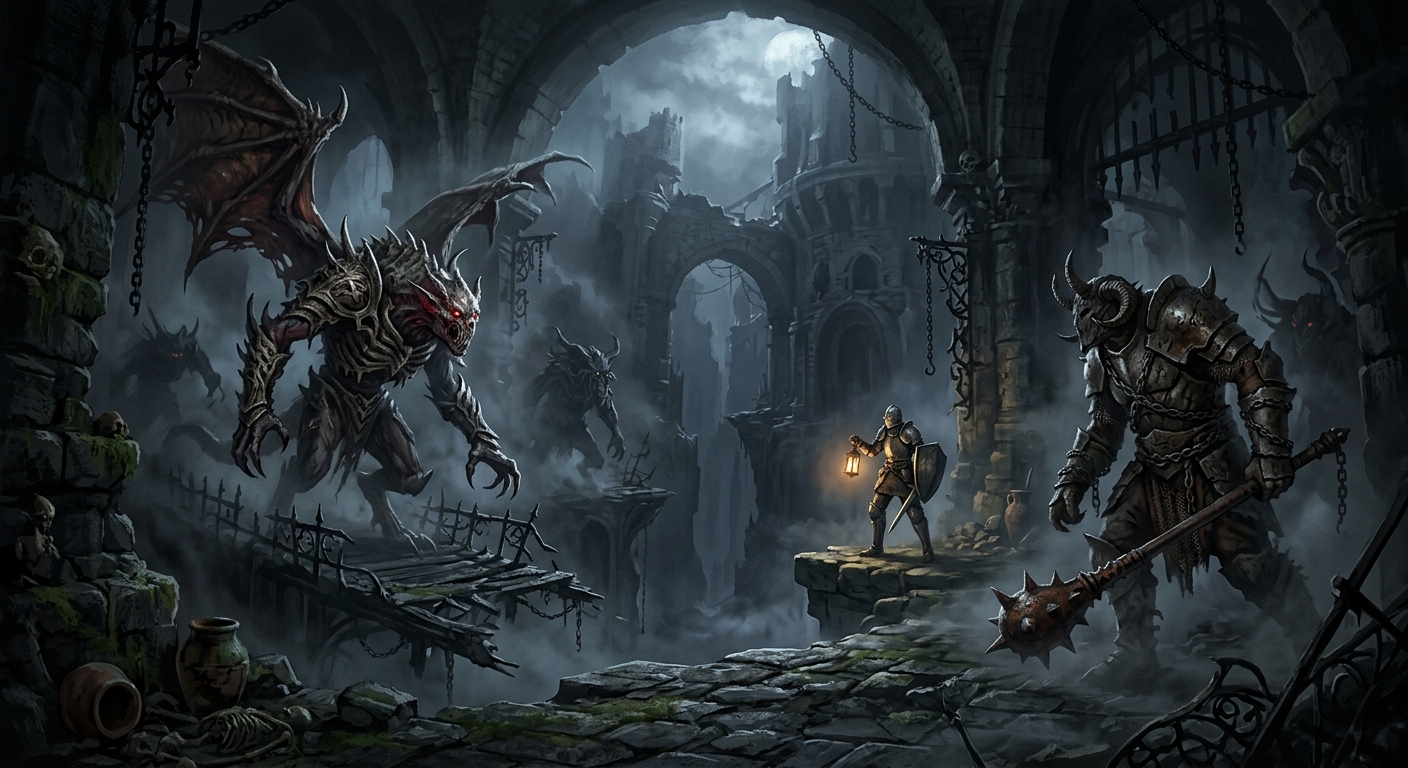
Demon’s Souls occupies a pivotal spot in FromSoftware’s history. It laid the groundwork for the Dark Souls trilogy, Bloodborne, Sekiro, and Elden Ring, introducing a philosophy of difficulty that prizes tension, learning, and hard-won triumph. Yet the game we actually played is only one version of what could have been. Hidden in files, prototypes, and design remnants are hints of enemies and encounters so vicious that even hardened Souls veterans might have balked.
Among those discoveries is one of the most infamous what-ifs in the series: massive bird-like creatures designed to grab the player and hurl them off sheer cliffs. They epitomize what some fans jokingly call a “middle finger” encounter—mechanics tuned less for challenge and more for sheer cruelty. The fact that they never made it into the shipping game tells us a lot about where FromSoftware ultimately chose to draw the line between harsh and outright unreasonable difficulty.
This article looks at how those cut enemies, along with other unused ideas, help illuminate the evolution of FromSoftware’s design approach—from Demon’s Souls’ experimental roots to the more refined but still punishing games that followed.
From Experiment to Blueprint: Why Demon’s Souls Mattered
When Demon’s Souls launched on PlayStation 3 in 2009, it didn’t arrive with the prestige the Souls name carries today. It was an odd, atmospheric action RPG with unconventional online features and a reputation for punishing newcomers. Over time, however, it became clear that this was more than a niche curiosity: it was a template for a new subgenre.
Several elements in Demon’s Souls became core to the later Soulsborne formula:
- Death as a learning tool rather than a simple fail state
- Level layouts that interlock and loop back, rewarding exploration
- Cryptic storytelling delivered through environment and item descriptions
- Persistent tension driven by meaningful risk and loss on death
According to interviews with director Hidetaka Miyazaki, the goal was never to create difficulty for its own sake. Instead, challenge was meant to make the experience meaningful and memorable, with success feeling earned rather than handed to the player. In a widely cited interview, he described hardship as the source of emotional satisfaction in his games, emphasizing that raising difficulty without fairness is not the objective.1
That emphasis on fairness becomes especially interesting when we look at the content that was left on the cutting room floor.
Unearthing Cut Content: How Fans Discover What Might Have Been
Modern Souls communities have turned excavation of old game data into its own form of detective work. The Demon’s Souls remake and the original PlayStation 3 version both contain remnants of experiments, test zones, debug labels, and unused models. Modders and technical analysts comb through these assets to reconstruct how ideas evolved during development.
Typical methods include:
- Data-mining game files to locate unused models, animations, or behavior scripts
- Re-enabling disabled AI routines via modding tools to see how they act in-game
- Comparing prototype builds (where available) to retail versions to track changes
- Cross-referencing internal names or debug strings that hint at planned features
For Demon’s Souls, this process has revealed more than just cosmetic oddities. It points to entire encounter concepts that were built far enough to be testable, then ultimately abandoned. The infamous giant cliff-throwing birds are a particularly striking case, because they embody a specific design tone that the final game largely avoids: untelegraphed, near-instant death in situations where the player’s agency is limited.
Giant Birds, Sheer Cliffs, and the Edge of Fairness
FromSoftware is no stranger to putting players near lethal drops. The series delights in narrow walkways, swaying bridges, and precarious ledges that transform the environment into a constant threat. What cut enemies like the cliff-hurling birds would have done is remove one level of control: instead of slipping due to your own movement, you could be forcibly thrown into the void by an enemy whose main purpose was to erase you in one motion.
Consider how such an enemy would function:
- It lurks in areas dominated by vertical drops and cramped pathways.
- It can close distance quickly, potentially from angles the player is not watching.
- Its signature attack is not gradual damage but an immediate positional displacement.
- The failure state is instant death, even if you have full health and strong gear.
In practice, that would likely create scenarios where a single misjudged camera angle or a slight delay in reaction leads to instant, unavoidable death. Players already worried about missteps would now need to anticipate enemy grabs that bypass traditional combat, turning navigation into a constant gamble.
From a purely sadistic perspective, this sounds like a quintessentially Souls-like trap. Yet its absence is telling. The final game leans heavily into environmental danger, but usually in ways that allow some measure of counterplay: careful stamina management, shield use, or luring foes into safer spaces. Removing player agency to that degree veers close to what Miyazaki has described as “unreasonable” difficulty—difficulty that feels arbitrary rather than earned.
How Environmental Danger Works in Souls Games
To understand why an enemy built solely around throwing the player off cliffs might be a step too far, it’s useful to look at how environmental hazards typically function in the broader Soulsborne catalog. Across Demon’s Souls, Dark Souls, and beyond, these hazards almost always share several traits:
- They are telegraphed. Narrow ledges, crumbling floors, and obvious pits are visible, even if the player is under pressure.
- They reward caution. Slow, deliberate movement, shield usage, or ranged pulling makes them manageable.
- They integrate with enemy behavior. Foes often share your vulnerability to cliffs or traps, allowing you to turn the environment against them.
- They become less hazardous with knowledge. On repeat attempts, players can plan routes and anticipate danger.
When death comes because you overextended on a narrow platform or forgot about an environmental cue, the game reinforces its core loop: observe, learn, adapt. A hypothetical enemy whose main purpose is to bypass your defenses and forcibly eject you from the world removes many of those learning opportunities. Even if the enemy has tells, the punishment for a single mistake may be too disproportionate compared to other foes in the same area.
Difficulty, Fairness, and the Line Between Them
One reason the Souls games maintain such loyal communities is that many players perceive their harshness as fair. They may be unforgiving, but they are rarely random. Academic work on game difficulty often distinguishes between challenge (an obstacle that requires skill to overcome) and unfair frustration (setbacks that feel arbitrary or beyond player influence). Research on player motivation in difficult games suggests that players remain engaged when they can attribute failure to controllable factors, like tactics or preparation, rather than bad luck alone.2
FromSoftware’s own messaging aligns with this. In interviews, Miyazaki has stressed that simply raising difficulty is not the goal. Instead, his teams seek a balance where repeated failure leads to understanding, and where overcoming hardship brings a surge of accomplishment—sometimes described in psychology as a “eustress” response, a positive kind of stress that fuels engagement rather than burnout.3
Enemies whose primary function is to remove you from the world with minimal warning or counterplay threaten that balance. They may produce memorable moments, but they risk crossing over into the territory of arbitrary cruelty. The fact that such designs exist in prototype form but not in the final game supports the idea that an internal boundary exists: the team experiments with extremes, then pulls back to a level that most players can perceive as challenging yet ultimately fair.
Other Types of Cut Encounters and What They Suggest
The giant birds are just one example of Demon’s Souls’ more extreme experiments. Other cut or altered elements—documented by enthusiasts who study the game’s inner workings—point to similar tensions between ambition and restraint:
- Unused boss and enemy moves that chain multiple high-damage attacks with few safe windows for response.
- More aggressive enemy placements in tight corridors, sometimes stacking multiple dangerous foes in spaces that leave little room to dodge.
- Alternate AI behaviors where enemies pursue the player more relentlessly, reducing opportunities to reset or heal.
These ideas are not inherently unreasonable. In fact, later FromSoftware titles introduce many brutal scenarios that make Demon’s Souls look tame by comparison. The key difference lies in the surrounding systems: expanded mobility, more tools for crowd control, or new defensive mechanics can make extreme encounters feel manageable. In Demon’s Souls’ slower, more limited framework, the same intensity might have tipped from exhilarating to exhausting.
How Later Games Refined the Formula
Looking at later FromSoftware games helps contextualize why certain Demon’s Souls experiments were shelved. Over time, the studio increased both the complexity of its enemy designs and the skill demands placed on players—while also expanding the player’s toolkit.
| Game | Key Player Tools | Typical Difficulty Flavor |
|---|---|---|
| Demon’s Souls | Blocking, rolling, ranged pulls, limited mobility | Deliberate combat, punishing positioning, attrition |
| Dark Souls trilogy | Refined dodge, poise tweaks, varied builds | Mix of endurance fights, traps, and attrition-based challenges |
| Bloodborne | Fast dodges, regain system, aggressive builds | High-speed aggression, pattern recognition, pressure |
| Sekiro | Deflects, posture system, vertical mobility | Rhythm-based duels, punishing parry timing |
| Elden Ring | Open world, spirit ashes, jump attacks, wide build variety | Spike difficulty bosses offset by optional progression routes |
By the time we reach games like Sekiro and Elden Ring, extremely aggressive enemies and complex multi-phase bosses are more acceptable because the player can respond with greater mobility, build diversity, and support tools. In Demon’s Souls, by contrast, the relatively constrained movement and sparse safety nets mean that exceptionally punishing enemy designs can feel inescapable rather than exhilarating.
This perspective helps explain why something like a dedicated cliff-thrower enemy might work in a faster game with more recovery options, but come across as wildly unfair in an early experimental title that was still defining baseline expectations.
Design Lessons From an Enemy That Never Was
The most interesting aspect of cut content is not that players were spared some truly nasty surprises. It’s that those discarded ideas reveal how FromSoftware iterates on its core philosophy. Each unused enemy, attack, or layout is a snapshot from a phase where the designers were testing just how far they could push the player.
From the giant birds and similar experiments, several lessons emerge:
- Extremes are valuable in prototyping. By building something obviously excessive, designers can more clearly see where the boundary of fairness lies.
- Death must feel instructive. If a failure teaches nothing beyond “that was cheap,” it clashes with the studio’s stated goal of meaningful hardship.
- Player agency is non-negotiable. The player must retain the sense that they could have acted differently, even in defeat.
- Context matters. A mechanic that would be acceptable in a faster, more flexible game might be oppressive in a slower, more restrictive one.
When a design idea is removed, that decision reflects not just technical constraints but value judgments about player experience. In Demon’s Souls, those judgments tilted toward preserving a sense of fairness—even if the result still feels brutally difficult to newcomers.
FAQs: Demon’s Souls Difficulty and Cut Content
Did Demon’s Souls really have enemies that threw players off cliffs?
Evidence from game files and community analysis points to prototype enemies designed to grab or shove players from elevated areas, effectively causing instant death. These enemies do not appear in the final retail game, indicating that the concept was explored but ultimately abandoned.
Why would FromSoftware remove such memorably cruel ideas?
While FromSoftware embraces high difficulty, the studio has consistently emphasized fairness and learnability. Enemies whose main function is instant, low-agency death risk feeling arbitrary rather than challenging, which can undercut long-term engagement.
Are there similar “unfair” moments in the shipped game?
Demon’s Souls certainly includes ambushes, traps, and precarious platforms that can cause sudden death, especially for first-time players. The difference is that most of these hazards can be mitigated with knowledge, cautious movement, or better positioning on subsequent attempts.
How do later FromSoftware games handle this balance?
Later titles often feature more aggressive enemy designs and complex bosses but also give players expanded tools—greater mobility, build variety, and support mechanics—so that even intense encounters preserve a sense of agency and potential mastery.
Is cut content canon or part of the game’s story?
Generally, no. Cut content represents ideas that were not fully integrated into the narrative or balance. While it can inspire fan theories, it is better understood as a design sketchbook than as official lore.
Why These Discoveries Still Matter Today
More than a decade after its release, Demon’s Souls continues to invite analysis not only because it is the foundation of a hugely influential subgenre, but because its development story is still partially visible through leftover files and prototypes. Each discovery—whether a half-finished enemy or a scrapped boss move—adds nuance to our understanding of how FromSoftware learned to calibrate its distinctive blend of dread, difficulty, and discovery.
The giant birds that would have hurled players off cliffs may never have taken flight in the shipped game, but their ghost lingers as a signpost: it marks a point where experimentation met restraint, where the developers decided that even in a world built on suffering, there is such a thing as going too far. For players drawn to that tightrope between frustration and elation, knowing that line exists makes surviving Boletaria’s real horrors feel all the more satisfying.
References
- Interview: Hidetaka Miyazaki on the philosophy of challenge in his games — 80 Level. 2019-12-02. https://80.lv/articles/hidetaka-miyazaki-on-difficulty-in-fromsoftware-games/
- Why do people enjoy challenge in video games? A review of motivational theories — Rigby, S. & Ryan, R., in Motivation and Video Games, MIT Press. 2016-03-01. https://mitpress.mit.edu/9780262529952/
- Player experience of need satisfaction: A self-determination theory approach to gaming motivation — Przybylski, A. K. et al., Personality and Social Psychology Bulletin. 2009-04-01. https://doi.org/10.1177/0146167209337036
- Understanding challenge in digital games: An integrative review — Denisova, A., Guckelsberger, C., Zendle, D., CHI Conference on Human Factors in Computing Systems. 2017-05-06. https://doi.org/10.1145/3025453.3025730
- Flow: The Psychology of Optimal Experience — Csikszentmihalyi, M., Harper & Row. 1990-01-01. https://global.oup.com/academic/product/flow-9780195176797
Similar Articles





Read full bio of medha deb