Fun AI and Attrition: Designing Smarter, Fairer Strategy Games
How “fun AI,” attrition-focused combat, and legacy design are shaping the PvE challenge of modern Heroes-style strategy games.
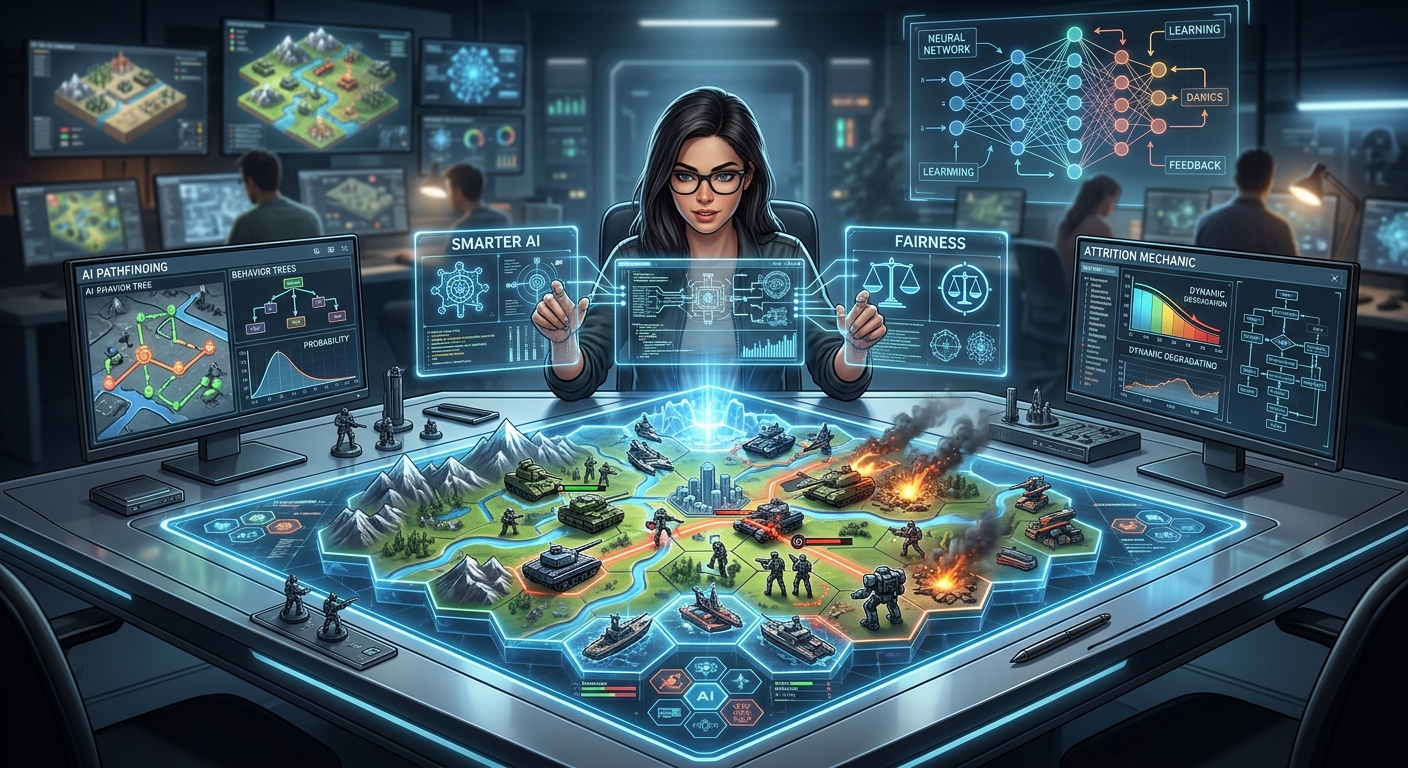
Turn-based fantasy strategy has a distinctive flavor: long campaigns, hard choices about sacrificing units, and a constant tug-of-war between safety and risk. Modern developers revisiting this classic formula are grappling with two intertwined challenges: how to make the AI feel smart without being punishingly perfect, and how to build combat that feels tense rather than random. A growing answer to both questions centers on two ideas: “fun AI” and attrition-based combat.
Drawing inspiration from the legacy of Heroes of Might and Magic and newer projects in that lineage, this article explores how those concepts shape player-versus-environment (PvE) difficulty, why they matter for long-form strategy campaigns, and what they can teach anyone designing—or simply appreciating—complex strategy games today.
From Killer AI to Fun AI: Rethinking PvE Opponents
Many older strategy games fell into a familiar trap: the AI was either painfully weak or brutally unfair. When designers talk about fun AI, they are trying to escape that binary. Instead of maximizing win rate at any cost, fun AI focuses on delivering interesting, readable, and occasionally forgiving behavior.
What Makes an AI “Fun” Instead of Frustrating?
A fun AI opponent typically has three defining traits:
- Competent but imperfect decision-making – It plays well enough to challenge you, but it leaves openings and makes human-like mistakes.
- Telegraphed intentions – Its priorities and behavior patterns are understandable, so you can plan around them.
- Respect for player investment – It avoids cheap tricks like omniscient scouting or infinite resources, especially in long campaigns.
In practice, this means deliberately capping AI optimization. Designers might:
- Limit how far ahead the AI plans.
- Restrict its knowledge to what it could reasonably “see” in the game world.
- Script occasional suboptimal moves to create opportunities for counterplay.
This philosophy aligns with modern game AI research that emphasizes believable, legible behavior over raw computational strength. For instance, many studios now favor behavior trees and utility-based systems precisely because they can encode priorities humans can interpret, rather than opaque, purely statistical approaches.1
Why Strategy Campaigns Need Fun AI
Fun AI becomes especially critical in campaign-style strategy games where players invest dozens of hours into building armies, developing heroes, and exploring massive maps. A single AI “gotcha” can invalidate that investment. By contrast, a balanced AI that sometimes misses lethal plays or chooses a suboptimal target creates memorable comebacks and dramatic escapes.
Games descended from the Heroes formula—and spiritual successors such as Olden Era—must solve this problem carefully. They often feature:
- Persistent heroes and units across multiple battles.
- Long attrition arcs, where early damage haunts you hours later.
- Exploration-heavy maps that reward risky scouting and opportunistic fights.
In this context, an AI that plays “perfectly” can feel less like a worthy opponent and more like an executioner. Fun AI is a way of tuning difficulty so that tension comes from your own strategic decisions, not from hidden bonuses or flawless computation.
Attrition as the Heart of Combat
One of the most distinctive features of classic Heroes-style games is that combat attrition matters. Losing units in an early battle might make a crucial future siege impossible. This stands in contrast to many modern tactics games where full or partial healing after battles is the norm.
What Is Attrition in Strategy Games?
In game design terms, attrition is the gradual loss of resources—usually units, hit points, ammunition, or mana—over multiple encounters. An attrition-centric game makes those losses meaningful and persistent:
- If you lose half your army in a “minor” skirmish, your next major fight becomes significantly harder.
- Consumables and limited-use abilities become precious tools, not spammed options.
- Retreat, avoidance, or clever positioning can be as valuable as winning outright.
Military theory reflects the same notion: attrition warfare seeks victory by gradually depleting the enemy’s capacity to fight rather than by a single decisive blow.2 Translating that into game mechanics creates a world where every battle is part of a bigger resource puzzle.
Why Attrition Feels So Satisfying
Players who love these systems often cite several reasons:
- Long-term consequences – Each decision echoes across hours of play.
- Meaningful risk assessment – You constantly weigh the value of immediate rewards against future vulnerability.
- Narrative tension – A battered army limping to a vital objective naturally tells a story.
Economic and game-theoretic research supports the idea that players engage more deeply when decisions balance present and future payoffs under resource constraints.3 Attrition-heavy designs tap directly into that tension: should you sacrifice units now for a powerful artifact, or preserve your strength for an unknown future threat?
How Fun AI Interacts With Attrition
Fun AI and attrition are tightly intertwined. If every unit loss truly matters over the long term, then:
- An AI that punishes any slip with total annihilation feels unfair.
- An AI that occasionally misplays gives you room to recover from mistakes.
Developers therefore often tune AI aggression, targeting priorities, and retreat logic with attrition in mind. For example, an AI might:
- Focus on threat level rather than always deleting your weakest stack.
- Break off a fight it’s clearly losing instead of fighting to the last unit, preserving a future challenge.
- Use resources like spells or consumables in ways that are strong but not fully optimized.
This keeps attrition significant without making every misstep fatal. Players still feel the sting of losses, but they also have a chance to mount comebacks and adapt their strategy around the AI’s recognizable habits.
Respecting the Heroes Legacy in Modern Design
Modern projects inspired by Heroes of Might and Magic, including Olden Era, are not trying to simply copy the past. Instead, they aim to capture the feel of those classics while adapting mechanics and AI behavior to contemporary expectations.
Key Elements of the Heroes-Style Formula
Games in this lineage typically share several pillars:
- Adventure maps filled with resources, monster stacks, and treasures.
- Hero-led armies with RPG progression and special abilities.
- Town building that unlocks new units and economic advantages.
- Turn-based tactical combat on a separate, grid-based battlefield.
Each of these elements interacts with attrition and AI:
| System | Attrition Impact | AI Considerations |
|---|---|---|
| Adventure Map | Exploration risks unit losses and resource expenditure. | AI must choose where to scout, when to contest pickups, and when to avoid strong guards. |
| Hero Progression | Power spikes can mitigate earlier attrition or exacerbate it if misbuilt. | AI should build coherent hero skill sets without perfect foresight. |
| Town Building | Recruitment choices determine how recoverable losses are. | AI must prioritize economic, tech, and unit structures in believable ways. |
| Tactical Combat | Unit deaths and spell use define long-term army strength. | AI should value trades, positioning, and retreat decisions with attrition in mind. |
When developers like Unfrozen talk about respecting the “old-school” feel, they are usually referring not just to art or tone, but to this interconnected system where each battle is one step in a long, attritional campaign.
Balancing PvE Difficulty Without Killing the Magic
One of the toughest tasks in Heroes-like games is balancing PvE. Players expect:
- Challenging neutral stacks that guard valuable resources.
- Enemy factions that grow over time and contest the map.
- Campaign scenarios that escalate without becoming unwinnable traps.
Developers must balance three levers: numerical stats, AI behavior, and scenario design.
Why Pure Number Tuning Isn’t Enough
Simply raising or lowering health, damage, or stack sizes can quickly break the delicate balance of an attrition-based game. Make neutrals too strong, and players feel forced into tedious grinding and save-scumming. Make them too weak, and the map turns into a trivial loot parade.
Instead, many teams favor softer, systemic adjustments:
- Rebalancing unit roles to reduce extreme outliers that trivialize content.
- Adjusting spell and ability costs to make decision-making more interesting.
- Designing mixed encounters that test positioning and target priority rather than raw stats.
Academic work on difficulty and flow in games supports this approach: players tend to stay most engaged when the challenge adapts to their increasing skill without sudden, opaque spikes.4
Scenario Design as a Balancing Tool
Campaign maps and scenarios provide another powerful way to tune difficulty. Designers can:
- Gate high-risk areas behind optional paths, allowing players to choose their level of risk.
- Introduce safe zones where players can rebuild after heavy losses.
- Script AI behavior to delay aggression early in a scenario, giving players time to stabilize.
This approach leverages fun AI: instead of an omnipresent threat that crushes you the moment you slip, AI opponents have defined pacing, territory preferences, and trigger conditions that players can learn.
Transparency, Telemetry, and Iteration
Modern developers can also draw on analytics and community feedback to refine their AI and attrition mechanics over time.
How Telemetry Informs Difficulty
Many studios now collect anonymized data on how players engage with PvE content. This can include:
- Where players most frequently lose campaigns or abandon saves.
- Which unit compositions or spell builds dominate successful runs.
- How often different difficulty modes are selected and completed.
By correlating these metrics with AI behavior and encounter composition, teams can identify problem spikes and nerfed content. This practice mirrors broader trends in analytics-driven game development, where telemetry guides balancing decisions without replacing hands-on testing.5
Community Feedback on Old-School Difficulty
Strategy communities tend to be vocal and detail-oriented. Developers embracing an “olden era” design style have to navigate nuanced expectations:
- Some players want brutally punishing campaigns reminiscent of classic PC games.
- Others prefer more forgiving experiences that maintain tension without requiring perfect play.
Fun AI and attrition systems allow developers to offer both, often through multiple difficulty modes and optional modifiers. For example, a higher difficulty might grant AI factions better economies and tighter tactical play, while lower settings could reduce attrition severity or make AI behavior more conservative.
Design Lessons for Players and Developers
Whether you are playing a Heroes-style game or designing your own strategy title, fun AI and attrition-centric combat highlight several enduring lessons.
For Players: Embrace the Long Game
In attrition-based campaigns, victory rarely hinges on a single battle. To thrive:
- Treat early losses as signals, not just failures. They reveal which threats you underestimated.
- Plan around AI habits. Once you understand how the AI prioritizes targets or objectives, you can bait mistakes.
- Value retreat and avoidance. Walking away from a tempting fight can save your run.
These habits turn what might otherwise feel like punishing difficulty into a strategic puzzle you can gradually solve.
For Designers: Prioritize Fairness Over Flawlessness
On the design side, fun AI and meaningful attrition suggest a guiding principle: players will accept losses if they feel they understand why they happened and believe they could do better next time. To support that:
- Make AI logic readable through consistent behavior patterns.
- Avoid invisible cheats that undermine the fantasy of a fair contest.
- Ensure encounters and maps offer multiple viable strategies, not just a single correct route.
When combined, these elements create the kind of campaign experience that strategy fans reminisce about for years: hard-fought victories, near-misses, and stories of battered armies that somehow pulled through.
Frequently Asked Questions
What exactly is “fun AI” in a strategy game?
Fun AI is an approach to AI design that prioritizes enjoyable, understandable behavior over maximum win rate. The AI is strong enough to challenge players but intentionally imperfect, avoiding opaque cheating and leaving room for creative counterplay.
Why do some turn-based games focus so much on attrition?
Attrition—persistent loss of units and resources—creates long-term tension and meaningful decision-making. In games where armies and heroes persist across many battles, every small loss shapes future encounters, making the campaign feel cohesive and high-stakes.
Can a game with heavy attrition still be accessible to newcomers?
Yes, if developers provide clear information, sensible difficulty options, and AI that behaves predictably rather than perfectly. Tutorial scenarios, tooltips highlighting risk, and less aggressive AI on lower settings can ease new players into attrition-focused systems.
How do developers stop PvE AI from feeling unfair?
They typically limit the AI’s knowledge to what it could reasonably see, avoid giving it extreme hidden bonuses, and design its behavior around priorities players can recognize. Some games also expose difficulty modifiers so players understand exactly how the AI is boosted, if at all.
Why are Heroes of Might and Magic-style games still influential today?
Their combination of adventure map exploration, hero progression, town building, and tactical combat creates a rich strategic loop. When paired with attrition-focused design and carefully tuned AI, these systems produce memorable, story-like campaigns that many modern players and developers still admire.
References
- Game Artificial Intelligence: Challenges and Opportunities — Yannakakis, G. N., Togelius, J. 2014-01-01. https://www.sciencedirect.com/science/article/pii/S000437021300162X
- US Army Doctrine Publication 3-0: Operations — U.S. Department of the Army. 2019-07-31. https://armypubs.army.mil/ProductMaps/PubForm/ADP.aspx
- Time Discounting and Time Preference: A Critical Review — Frederick, S., Loewenstein, G., O’Donoghue, T. 2002-06-01. https://www.jstor.org/stable/3210998
- Flow in Games — Sweetser, P., Wyeth, P. 2005-03-01. https://dl.acm.org/doi/10.1145/1077246.1077253
- Telemetric Data Collection and Game Analytics — Seif El-Nasr, M., Drachen, A., Canossa, A. 2013-01-01. https://link.springer.com/book/10.1007/978-1-4471-4769-5
Similar Articles





Read full bio of Sneha Tete