How Red Dead Redemption 2 Could Shape GTA 6
From cinematic gunplay to immersive NPC behavior, here’s how Rockstar’s Western epic could quietly power the next Grand Theft Auto.
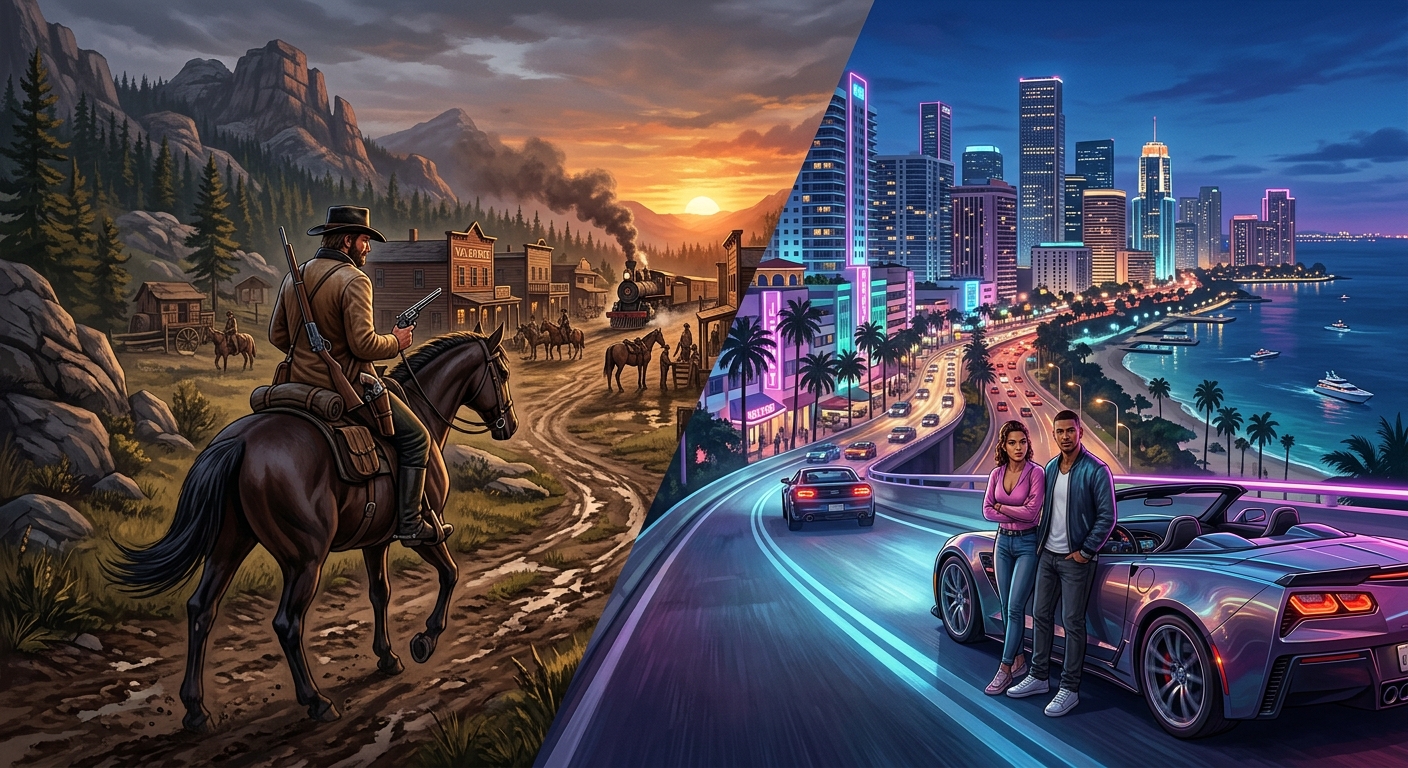
Rockstar Games has a long history of letting one blockbuster quietly inform the next. Systems debut in one title, get refined, then reappear in another game with a completely different tone and setting. With Red Dead Redemption 2 (RDR2) setting a new internal bar for immersion and detail, it’s reasonable to expect that Grand Theft Auto 6 (GTA 6) will borrow more than a few ideas from Rockstar’s open-world Western.
This article explores how design lessons, mechanics, and technology from RDR2 could influence GTA 6, drawing on Rockstar’s previous cross-pollination between franchises and the studio’s broader design philosophy.
Rockstar’s Habit of Reusing and Reinventing Systems
Rockstar rarely builds mechanics in isolation. The studio tends to:
- Introduce a new system in one game
- Observe how players use (or ignore) it
- Rework and reintroduce it in later titles
A clear historic example is the slow-motion targeting ability from the original Red Dead Redemption, which evolved into Michael’s bullet-time-esque special skill in GTA 5. This kind of mechanical migration is a pattern, not an exception.
Because both RDR2 and GTA 6 are built on iterations of Rockstar’s proprietary RAGE engine, many underlying systems—AI, physics, animation—are inherently portable between projects, making reuse not only likely but efficient from a production standpoint.
Core Ways RDR2 Could Influence GTA 6
While the thematic jump from dusty frontier to neon city might seem huge, the underlying design problems are similar: believable worlds, responsive NPCs, emergent gameplay, and narrative integration. RDR2 addressed these in several notable ways that GTA 6 can build on:
- Deeper AI-driven world simulation
- Layered, cinematic combat mechanics
- Persistent character and world states
- Diegetic storytelling tools like journals and camp life
| RDR2 Feature | Design Purpose | Possible GTA 6 Evolution |
|---|---|---|
| Contextual interactions with NPCs | Humanize the world, non-violent agency | Expanded city social interactions, crime setup opportunities |
| Honor system and reputation | Track morality and social response | Notoriety system tied to law, gangs, and media |
| Detailed environmental simulation | Immersion & emergent events | Dense urban systems: traffic, weather, crowds |
| Cinematic Dead Eye gunplay | Stylized yet readable combat | Modernized slow-mo or aim-assist abilities for urban shootouts |
| Evolving player journal | Diegetic recap & character insight | In-universe apps, social feeds, or vlogs tracking story |
NPC Behavior and World Simulation
RDR2 is renowned for world reactivity: NPCs respond to Arthur’s actions in nuanced ways, conversations escalate naturally, and small choices can ripple into later encounters. This level of simulation relies on complex AI behavior and world state tracking.
Official Rockstar interviews around both GTA 5 and RDR2 have emphasized how much effort goes into systemic world building rather than solely scripted events. For instance, Rockstar has described in developer features how its AI and physics components in RAGE are designed to support emergent situations without bespoke scripting in each case.1
Translating that to GTA 6’s urban environment could mean:
- Crowds remembering your previous disturbances in specific neighborhoods
- Store owners upgrading security after repeated robberies
- Gangs reacting differently based on how you treated individual members earlier
The more believable the city feels, the easier it is for Rockstar to deliver the cinematic chaos that the GTA series is known for, without relying exclusively on tightly scripted set pieces.
Combat, Gunplay, and Tactical Encounters
RDR2 refined firearm handling with weighty animations, clear feedback, and a paced, deliberate feel. Even when the action escalates, gunfights retain a grounded tone, and Dead Eye provides a cinematic layer of control.
GTA 6 doesn’t need to copy that pacing exactly—urban crime fiction traditionally leans more toward rapid, high-intensity engagements—but it can adopt RDR2’s commitment to readable, tactile combat. Improvements could include:
- More meaningful cover mechanics that integrate with destructible environments
- AI that flanks, retreats, and uses vehicles more intelligently in firefights
- Context-specific takedowns and movement, akin to RDR2’s contextual animation blending
Given that RAGE’s physics and animation systems are shared across Rockstar projects, iterative upgrades to recoil, bullet penetration, and hit reactions in RDR2 provide a strong foundation for GTA 6’s modern weapons and urban environments.2
Law Enforcement, Wanted Systems, and Notoriety
RDR2’s wanted system is more simulation-heavy than earlier GTA titles. Witnesses can report you, you can intimidate or eliminate them, and bounty hunters pursue you over time. This creates a sense that law enforcement is part of the world ecosystem rather than just a background threat.
For GTA 6, Rockstar has a chance to push the concept further. Thematically, a modern city’s law enforcement might incorporate:
- Surveillance cameras and drones instead of just patrolling officers
- Facial recognition-like systems in high-security areas
- Media coverage influencing your public image and police response
Improved AI can make police feel more strategically competent—blocking exits, coordinating perimeters, and escalating force in ways that feel more grounded in real-world tactics, which aligns with statements Rockstar has made in the past about striving for more believable law behavior in their worlds.3
Character Customization, Progression, and Daily Life
RDR2 leans heavily into Arthur’s daily routine: eating, sleeping, shaving, managing weight, and caring for his horse. While not every player wants that degree of micromanagement in GTA, the underlying idea—tying character stats and appearance into gameplay—could resonate in a crime sandbox.
Potential GTA 6 adaptations of RDR2’s simulation-heavy progression include:
- More robust skill and lifestyle systems tied to activities like driving, hacking, and combat
- Social hubs (cafés, gyms, clubs) that offer both stat benefits and narrative hooks
- Stronger linkage between how your character looks, what they own, and how NPCs treat them
Long-form progression systems are a proven engagement strategy in open-world games, as analyzed in multiple GDC talks where designers highlight how persistent character growth keeps players attached to the avatar and world.4
Storytelling Tools: From Arthur’s Journal to Digital Diaries
One of RDR2’s most beloved narrative devices is Arthur Morgan’s journal, which chronicles key events, sketches locations, and offers interior monologue. It’s both a recap tool and a character-deepening mechanic.
GTA 6, set in a modern era, has plenty of in-universe equivalents:
- Smartphone apps that log missions, side activities, and social relationships
- Video blogs or in-game social media posts that reflect the protagonist’s internal voice
- Message threads that recap plot beats in a diegetic way
These tools do more than summarize; they let Rockstar develop character without resorting to exposition-heavy cutscenes, aligning with broader industry trends toward environmental and diegetic storytelling observed by narrative designers across AAA projects.5
Mission Design and Open-Ended Problem Solving
RDR2 missions often blend linear sequences with pockets of freedom. While some players criticized heavy fail-states for deviating from prescribed paths, others appreciated the cinematic clarity. GTA 6 can learn from both the praise and the criticism.
Expect mission structures that:
- Retain big, authored set pieces for key story beats
- Offer more flexible approaches in setup and escape phases
- Leverage systemic world features (traffic, crowds, weather) as part of mission strategy
Rockstar has repeatedly highlighted in past commentary that their design philosophy balances authored narrative with systemic chaos. GTA 6 is well-positioned to lean harder into systemic problem solving, using RDR2’s toolset as a base and then loosening constraints where appropriate for GTA’s tone.
Vehicles, Traversal, and Environmental Diversity
RDR2’s horses are more than vehicles; they’re companions with their own stats and behaviors. That sense of relationship is harder to replicate with disposable cars, but the underlying tech—vehicle handling, physics interactions, and terrain response—translates well to GTA’s automotive core.
Improvements GTA 6 could inherit from RDR2’s traversal systems include:
- More meaningful differences between vehicle classes and conditions
- Terrain-aware driving physics (mud, water, weather, road surface)
- Persistent damage states that matter beyond pure visual flair
If GTA 6 includes coastal regions, swamps, or rural outskirts—as past entries and leaked maps have suggested for similar games—RDR2’s handling of off-road environments will be an invaluable template.
Multiplayer Foundations: Lessons for Future Online Modes
While the article that inspired this discussion focuses primarily on single-player design, any modern Rockstar release inevitably raises questions about its online component. RDR2’s Red Dead Online and GTA Online have provided Rockstar a long-running live service laboratory.
Key lessons that could flow into GTA 6’s multiplayer include:
- The appeal of role-focused activities (bounty hunting, trading) that give players defined identities
- The need for environmental and systemic depth to keep emergent play fresh over time
- The importance of balancing grind with meaningful progression and narrative hooks
Analysts have repeatedly highlighted the financial significance of GTA Online for Rockstar’s parent company Take-Two Interactive, making it highly likely that GTA 6’s systems will be designed with long-term online support in mind while still delivering a strong single-player experience.6
Why Borrowing from RDR2 Is Almost Inevitable
Given the shared tech stack, Rockstar’s history of iterating systems across titles, and the critical success of RDR2’s more simulation-oriented design, it would be surprising if GTA 6 did not incorporate at least some of that game’s key ideas. The challenge lies in adapting those systems to fit GTA’s faster, often more satirical flavor.
Ultimately, RDR2 provides GTA 6 with:
- A proven blueprint for deeper NPC behavior and world reactivity
- An upgraded foundation for combat and physics
- Refined approaches to narrative integration and character development
- Robust simulation systems that can be tuned up or down to suit different player tastes
If Rockstar continues its tradition of cross-pollination, GTA 6 may feel familiar in moment-to-moment gameplay yet surprising in how cohesive, alive, and reactive its city becomes—an urban evolution of the studio’s open-world cowboy epic.
Frequently Asked Questions
Will GTA 6 definitely reuse mechanics from Red Dead Redemption 2?
Nothing is guaranteed until Rockstar formally reveals detailed gameplay, but the studio’s track record strongly suggests that successful systems are rarely discarded. RDR2’s AI, animation, and world simulation are built on tech that is inherently reusable in GTA 6, making some level of mechanical inheritance highly likely.
Could GTA 6 have a morality or honor system like RDR2?
A one-to-one copy of RDR2’s honor system would clash with GTA’s more irreverent tone, but a notoriety or reputation mechanic that tracks how law enforcement, gangs, and the public perceive you fits the crime-focused setting and is a logical evolution of previous wanted and respect systems in the series.
Will GTA 6’s missions be less linear than Red Dead Redemption 2’s?
RDR2’s occasionally rigid mission fail-states were a common point of critique. GTA 6 has an opportunity to embrace more open-ended mission design, especially in a city where multiple routes, vehicles, and tools are available. Expect a mix of directed cinematic sequences and more systemic objectives.
Is Rockstar likely to carry over RDR2’s realism-heavy survival elements?
Some of RDR2’s more granular survival mechanics—such as regular eating or grooming—may be toned down or reframed in GTA 6 to avoid friction with the series’ faster pacing. However, the underlying idea of tying character condition and lifestyle to performance is likely to persist in some streamlined form.
How might RDR2 influence GTA 6’s online mode?
RDR2’s role systems, environmental simulation, and slower-paced emergent gameplay offer useful lessons for GTA 6’s eventual online component. Expect Rockstar to combine the economic and social success of GTA Online with some of RDR2’s more immersive, role-driven features.
References
- RAGE Technology Overview — Rockstar Games. 2018-10-26. https://www.rockstargames.com/reddeadredemption2/features/technology
- Red Dead Redemption 2: The Complete Official Guide — Piggyback/Take-Two Interactive. 2018-10-26. https://www.take2games.com
- Grand Theft Auto V: The Official Trailer and Game Info — Rockstar Games. 2013-09-17. https://www.rockstargames.com/V
- Designing Open Worlds: Systems, Stories and Making Them Work Together — Game Developers Conference. 2020-03-18. https://gdcvault.com
- Narrative in Open-World Games: Balancing Player Freedom and Authorial Control — MIT Game Lab. 2019-11-05. https://gamelab.mit.edu
- Take-Two Interactive Software, Inc. Annual Report — Take-Two Interactive. 2023-05-17. https://ir.take2games.com
Similar Articles




Read full bio of Sneha Tete