How to Play D&D in Zero Gravity
From spinning d20s in orbit to running a full campaign around the Moon, here’s how tabletop RPGs can actually work in space.
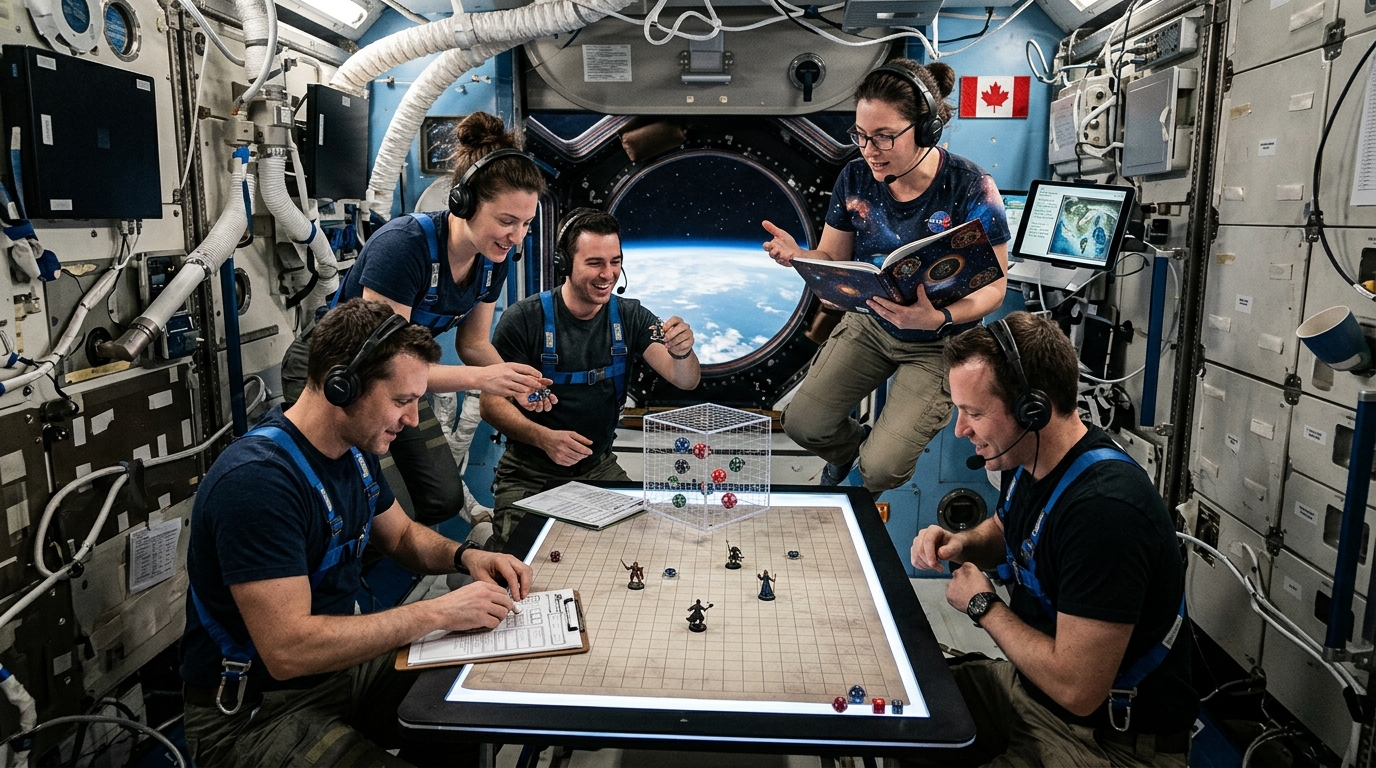
Thanks to a recent video from a real astronaut casually rolling a twenty-sided die in orbit, the idea of running a Dungeons & Dragons session in space has jumped from pure fantasy into the realm of practical questions. If a d20 can be rolled in microgravity, what else would you need to keep a campaign going aboard a spacecraft or a future lunar mission?
This article explores how tabletop roleplaying games like D&D can be adapted for life in orbit or on the way to the Moon. Drawing inspiration from the astronaut’s dice-rolling demonstration, we’ll look at physical constraints, clever gear, rules tweaks, and even campaign ideas that make the most of a real space setting.
Why D&D in Space Isn’t Just a Joke
Board games and card games have already made it into orbit. NASA has long recognized that fun, social activities help crews manage stress and maintain morale during missions.1 Astronauts aboard the International Space Station (ISS) regularly watch movies, take photos, and play games as part of their off-duty time. A tabletop RPG is, at its core, a structured group storytelling exercise, which fits well with those goals.
On longer missions—whether to lunar orbit through NASA’s Artemis program or eventually to Mars—psychological health becomes even more important. The Human Research Program has identified behavioral health and team cohesion as critical risks for long-duration spaceflight.2 Cooperative games like D&D offer:
- Shared narrative focus that pulls the crew together around a non-work goal.
- Stress relief via humor, imagination, and roleplay.
- Cognitive training through problem-solving and improvisation.
So while a spacefaring D&D session sounds like a meme, it’s surprisingly aligned with serious research into how to keep astronauts healthy and effective on long missions.
The Physics Problem: Rolling Dice Where There’s No Down
On Earth, rolling dice is trivial: you drop them on a flat surface, they bounce, and gravity takes care of the rest. In orbit, with microgravity, that basic assumption disappears. Dice don’t land; they drift. Without careful control, you’d get a slow explosion of polyhedral plastic tumbling through the cabin.
The astronaut demonstration shows that you can simulate a roll by giving the die a spin and then catching it in your hand, reading the visible face. That simple technique hints at a broader principle: in microgravity, the roll is less about a surface and more about imparting rotational energy and then constraining the die again.
Practical Zero-G Dice Techniques
Here are a few realistic, spacecraft-safe options for resolving random results:
- Spin-and-catch – Flick the die with your thumb to make it spin, then close your hand around it. The uppermost face visible between your fingers (or when you open your hand again) is the result.
- Dice bag roll – Place the die in a small, transparent pouch, shake it, then stop and press the bag against a surface. The face touching the film or fabric is your roll.
- Contained tube roll – Use a clear cylindrical tube with soft bumpers at each end. Shake the tube, then let the die settle against one end. The face oriented toward a marked viewing window is the result.
- Digital backup – For missions where every gram matters, a digital dice roller on a tablet is a practical backup, especially during busy phases of the mission.
Comparing Zero-G Dice Methods
| Method | Pros | Cons | Best Use |
|---|---|---|---|
| Spin-and-catch | Very tactile and fun; no extra gear | Needs practice, risk of dice drifting away | Short, casual sessions with experienced crew |
| Dice bag roll | Dice contained; easy to share; quiet | Less dramatic; can be fiddly to read | Routine game nights in cramped modules |
| Contained tube roll | Very controlled; good for filming | Requires custom hardware; single die at a time | Public outreach or demonstration games |
| Digital dice | Zero physical clutter; highly reliable | Less tactile; depends on power and devices | Backups during busy or high-risk mission phases |
Making Gear Space-Friendly
Spacecraft are hostile to clutter. Loose objects can lodge in vents, bump sensitive panels, or become hazards during contingency maneuvers. Any tabletop game in orbit has to be ruthlessly compact, safe, and easily stowed. NASA’s own stowage and configuration practices emphasize minimizing free-floating items and securing everything to labeled locations.3
Lightweight, Compact Components
A space-ready D&D kit might include:
- Single shared set of dice in a tethered bag, rather than separate sets for each player.
- Micro-sized character sheets, laminated and written with erasable markers.
- Softbound or digital rulebooks instead of hardcovers, perhaps limited to the essentials.
- Elastic-banded notebooks for the Dungeon Master (DM) to keep notes and maps secure.
Securing Everything
Most spacecraft already use Velcro, bungee cords, and soft pouches to secure equipment. That same philosophy applies to a tabletop RPG kit:
- Attach Velcro strips to pens, bookmarks, and dice bags and pair them with Velcro patches near the crew’s rest area.
- Use clipboards with straps or elastic corners to anchor character sheets against knees or walls.
- Consider magnetic tokens and a thin metal board if minis or mapping are important to the group.
Because debris in spacecraft can be dangerous, any tokens, dice, or small props should be sturdy, rounded, and large enough not to vanish into vents or grate openings.
Scheduling a Campaign Around Real Missions
Time aboard any spacecraft is at a premium. Crew schedules on the ISS are carefully choreographed with work tasks, exercise, maintenance, and sleep.4 A D&D campaign would have to fit neatly into approved off-duty windows, without interfering with required rest.
Short Sessions, Long Story
Instead of four- or five-hour marathons common on Earth, a space campaign would likely use:
- 60–90 minute sessions, matching typical recreational blocks late in the “day”.
- Episodic adventures that each deliver a satisfying mini-plot without needing long sessions.
- Asynchronous planning, where players jot down downtime actions or character thoughts between sessions.
This pacing works well with the structured nature of missions like Artemis, which will involve specific phases such as launch, translunar coast, lunar orbit, and return.
Using the Mission Timeline as a Story Skeleton
One clever approach is to mirror the real mission phases inside the campaign:
- Play a prologue session during pre-flight quarantine, setting up characters and their home base.
- Run exploration-focused episodes during transit days, when the crew has more consistent free time.
- Pause or switch to lighter, low-stakes scenes during critical mission operations (like lunar orbit insertion or EVA days).
- Finish with a post-mission epilogue back on Earth, potentially with friends and family joining in as NPCs.
Designing Adventures for Astronaut Players
If you’re an astronaut—or simply roleplaying one at your home table—using a real space mission as the backdrop adds a unique twist. You can run a traditional fantasy campaign, but many crew members might enjoy a setting that reflects their real environment.
Three Setting Styles for Spaceborne D&D
- Classic fantasy in space – Dragons in the asteroid belt, spelljammers around Mars, dwarven foundries on the Moon. This lets players disconnect from work while still enjoying the novelty of playing in orbit.
- Near-future sci-fi – Slightly fictionalized versions of the ISS, Artemis spacecraft, or lunar bases. Players deal with alien microbes, rogue AI, or political intrigue among space agencies.
- Metafictional campaign – The players portray versions of themselves on a mission, with the game blending real schedules and events into the story. Game events might even reference actual daily challenges.
Sample Story Hooks for a Lunar-Orbit Campaign
Here are a few prompts that could drive a campaign played during a mission around the Moon:
- Silent Anomaly – While in lunar orbit, the crew intercepts impossible radio transmissions coming from the Moon’s far side: voices speaking an unknown language that somehow use the players’ names.
- The Broken Archive – A derelict orbital station drifts near the Moon, filled with ancient data crystals. The party must explore its haunted corridors before the orbit decays.
- Mirror Mission – The ship passes through a strange spatial distortion, and the crew encounters distorted doubles of themselves with conflicting objectives.
Rules Tweaks for Gaming in Microgravity
Running D&D in space doesn’t demand a new rule system, but a few adjustments can make play smoother and more immersive, especially with limited time and space.
Streamlining Mechanics
- Use average damage for many NPC attacks to reduce dice rolling overhead.
- Adopt simplified initiative (players act as a group, then enemies) to keep combat moving.
- Pre-roll resources such as wild magic surges or wandering monsters between sessions and jot the results in the DM’s notebook.
In-Game Physics: Microgravity as a Narrative Tool
If your setting includes zero-gravity environments, you can incorporate them into the rules for thrilling set-pieces:
- Characters make Athletics or Acrobatics checks to push off surfaces and change direction.
- Firearms, magic blasts, or recoil might propel characters backward if they’re not anchored.
- Spells like Feather Fall or Fly interact differently in microgravity, perhaps granting finer directional control rather than simple falling speed reduction.
For astronauts, these details may resonate strongly with their daily experience of using handrails, footholds, and careful momentum control aboard spacecraft.
Public Outreach: Streaming a Game from Orbit
Space agencies and commercial partners increasingly use social media and live events to connect the public with ongoing missions. ESA, NASA, and others have streamed live Q&As and educational segments from the ISS.5 A short D&D session broadcast from lunar orbit would be a powerful outreach tool, mixing science, education, and fandom.
Potential Benefits
- Inspiring younger audiences by showing that astronauts enjoy the same hobbies as many of their fans.
- Demonstrating microgravity physics in a fun, accessible way—such as showing the spin-and-catch dice technique.
- Highlighting teamwork and communication, both critical to spaceflight and core to cooperative games.
Technical Considerations
A streamed game would need to fit within the mission’s communication and bandwidth constraints, with contingency plans for dropouts or signal delays. Pre-recording sessions for later broadcast could provide more flexibility while still giving viewers a genuine look at life and leisure in space.
FAQs: D&D Beyond Earth
Can astronauts actually bring physical dice into space?
Yes, provided the items meet mission safety and stowage requirements and are approved as personal effects. Objects must be safe, non-fragile, and easy to secure so they don’t interfere with equipment or airflow.
Is rolling dice with a spin-and-catch motion fair?
As long as the die is well-balanced and the spin is vigorous and not deliberately controlled to influence a face, the result should be effectively random. The key is to treat every roll the same way and avoid techniques that obviously favor certain outcomes.
Would agencies allow regular tabletop sessions during missions?
Space agencies already allocate recreational time to help maintain crew mental health. A tabletop RPG could fit into that as long as it doesn’t affect required rest, operations, or safety. Ultimately, it would be up to mission planners and the crew’s own preferences.
Do you need special “space rules” to play D&D in orbit?
No new rules are strictly necessary. The existing game works fine with minor practical tweaks such as streamlined combat and contained dice rolling. Optional house rules can add flavor by modeling microgravity movement or vacuum hazards if they suit the group’s tastes.
Could a space D&D campaign help with real mission training?
It’s not a substitute for formal training, but collaborative games can strengthen communication, problem-solving, and trust. In that sense, a campaign could complement other team-building activities, though it would primarily be classified as recreation rather than training.
From Cabin Table to Command Module
The sight of a d20 tumbling gracefully in microgravity is more than a viral clip: it captures how human culture adapts to new frontiers. Wherever people travel, they bring stories, games, and rituals along for the ride. A D&D campaign aboard a lunar mission would be a playful extension of that tradition—part morale booster, part public outreach, and part celebration of imagination.
For now, most of us will keep our dice firmly planted on earthly tables. But thanks to astronauts experimenting with zero-g dice techniques, the path is clear: when humanity sails out to the Moon and beyond, the polyhedrals can come along for the journey.
References
- Psychological Support — NASA. 2016-03-31. https://www.nasa.gov/hrp/elements/bhp/psychological-support/
- Human Research Program: Behavioral Health and Performance — NASA. 2024-01-10. https://www.nasa.gov/human-research-program/elements/bhp/
- Life Aboard the International Space Station — NASA. 2020-07-09. https://www.nasa.gov/mission_pages/station/expeditions/expedition30/tryanny.html
- Space Station User’s Guide: Stowage and Inventory — NASA. 2015-05-01. https://www.nasa.gov/sites/default/files/atoms/files/iss_user_guide.pdf
- International Space Station Daily Timeline — NASA. 2022-11-18. https://www.nasa.gov/mission_pages/station/living/index.html
- European Space Talks & Outreach from Space — European Space Agency (ESA). 2021-10-12. https://www.esa.int/Education/Education_office/ESA_Astronauts_and_Education
Similar Articles




Read full bio of Sneha Tete