Jak 3’s Fan PC Port Completes Naughty Dog’s Lost Trilogy
A community-made Jak 3 PC build rounds out the OpenGOAL project, bringing Naughty Dog’s full PS2 trilogy to modern computers.
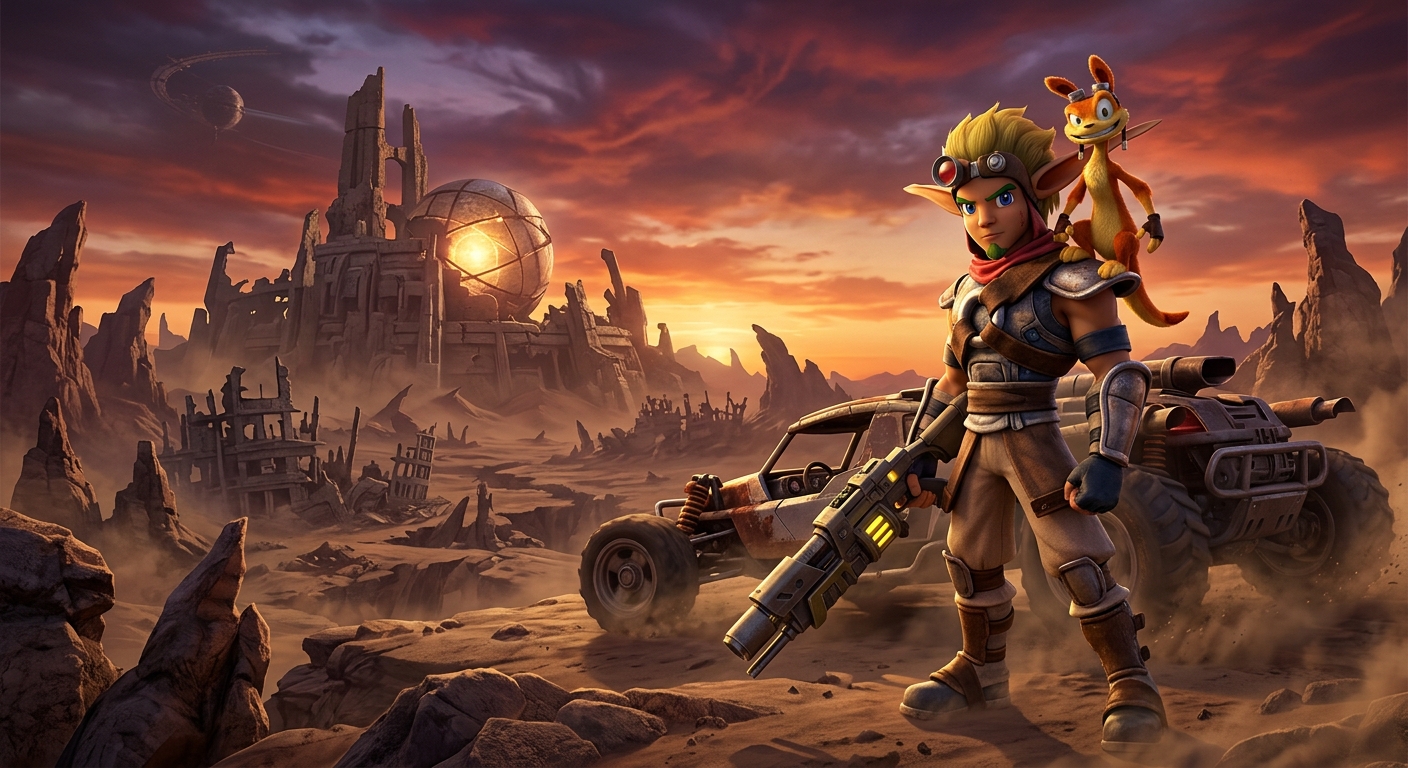
The PlayStation 2 era produced some of the most beloved 3D platformers ever made, and the Jak and Daxter trilogy by Naughty Dog is often cited as one of that generation’s highlights. For years, though, the series has been awkward to play on modern hardware, with no official native PC versions in sight. That gap has now effectively been closed by fans: a new native PC port of Jak 3, built on the community-driven OpenGOAL project, has entered beta, meaning the entire original trilogy is now playable on PC with higher resolutions, improved performance, and mod support.
This article explains what the Jak 3 PC port is, how OpenGOAL works, what you need to use it legally, and why this fan effort matters for game preservation and for the future of retro platformers on modern systems.
From PS2 Classic to Modern PC: How We Got Here
Before looking at the specifics of Jak 3’s port, it helps to understand how these games lived on after their PS2 debut.
- Original platform: The Jak and Daxter trilogy launched on PlayStation 2 between 2001 and 2004, pushing Sony’s hardware with large open levels, fast loading, and cinematic storytelling.
- Later releases: Sony later repackaged the games for PS3 and PS Vita via an HD collection and made them playable on PS4 and PS5 through emulation and streaming-style offerings.
- Missing piece: Despite Naughty Dog’s profile as a premier PlayStation studio, these titles never received official native PC ports, unlike some other Sony-published series in recent years.
That absence led enthusiasts to take matters into their own hands, resulting in the OpenGOAL project, a long-term effort to understand the technology behind the trilogy and recreate it in a way that runs natively on modern PCs.
What Is OpenGOAL and Why Does It Matter?
OpenGOAL is a fan project aimed at reimplementing the engine used by the original Jak and Daxter games and recompiling them to run as native executables on modern machines. Rather than attempting to emulate the PS2’s hardware, it focuses on the programming language and tooling Naughty Dog used internally.
The technical idea in plain language
In the PS2 era, Naughty Dog created its own Lisp-like language called GOAL (Game Oriented Assembly Lisp) for development. The OpenGOAL team has been reverse-engineering that environment and building a compatible toolchain that can:
- Read the game’s original data from a legally obtained PS2 disc image (ISO).
- Translate the original GOAL code into a modern-language reimplementation.
- Compile that into a PC-native executable that no longer depends on PS2 hardware.
Technically, this approach is closer to a re-compilation and engine reimplementation than traditional emulation. Emulation simulates the original console; OpenGOAL instead re-creates the game logic in a new environment.
How the trilogy came to PC via OpenGOAL
OpenGOAL’s work has been incremental:
- Jak and Daxter: The Precursor Legacy received a fan PC port first, serving as the proof of concept for the toolchain.
- Jak II followed, addressing a much more complex game with larger environments and more systems.
- Jak 3 is the latest milestone, now publicly available in beta as a native PC build.
Each step not only made another game playable on PC but also strengthened the project’s understanding of Naughty Dog’s original tech.
Jak 3 PC Port in Beta: What Players Get Right Now
The newly released Jak 3 PC port is described as a beta, meaning the core content is playable from start to finish, but some rough edges and bugs remain. It is built on the same OpenGOAL launcher and pipeline used for the earlier games in the trilogy.
Notable benefits over the PS2 original
Players who have tried earlier OpenGOAL releases will recognize many of the improvements that Jak 3 now inherits:
- Native PC performance: The game is freed from PS2 frame-rate limitations, allowing higher and more stable FPS on modern hardware.
- High-resolution support: You can run Jak 3 at 1080p, 1440p, 4K, ultrawide resolutions, and beyond, depending on your display and GPU.
- Mod support: OpenGOAL integrates with community mod lists, letting players tweak visuals, gameplay, and quality-of-life behavior.
- Modern input options: The PC launchers support a range of controllers and keyboard/mouse setups, with customizable bindings.
Because it is still in beta, some visual or audio glitches, minor scripting issues, or performance wrinkles may appear. Feedback from early adopters helps the team fix and refine the port over time.
Feature comparison at a glance
| Version | Platform | Resolution | Frame Rate | Mod Support |
|---|---|---|---|---|
| Original Jak 3 | PlayStation 2 | Standard definition | Target ~30 FPS | No |
| HD Collection / Emulated | PS3, PS4, PS5 | Higher than PS2, but limited | Varies by platform/emulation | No official modding |
| OpenGOAL Jak 3 Beta | Windows / PC (native) | Up to 4K+ depending on hardware | Higher and more stable FPS, user-configurable | Yes, via community mod lists |
Legal Use: You Still Need Your Own Jak 3 Copy
Projects like OpenGOAL intentionally avoid distributing copyrighted content. To use the Jak 3 PC port, players must provide their own copy of the original PS2 game.
How the launcher stays within legal bounds
The OpenGOAL launcher and associated tools are downloadable for free and do not contain game data. To play:
- You obtain a legally owned copy of Jak 3 for PS2.
- You create a disc image (ISO) of that game using your own hardware.
- You point the OpenGOAL launcher to the ISO, which extracts the needed assets and compiles its native build.
This separation between open-source tools and proprietary assets aligns with legal advice typically given to fan projects involving reverse engineering and game preservation. Courts in the United States have recognized that certain forms of reverse engineering can be fair use when undertaken for compatibility purposes, provided no copyrighted assets are redistributed.
How to Get Started with the Jak Trilogy on OpenGOAL
While this article does not host or link to any copyrighted game files, it can outline how the general process works so you know what to expect.
Typical setup steps
The exact steps may evolve, but broadly you can expect the following workflow:
- Visit the official OpenGOAL website to download the launcher for your platform.
- Install or unpack the launcher to a folder with sufficient disk space.
- Ensure the launcher and its tooling are updated to the recommended versions.
- Prepare ISOs of the Jak and Daxter games that you legally own on PS2.
- Use the launcher’s “install from ISO” (or equivalent) option to build each game.
Once the process completes, you should be able to launch each game directly from the tool, configure graphics and input options, and begin playing.
Modding and community additions
One of the defining strengths of OpenGOAL is its mod ecosystem. Many launchers integrate a curated list of mods hosted on community sites, making it straightforward to enhance or experiment with the trilogy:
- Visual tweaks: Color correction, sharper UI elements, and texture adjustments.
- Gameplay adjustments: Balance changes, difficulty options, or minor mechanical tweaks.
- Quality-of-life fixes: Skippable cutscenes, updated camera behavior, or additional control options.
Installing mods typically involves enabling an official mod list URL in the launcher and choosing the mods you want from a menu rather than manually editing files.
Why This Trilogy Is Often Called Underrated
Despite being developed by the same studio that later created Uncharted and The Last of Us, the Jak and Daxter trilogy is sometimes considered overlooked compared to other platforming legends like Mario or Ratchet & Clank. The arrival of Jak 3 on PC offers an opportunity to revisit what made these games special.
Evolution across three games
- Jak and Daxter: The Precursor Legacy: A bright, fast-paced platformer with minimal loading, focusing on collecting, jumping, and light combat.
- Jak II: A darker, more story-driven sequel with open-city exploration, vehicles, and a stronger narrative edge.
- Jak 3: A hybrid of the two prior entries, combining wild wasteland exploration, vehicle combat, platforming, and cinematic storytelling.
This trajectory from classic mascot platformer to open-world action game gives the trilogy a distinct identity that still stands out today.
Preservation and access for new players
Modern game preservation advocates often highlight how difficult it can be for new generations to experience older titles on current hardware. A 2023 study by the Video Game History Foundation and the Software Preservation Network found that roughly 87% of classic games released in the United States are out of print and not commercially available in any form. While the Jak trilogy has seen re-releases, those console-only options still limit access for PC-focused players.
Community-driven projects like OpenGOAL help bridge that gap, enabling people with legal copies of the games to experience them on current systems with modern conveniences. This does not replace the role of official re-releases, but it shows how committed fans can contribute to keeping older works playable.
The Broader Trend: Fan Ports and Recompilation Projects
OpenGOAL is part of a broader movement of fan-led efforts to keep older games alive through reverse engineering, engine reimplementations, and open-source tools. Examples include OpenRW (attempting to recreate the engine for Grand Theft Auto III) and projects like ScummVM, which reimplements classic adventure game engines so they can run on modern hardware.
These projects operate in a complex legal and technical environment. Developers often ensure they distribute only original code and tools, leaving users to supply their own assets. Some rights holders have tolerated or even quietly benefited from such efforts, as they can increase interest in dormant franchises. Others have taken a more aggressive stance, issuing takedown notices or legal threats.
The Jak 3 OpenGOAL port arrives at a time when more publishers are experimenting with PC releases of formerly platform-exclusive games. Sony has gradually brought series like Horizon, God of War, and Spider-Man to PC. Yet many classics from the PS2 catalog remain unavailable. Fan projects therefore fill a niche: they serve existing fans who already own the games and want a better way to play them, and they generate renewed conversation about forgotten series.
Potential Risks and Limitations
As promising as OpenGOAL’s Jak 3 port is, players should keep a few caveats in mind:
- Beta status: Expect occasional bugs, missing features, or compatibility issues. The port will likely improve over time as more people test it.
- No official support: This is an unofficial project, so patches and help come from volunteers rather than a commercial publisher.
- Legal uncertainty: While the project takes steps to avoid distributing copyrighted content, the legal landscape around reverse engineering and fan ports can change, and rights holders may still object.
- Hardware variation: Performance and stability can vary widely depending on your PC configuration, drivers, and operating system.
Anyone trying the port should be comfortable troubleshooting, reading community documentation, and backing up their data.
What Jak 3 on PC Means for the Future of Classic Platformers
Jak 3’s native PC port is more than just another way to replay a beloved game. It symbolizes a broader shift in how players engage with console-era titles:
- Higher technical expectations: Many players now expect classic games to support high resolutions, high frame rates, and customization options rather than being locked to their original specs.
- Mod-friendly ecosystems: Even console-originating franchises benefit from PC-like modding scenes that can fix issues, rebalance mechanics, or add new content.
- Community stewardship: When official support is absent or limited, dedicated fans can help keep franchises alive and relevant.
In the specific case of Jak and Daxter, the OpenGOAL trilogy may become the de facto way many players experience the series going forward, particularly those who primarily game on PC. It also demonstrates the viability of GOAL-focused reverse engineering, which could, in principle, enable future work on related titles—though that would require time, resources, and careful navigation of legal boundaries.
Frequently Asked Questions
Is the Jak 3 PC port official?
No. The Jak 3 PC port is an unofficial fan project built on the OpenGOAL toolchain. It is not developed, endorsed, or supported by Naughty Dog or Sony.
Do I need to own Jak 3 on PS2 to use this port?
Yes. To stay within legal boundaries, you must supply your own PS2 disc image (ISO) of a copy you own. The OpenGOAL launcher only provides the tools and engine reimplementation, not the game data itself.
Is the Jak 3 PC port finished?
The port is currently in beta. The game is playable, but you may encounter bugs, incomplete features, or compatibility issues that will likely be refined in future updates.
Which platforms can run the Jak trilogy via OpenGOAL?
The tooling primarily targets modern PCs. Support may vary by operating system and hardware, but Windows is widely used. Compatibility for other platforms depends on community contributions and ongoing development.
Is it safe to use the OpenGOAL tools?
As with any community software, you should download the launcher only from the project’s official site, follow documentation, and use antivirus or security tools you trust. The project is open-source, which allows technically inclined users to review the code.
References
- Sony Computer Entertainment America Inc. v. Connectix Corp. — U.S. Court of Appeals for the Ninth Circuit. 2000-02-10. https://law.justia.com/cases/federal/appellate-courts/F3/203/596/479862/
- Preserving Play: Does the videogame industry have a preservation problem? — Video Game History Foundation & Software Preservation Network. 2023-07-18. https://gamehistory.org/games-vanishing-report/
- ScummVM Documentation: About ScummVM — ScummVM Team. 2024-01-15 (accessed). https://www.scummvm.org/documentation/
- PlayStation games on PC — PlayStation (Sony Interactive Entertainment). 2024-03-01 (accessed). https://www.playstation.com/en-us/games/pc-games/
Similar Articles





Read full bio of medha deb