PopCorn Duel: A New Retro Quest for the Sega Genesis
How Alone in the Dark creator Frédérick Raynal is reviving a 1988 DOS brick-breaker on Sega Genesis with bespoke spinner controls.
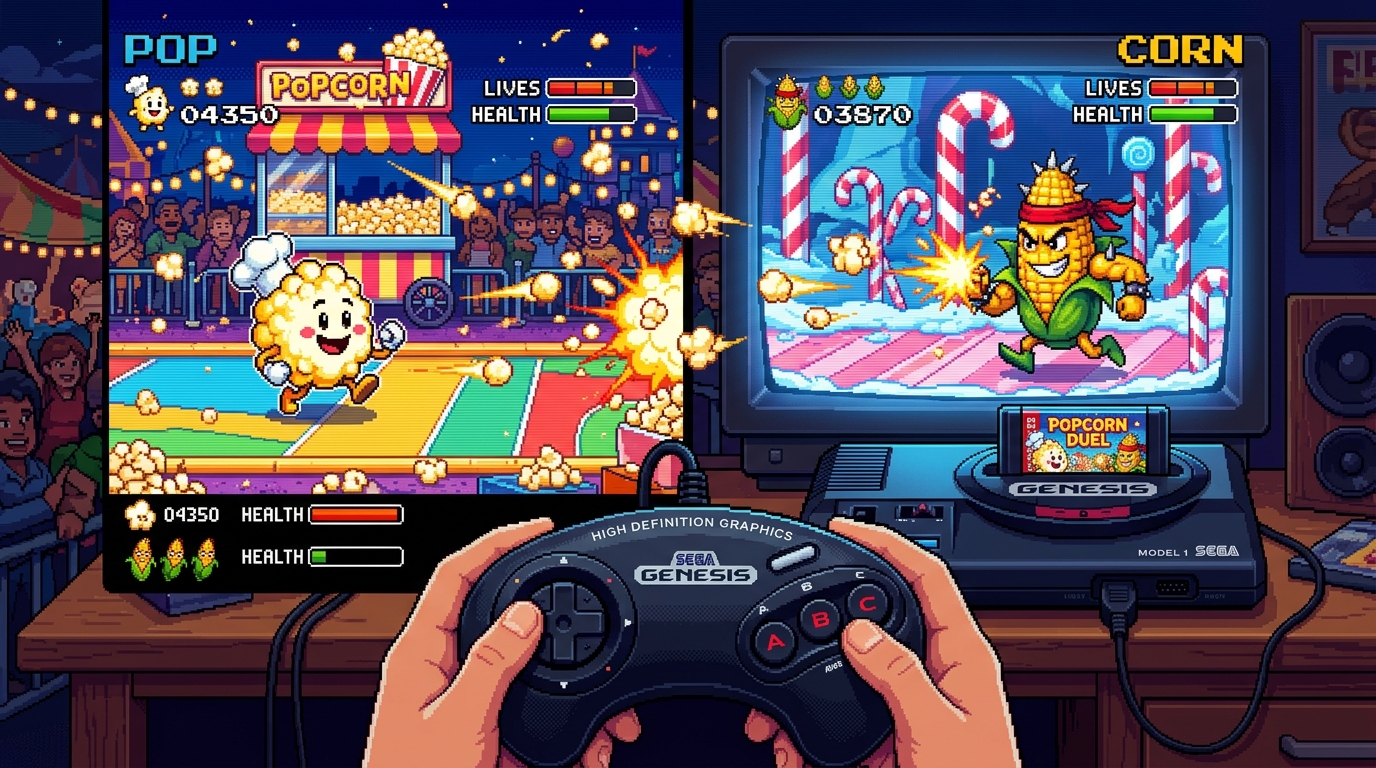
More than three decades after helping define survival horror with Alone in the Dark, designer Frédérick Raynal has turned back the clock to an even earlier chapter of his career. He is revisiting PopCorn, a 1988 MS‑DOS brick‑breaker, and reimagining it as PopCorn Duel for the Sega Mega Drive / Genesis. Rather than shipping as a simple ROM, the project is tied to a crowdfunding campaign and comes bundled with its own bespoke spinner controller, designed to recreate and update the feel of arcade paddle games on a 16‑bit console.
This article explores the project’s roots, the hardware twist that sets it apart, and what it reveals about the changing nature of retro game development and physical releases.
From DOS Shareware to 16-bit Revival
The original PopCorn on PC
Before Alone in the Dark brought Raynal to international prominence, he worked on a number of smaller games, including PopCorn, a Breakout-style brick‑breaker released on MS‑DOS in the late 1980s. Brick‑breaker titles were a staple of home computing in that era, extending the arcade formula popularised a decade earlier by Atari’s Breakout and Super Breakout in the mid‑1970s.1
On PC, PopCorn followed this lineage:
- A horizontally moving paddle at the bottom of the screen.
- A ball that ricochets around the playfield, breaking tiles on impact.
- Power‑ups and varied layouts to keep stages distinct.
It was a modest, fast-paced action game, but one that helped Raynal refine his understanding of timing, collision, and user feedback—skills that would later prove vital in the leap to 3D horror.
Why return to PopCorn now?
Raynal’s decision to revisit PopCorn decades later fits into a wider pattern in game development: creators returning to formative works with fresh tools and experience. In his case, the motivations are layered:
- Personal heritage: PopCorn predates his best‑known titles and offers a chance to share an earlier, more arcade‑like side of his work.
- Retro hardware appeal: The Sega Genesis / Mega Drive remains one of the most actively supported retro platforms, with new physical releases and homebrew projects.
- Hardware experimentation: The project’s unique spinner controller suggests a desire not just to port an old game, but to explore new ways of interacting with old systems.
The result is PopCorn Duel, a reimagining tailored to Sega’s 16‑bit console and to competitive play.
PopCorn Duel: Brick-Breaking Reimagined
Core concept and gameplay
PopCorn Duel builds on the brick‑breaker foundation but shifts the focus toward head‑to‑head competition. While details can evolve during development, its central ideas include:
- Simultaneous two‑player action: Both players control paddles, vying to control the ball’s trajectory and outlast their opponent.
- Competitive twists: Bricks and power‑ups can influence both sides of the screen, potentially turning defense into offense.
- Fine‑grained control: The custom spinner hardware (more on that below) enables precise angle and speed control that is hard to match with a standard D‑pad.
In essence, PopCorn Duel aims to turn a traditionally solitary arcade mechanic into a multiplayer contest, echoing the spirit of classic competitive arcade cabinets while running on home hardware.
Why Genesis / Mega Drive?
The choice of Sega’s 16‑bit machine is not arbitrary. The console enjoys a particularly strong homebrew and enthusiast scene, with developers still releasing new titles on cartridge decades after the platform’s commercial life ended. Enthusiast interviews and retrospectives consistently note the Mega Drive’s persistent fan base and continued production of new physical games.2 For a project like PopCorn Duel, this matters for several reasons:
- Technical familiarity: The hardware is well documented, and development tools are widely available.
- Collector culture: Many fans actively seek new boxed Genesis releases to sit alongside their 1990s collections.
- Global reach: The platform is known as Mega Drive in many territories and Genesis in North America, offering broad nostalgic recognition.
By targeting this platform, PopCorn Duel taps into a ready‑made audience eager for new experiences on original hardware.
The PopCorn Spinner: A New Take on Paddle Controls
Why a spinner controller?
One of the defining choices of PopCorn Duel is the decision to ship the game with a proprietary spinner controller, sometimes referred to informally as the “PopCorn Spinner.” Spinner and paddle inputs have deep roots in arcade history. Games such as Pong and Breakout relied on rotary dials that offered smooth, analog movement across the screen.3 Unlike digital buttons, these controllers let players make minuscule adjustments at high speed.
On the Genesis, most paddle‑like experiences rely on the standard D‑pad or analog adapters. By designing a dedicated spinner, Raynal’s project aims to:
- Replicate the tactile feel of 1970s–1980s arcade machines.
- Give PopCorn Duel a distinct identity among Genesis titles.
- Enable a control scheme tailored precisely to brick‑breaker mechanics and competitive play.
Design goals and considerations
While full technical specifications may evolve, several design goals are typical for custom spinner interfaces on retro consoles:
- Low latency: Input must translate immediately into paddle movement to maintain a responsive feel.
- Durability: Brick‑breakers encourage abrupt, repetitive movements; the hardware must withstand frequent use.
- Console compatibility: The spinner needs to present itself to the Genesis as a valid controller device, usually by emulating expected signals.
- Accessibility: Ideally, the controller should remain usable by players with differing levels of dexterity and experience.
Because PopCorn Duel includes spinner controllers as part of its pitch, the hardware isn’t a peripheral afterthought; it is integral to the game’s identity.
| Feature | 3-Button Genesis Pad | PopCorn Spinner (Concept) |
|---|---|---|
| Primary Input Type | Digital D-pad | Rotary encoder / spinner |
| Movement Resolution | Discrete steps left/right | Smooth, fine-grained rotation |
| Ideal for | Platformers, action games | Brick-breakers, pong-likes, fine aiming |
| Tactile Sensation | Thumb-based directional presses | Hand-controlled dial turning |
Crowdfunding a New Physical Genesis Release
Why Kickstarter for a retro project?
PopCorn Duel’s route to players is through crowdfunding, reflecting a wider industry pattern. Platforms such as Kickstarter have become common for independent developers, especially when physical production and custom hardware are involved. Research on crowdfunding in gaming notes that it allows creators to validate demand before incurring manufacturing costs and to involve a community early in development.4
For a project like PopCorn Duel, crowdfunding serves several purposes:
- Gauge interest: Not every retro fan owns or uses a Genesis in 2026; pledges indicate how many players want a physical cartridge and hardware.
- Fund manufacturing: Producing bespoke controllers, cartridges, and boxes requires upfront funding and minimum order quantities.
- Offer tiered rewards: Backers can choose between ROM-only, cartridge‑only, or bundles including spinners and extras, depending on the campaign design.
Time pressure and campaign pacing
The original article that inspired this piece emphasized that the project had less than a week remaining to reach its funding goal. This highlights a recurring dynamic in crowdfunding:
- Many campaigns receive a surge of pledges at the beginning and end of the funding period.
- Mid‑campaign lulls can make progress appear stalled, even if the final days deliver a significant boost.
- Creators must communicate frequently, showing prototypes, sharing videos, and answering questions to maintain interest.
For backers considering a retro hardware project, these last days are often decisive: they weigh the appeal of unique physical items against the risk that funding may fall short and the project may not proceed.
Why Retro Hardware Still Matters
Nostalgia and authenticity
PopCorn Duel exists because there is still a sizeable audience that values playing new games on old machines. Nostalgia plays an obvious role, but the appeal is broader than memory alone:
- Authentic audiovisual output: CRT displays, original sound chips, and period controllers produce a distinct look and feel that emulation approximates but does not fully replicate.
- Physical collections: Many players enjoy building shelves of cartridges and boxes with consistent-era artwork and design.
- Technical challenge: Developers often relish working within the constraints of 16‑bit hardware—limited memory, strict timing, and unusual quirks.
This context helps explain why a veteran designer would choose to release a new game on a 1988 console instead of solely targeting modern platforms.
Preservation and new work on old systems
Institutional and community efforts to preserve classic games have grown in recent years. For example, national libraries and archives have started to treat video games as cultural artifacts. The Library of Congress has discussed the challenges of preserving digital games, from hardware obsolescence to licensing constraints.5 Parallel to these efforts, creators continue to produce new software for old hardware, keeping platforms like the Genesis culturally and technically alive.
PopCorn Duel fits into this living history. Rather than being a museum exhibit, it is an active work designed to be played on original hardware, contributing new material to an ongoing story.
The Creative Arc of Frédérick Raynal
From PopCorn to Alone in the Dark
Raynal is most widely recognized for his role in designing the original Alone in the Dark (1992), often cited as a foundational survival horror title that introduced polygonal characters exploring pre‑rendered environments.6 That game’s success overshadowed his earlier, more arcade‑like projects, but those early titles helped lay the groundwork for his later innovations.
In that light, PopCorn Duel is not just a nostalgic detour; it is a deliberate return to an earlier kind of design: immediate, responsive, score‑driven, and centered on finely tuned input. It shows how a creator known for cinematic tension and 3D spaces can still find inspiration in simple, abstract gameplay loops.
A pattern of experimentation
Across his career, Raynal has shifted between genres and platforms rather than staying within a single niche. Revisiting PopCorn on the Genesis with a bespoke controller is consistent with this pattern of experimentation:
- Moving from home computers to consoles.
- Switching back from 3D horror to 2D arcade mechanics.
- Pairing software design with hardware design.
For players and historians alike, PopCorn Duel offers a lens through which to view the evolution of one designer’s craft.
What PopCorn Duel Means for Retro Enthusiasts
For collectors and hardware fans
For Genesis and Mega Drive collectors, PopCorn Duel is significant on multiple fronts:
- New cartridge release: It enriches the library of officially manufactured physical games available for the system long after its commercial end.
- Custom controller: The bundled spinner is a conversation piece and potentially usable with other homebrew projects that support its input scheme.
- Creator pedigree: A game authored by a well‑known designer can hold special appeal in a collection.
For players focused on gameplay
Even for those less concerned with collecting, PopCorn Duel promises:
- Fast, learnable mechanics that rely on reaction time and precision.
- Local multiplayer that fits comfortably into a living‑room setting.
- An opportunity to experience how a 1980s PC concept feels when reinterpreted on a 1990s console with modern sensibilities.
As with many retro projects, the real value lies in the interplay of familiarity and novelty: players recognize the brick‑breaker skeleton but encounter it in an unfamiliar competitive frame with unusual hardware.
Frequently Asked Questions
Is PopCorn Duel an entirely new game or just a port?
PopCorn Duel is best described as a remake and expansion of the original 1988 PopCorn. It keeps the core brick‑breaker concept but reworks the design for 16‑bit hardware, adds a focus on competitive play, and integrates support for a custom spinner controller that did not exist for the DOS version.
Do I need the spinner controller to play?
Specific control options depend on the final release, but projects of this type typically aim for compatibility with standard Genesis pads while offering the spinner as the “premium” experience. The spinner enhances precision and feel, but many players may still use the regular controller, especially for casual play or emulation.
Will it work on both Mega Drive and Genesis consoles?
Most modern Mega Drive / Genesis homebrew cartridges are designed with regional hardware differences in mind. Although implementation details can vary, the goal for commercial releases is usually broad compatibility across PAL and NTSC systems. Prospective buyers should check any final product notes for specific region support.
Can PopCorn Duel be played on modern hardware?
Many new retro games eventually reach modern systems via digital downloads, remasters, or FPGA‑based clone consoles. Whether PopCorn Duel will receive such a release depends on the project’s roadmap and licensing decisions. Even if the initial focus is on original hardware, it is technically feasible to adapt the game to contemporary platforms later on.
How does this project fit into video game preservation?
While preservation is often associated with archiving existing titles, new works on old systems also contribute to the cultural record. PopCorn Duel illustrates how classic platforms remain active creative spaces and shows that game history is not only about looking backward, but also about extending those platforms with contemporary perspectives and technologies.
References
- Super Breakout (Atari 2600) Manual — Atari, Inc. 1978. https://atariage.com/manual_html_page.php?SoftwareLabelID=465
- Sega Mega Drive / Genesis: A Technical Retrospective — The National Museum of Computing. 2020-11-15. https://www.tnmoc.org/news/sega-mega-drive-retrospective
- History of Atari’s Pong — Computer History Museum. 2015-06-01. https://computerhistory.org/blog/pong-innovations-that-made-it-an-icon/
- Kickstarter and the Video Game Industry — World Bank Blogs (Digital Development). 2019-10-07. https://blogs.worldbank.org/digital-development/how-kickstarter-changing-video-game-industry
- Preserving Virtual Worlds Final Report — Library of Congress / Preserving Virtual Worlds Project. 2010-12-31. https://www.loc.gov/programs/national-digital-information-infrastructure-and-preservation-program/resources/preserving-virtual-worlds/
- Alone in the Dark (1992) Developer Interview — Gamasutra (now Game Developer). 2012-09-10. https://www.gamedeveloper.com/design/postmortem-infogrames–alone-in-the-dark
Similar Articles



Read full bio of Sneha Tete