Resident Evil Classics Hit Steam With a DRM Twist
Capcom’s original Resident Evil trilogy and Breath of Fire IV arrive on Steam, but added DRM sparks debate among PC players.
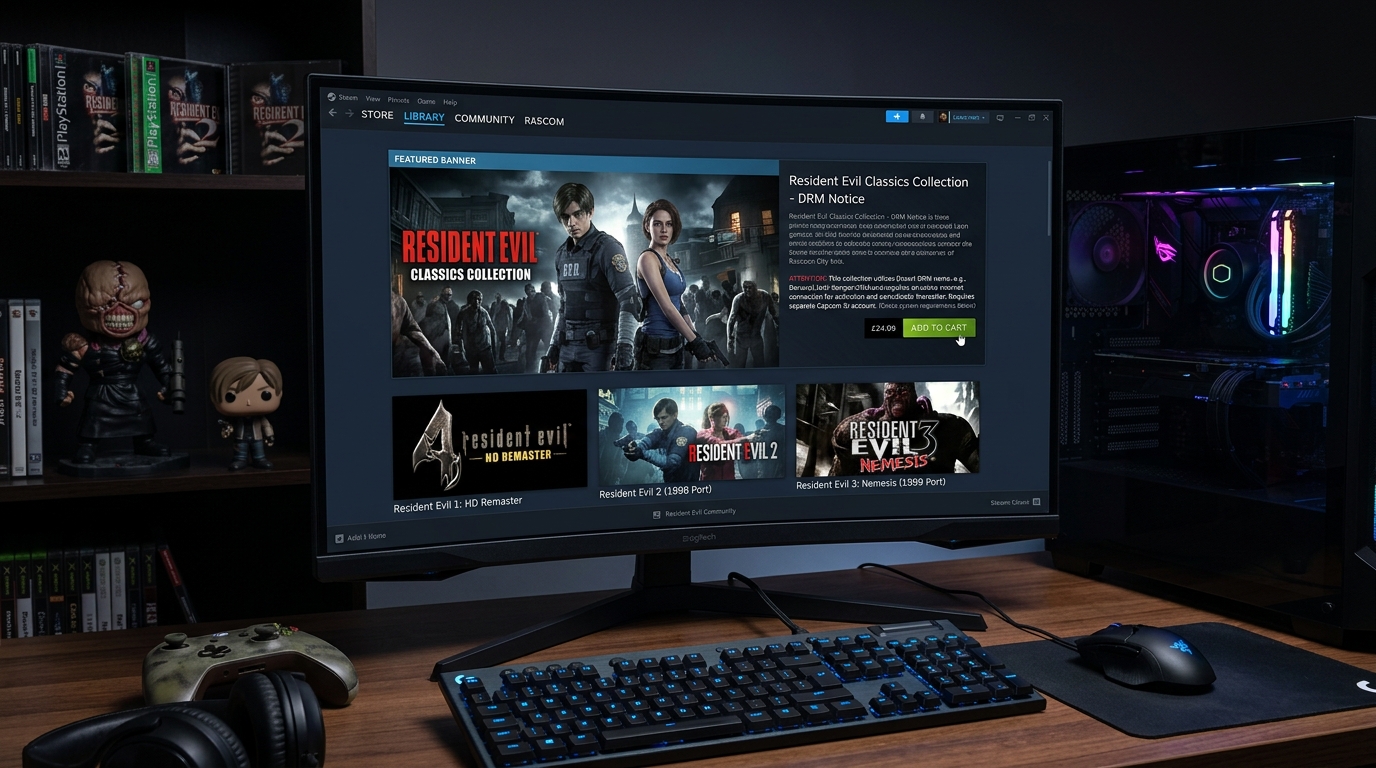
Capcom has quietly expanded its PC catalog by bringing the original Resident Evil PlayStation trilogy and cult JRPG Breath of Fire IV to Steam. For fans of classic survival horror and turn-based role-playing, it is the kind of surprise drop that usually sparks pure celebration: four influential titles, officially available on a modern storefront, with attractive introductory discounts. Yet this launch has also ignited a familiar controversy, as players discovered that Capcom’s Steam versions ship with additional digital rights management (DRM) that is not present on the same games’ DRM-free releases elsewhere.
This article breaks down what has arrived on Steam, why the added DRM matters, how the community is reacting, and what the situation reveals about long-term game preservation and consumer rights on PC.
The New Arrivals: Four Classics Make the Jump to Steam
The headline of the announcement is straightforward: four late-90s Capcom classics, previously reintroduced on GOG, have now joined Steam’s vast library of PC titles:
- Resident Evil (1996) – the original mansion-set survival horror adventure
- Resident Evil 2 (1998) – the Raccoon City outbreak expanded across dual scenarios
- Resident Evil 3: Nemesis (1999) – Jill Valentine’s desperate escape from the biohazard
- Breath of Fire IV (2000 PC release) – a hand-drawn, story-driven JRPG set in a war-torn world
These versions are not remakes or remasters. They are the classic editions, preserving the look, sound, and pacing of the era in which they first appeared, originally brought to modern PCs through GOG’s work on compatibility and now repackaged for Valve’s platform.
Why These Releases Matter to PC Players
For years, long-time fans have faced a tricky choice: track down physical PlayStation discs and older consoles, resort to emulation of varying legality and quality, or hope publishers would eventually make the classics accessible on current systems. By landing on Steam, these games gain:
- Broader visibility via Steam’s recommendation engine and tagging system.
- Ease of purchase for players who prefer keeping their PC library in one ecosystem.
- Community features such as reviews, guides, and the potential for Steam overlay conveniences.
Coupled with a notable introductory discount, the offer looks enticing on the surface. However, the difference in how Capcom chose to package the games on Steam versus GOG is at the heart of the controversy.
GOG vs Steam: One Catalog, Two DRM Philosophies
Before arriving on Steam, Capcom’s classic Resident Evil titles and Breath of Fire IV first reappeared on GOG. GOG is known for a strict DRM-free policy: once purchased, games can be downloaded and backed up without requiring an always-on client or online checks. This stance is prominently presented in GOG’s own principles, which emphasize ownership and offline access as core values for buyers.1
Steam, in contrast, does not prohibit DRM. Valve’s platform generally requires the Steam client to authenticate games, and publishers are free to add extra DRM layers on top. In this case, Capcom opted to integrate The Enigma Protector, a commercial DRM and software protection tool, into the Steam versions of all four classic titles.
| Aspect | GOG Versions | Steam Versions |
|---|---|---|
| DRM | No DRM (offline installers, backups allowed) | Steam platform + Enigma Protector DRM |
| Offline Play | Fully offline; client not required | Typically playable offline once authenticated, but bound to Steam |
| Ownership Model | Downloadable files intended to be kept indefinitely | License tied to Steam account and infrastructure |
| Community Features | GOG Galaxy and forums | Steam reviews, guides, achievements (where applicable) |
This contrast between a DRM-free release and a DRM-laden one, for essentially the same product, is what many players find frustrating. It raises questions about why the extra restrictions are necessary on Steam at all.
What Is Enigma Protector and Why Are Players Concerned?
Enigma Protector is a commercial software protection system designed to make reverse-engineering and unauthorized copying more difficult. According to its developer’s documentation, it can encrypt executable files, embed license checks, and add anti-debugging measures intended to complicate cracking efforts.2 While such tools are common in commercial software, they are controversial when used in games—especially older titles already preserved and sold elsewhere without protection.
Common Player Concerns About Added DRM
Community reactions to Enigma DRM in these Steam releases broadly fall into several categories:
- Preservation and longevity – Players fear that additional DRM layers make it more likely that games will become unplayable if authentication systems fail or are retired.
- Performance and compatibility – While not all DRM noticeably impacts performance, past examples like Denuvo have drawn criticism for alleged stuttering or CPU overhead, prompting suspicion toward any new protection software.3
- Principle of the matter – Because these titles are already available DRM-free on GOG, some see the added restrictions on Steam as unnecessary and consumer-unfriendly.
- Linux and Proton users – Extra DRM can complicate running games through compatibility layers such as Valve’s Proton for Linux, potentially requiring patches or workarounds.
To be clear, not every DRM implementation causes noticeable technical issues, and many players may never encounter problems. But from a consumer standpoint, each added dependency can represent another potential point of failure over the long life of a digital library.
Community Reception: Praise for the Games, Critique for the Policy
Once the games appeared on Steam, early user reviews tended to separate two distinct points:
- Game quality – The original Resident Evil trilogy and Breath of Fire IV are widely regarded as some of Capcom’s finest work, with long-standing critical acclaim and dedicated fanbases.
- Release decisions – The choice to add DRM to the Steam versions, despite DRM-free equivalents existing elsewhere, drew criticism and calls for potential buyers to evaluate both storefronts carefully.
This split reaction highlights a broader PC gaming trend: players can enthusiastically support classic game preservation while simultaneously pushing back against restrictive publishing practices.
Why Retroactive DRM Feels Different
The controversy is sharpened by the retroactive nature of the DRM choice. These are not brand-new releases; they are decades-old titles that have already been sold in different forms, including recent DRM-free versions. Adding protection at this stage, from the player’s perspective, offers no new value while reducing flexibility.
It also feeds into lingering anxieties about digital game access. Although Valve has publicly stated that it intends to maintain user access to purchased titles even in the event of major changes to the platform, the legal framework around digital ownership emphasizes licensing rather than permanent property.4 Extra DRM layers can exacerbate fears that access to purchased games might depend on external services staying up indefinitely.
Game Preservation, Ownership, and the Role of DRM
The debate around Capcom’s latest releases is part of a larger conversation about how the games industry handles older titles. Preservationists and consumer advocates argue that DRM and platform lock-in introduce fragility into the historical record of games. If server-based authentication fails and no DRM-free backup exists, entire catalogs risk becoming inaccessible.
Industry bodies like the Entertainment Software Association have historically defended copyright protections and DRM as necessary tools to combat piracy and protect commercial interests.5 However, preservation-focused organizations and institutions, including libraries and museums, have repeatedly raised concerns that strict protection measures undermine efforts to archive and study games over the long term.
How Players Are Responding in Practice
Faced with multiple official versions of the same game, PC players are increasingly making purchasing decisions based on DRM and long-term access considerations. Common responses include:
- Choosing DRM-free where possible – Some players prefer GOG or other DRM-free options for any game they value for long-term replay.
- Using Steam for convenience – Others prioritize Steam’s ecosystem and social features and accept the DRM trade-offs as part of that choice.
- Double-dipping selectively – A subset of enthusiasts buys DRM-free versions for preservation and also picks up Steam copies for ease of use and community interaction.
Capcom’s decision with the Resident Evil trilogy and Breath of Fire IV pushes more players to weigh these trade-offs explicitly rather than treating storefronts as interchangeable.
Buying Advice: Which Storefront Makes Sense for You?
If you are considering purchasing these classics, it helps to clarify your priorities. The games are fundamentally the same in content on GOG and Steam, but the packaging differs. Consider the following perspectives:
Steam Might Suit You If…
- You already maintain most of your library on Steam and value having everything in one launcher.
- You enjoy reading and leaving reviews, using community guides, and tracking playtime.
- You are comfortable with DRM and do not expect to play these titles far into the future on offline or archival setups.
GOG Might Suit You If…
- You prioritize long-term access, offline play, and the ability to back up installation files independently.
- You want to avoid additional DRM layers like Enigma and reduce your reliance on any single storefront or client.
- You treat classic games as part of a personal archive you plan to preserve across hardware generations.
In both cases, it is worth monitoring patch notes and community feedback, especially regarding performance, compatibility, and any unforeseen side effects of the DRM.
Frequently Asked Questions
Are the Steam versions of the Resident Evil classics remastered?
No. The Steam releases are based on the original versions of Resident Evil, Resident Evil 2, and Resident Evil 3: Nemesis, not the later remakes. They preserve the 90s-era graphics, camera angles, and controls, updated only enough to function on modern PCs.
Do I need to be online to play these games on Steam?
Steam generally requires an initial online authentication and client setup, but the games are typically playable offline afterward as long as your account remains in good standing and the necessary files and DRM checks pass. However, the titles remain tied to Steam and the included DRM, unlike the DRM-free GOG releases, which can be backed up and run without a client.
Does Enigma Protector affect performance?
There is no universal answer, as impact can vary by implementation and system. Some DRM solutions have been criticized in the past for affecting performance or compatibility, which contributes to player suspicion.3 The best source of information is usually user reports and technical analyses that appear over time after release. As of now, the main concern is the principle and long-term access rather than confirmed performance degradation.
Why is Capcom adding DRM to older games?
Capcom has not provided a detailed public explanation specific to these releases. In general, publishers adopt DRM to deter unauthorized copying and protect their IP, even for older titles. From a consumer standpoint, the move feels controversial because these same games have already been made available DRM-free on GOG, suggesting that they can be commercially viable without extra restrictions.
Is it legal to back up my Steam games?
While you can copy local files as a form of backup, your ability to play those backups still depends on Steam’s infrastructure and DRM systems. You are licensing the software under Steam’s Subscriber Agreement, not purchasing a physical product, so access rights can differ from traditional ownership.4 DRM-free releases, by contrast, are designed to be backed up and run independently without ongoing platform checks.
What This Means for the Future of Classic Game Re-Releases
Capcom’s decision to add Enigma DRM to its Steam versions of the Resident Evil trilogy and Breath of Fire IV underscores the trade-offs baked into modern digital distribution:
- Publishers retain strong tools to protect their intellectual property and shape how games are accessed.
- Players must navigate differences between storefronts, even when the underlying game is identical.
- Preservation and long-term access remain unresolved challenges, especially for titles that rely on proprietary DRM.
For fans, the silver lining is that these classics are now easier to obtain legitimately on PC than they have been in years. For critics, the added DRM on Steam is a reminder that digital convenience often comes with strings attached. As more publishers mine their back catalogs, how they balance access, preservation, and control will shape not only sales, but also how future generations can experience gaming history.
References
- About GOG — GOG.com. 2023-06-01. https://www.gog.com/about
- The Enigma Protector: Features — Enigma Software. 2024-01-10. https://enigmaprotector.com/en/features.html
- Denuvo anti-tamper tech blamed for PC game performance issues — Eurogamer (ReedPop). 2017-01-30. https://www.eurogamer.net/denuvo-anti-tamper-tech-blamed-for-pc-game-performance-issues
- Steam Subscriber Agreement — Valve Corporation. 2023-09-30. https://store.steampowered.com/subscriber_agreement/english/
- Video Game Preservation in Libraries: A Copyright Guide — American Library Association. 2021-08-15. https://www.ala.org/advocacy/copyright/tools-resources/videogame-preservation
Similar Articles







Read full bio of medha deb