
Resident Evil Requiem and Clair Obscur Top Metacritic
How Resident Evil Requiem joined Clair Obscur: Expedition 33 at the summit of Metacritic’s all‑time user‑rated games chart.
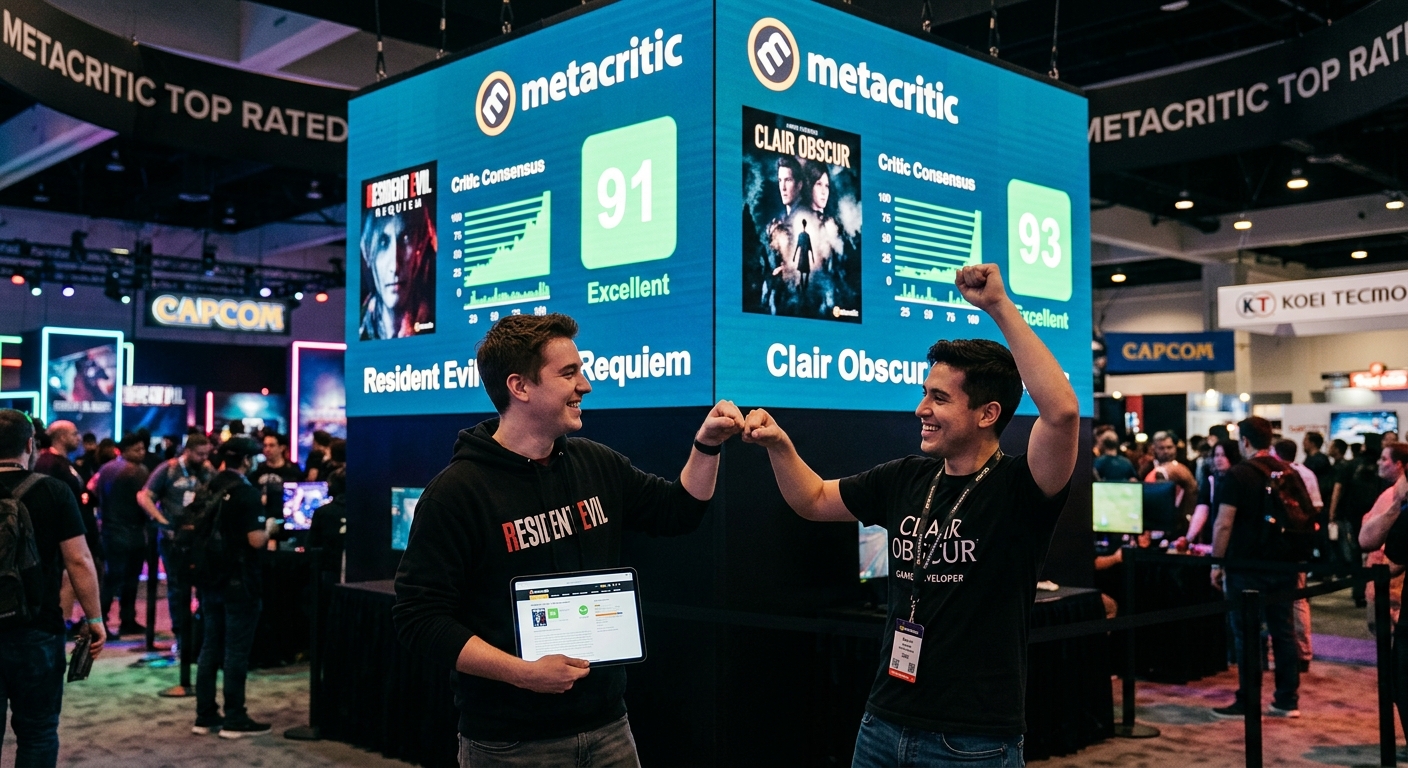
Resident Evil Requiem Joins Clair Obscur at the Top of Metacritic
Resident Evil Requiem has stormed onto Metacritic with such a strong reception that it now shares the highest user score on the site with last year’s breakout hit, Clair Obscur: Expedition 33. Both titles sit at an eye‑catching 9.5/10 user rating, putting them above a long list of beloved classics and reigniting debate over how much Metacritic scores really tell us about the “best” games ever made.
This article explores how Requiem reached that lofty position, what it means to be tied with Clair Obscur, how Metacritic user scores work, and why these rankings should be read with both enthusiasm and caution.
The Games Sharing Metacritic’s Top User Score
Two very different games now share Metacritic’s highest user score according to players: a flagship survival horror sequel and an inventive turn‑based RPG. Their convergence at the same numerical rating highlights both the breadth of modern gaming and the quirks of aggregate scoring.
Resident Evil Requiem: A Modern Peak for Survival Horror
Resident Evil Requiem continues Capcom’s long‑running series, building on decades of horror design. While specific plot details can vary by region and marketing, its broad appeal comes from three pillars:
- Refined survival horror gameplay with tense resource management, atmospheric exploration, and memorable enemy encounters.
- Polished presentation that leverages modern hardware for detailed environments, sophisticated lighting, and strong audio design, all essential to effective horror.
- Respect for series identity, referencing classic Resident Evil motifs while pushing forward with new mechanics and narrative twists.
Capcom’s commitment to the franchise over nearly three decades has repeatedly been recognized in industry coverage and sales data, illustrating how iterative refinement and brand trust can culminate in exceptionally strong launches.1
Clair Obscur: Expedition 33: The Sleeper Hit RPG
Clair Obscur: Expedition 33 took a different route to the top of Metacritic. As a turn‑based RPG that blends painterly visuals with a distinctive tone, it won over players primarily through word of mouth and critical praise rather than franchise recognition.
Key factors that helped it resonate with players include:
- Unique art direction, leaning on surreal, painterly imagery rather than conventional fantasy designs.
- Mechanically rich combat, often centered on timing, synergy between party members, and creative build options.
- Strong narrative hooks, focusing on a doomed world, cyclical journeys, and emotionally driven character arcs.
The result was a game that quickly climbed user rankings, proving that new IP can still stand shoulder‑to‑shoulder with juggernaut franchises when execution and originality align.
How Metacritic User Scores Work
Metacritic aggregates two distinct types of ratings: critic scores and user scores. Understanding the difference is essential before treating Requiem and Clair Obscur’s shared 9.5/10 as definitive proof of objective quality.
Critic Score vs. User Score
| Aspect | Critic Score | User Score |
|---|---|---|
| Who votes? | Selected professional outlets | General public / registered users |
| Scale | 0–100 (converted to Metascore) | 0–10 (often displayed to one decimal) |
| Weighting | Weighted by outlet influence | Typically unweighted average |
| Vulnerability to brigading | Lower | Higher (review bombing, fan campaigns) |
| Purpose | Summarize professional critique | Capture broader player sentiment |
Metacritic itself describes its Metascore as a weighted average based on selected critics, whereas user scores are a straight community average and thus more prone to sudden swings.2
The Power and Pitfalls of User Scores
User scores can be valuable because they:
- Reflect actual player sentiment beyond media narratives.
- Capture long‑tail reactions as games are patched or re‑evaluated.
- Provide a quick snapshot of how a community feels at launch.
However, they also have notable weaknesses:
- Review bombing: Coordinated campaigns can inflate or tank scores for reasons unrelated to the game’s design, such as business decisions or controversies. This has been documented across multiple gaming platforms and retailers, prompting some to introduce tools to detect and mitigate bombed periods.3
- Small sample size: When a game is new, a few thousand (or even a few hundred) highly motivated fans can push the average upward.
- Binary sentiment: Many users rate games either extremely high or extremely low, reducing nuance in the average.
With this context, Requiem and Clair Obscur’s 9.5/10 scores are impressive, but they should be viewed as snapshots of enthusiasm rather than final verdicts on their long‑term status.
What a 9.5/10 User Score Really Means
A 9.5 average on a 0–10 scale is substantially above typical user ratings for games. Industry studies of product rating distributions show that most items cluster closer to 4.0/5 (or 8/10) even when audiences are generally happy, because neutral and moderate scores dilute extremes.4 Climbing to 9.5 requires a heavy skew toward maximal ratings.
Statistical Perspective
While Metacritic does not publicly release full distributions for each title, a few broad conclusions can usually be drawn when a game reaches the 9.5 level:
- High proportion of 9s and 10s: The majority of voting users are extremely positive.
- Limited backlash at launch: There are relatively few low scores from performance issues, content backlash, or unmet expectations.
- Strong alignment with fan expectations: Long‑time series fans or genre enthusiasts feel that the game delivers exactly (or more than) what they wanted.
For Resident Evil Requiem, this suggests a launch with strong technical performance on key platforms, a tone that matches what survival horror fans crave, and content that satisfies long‑term followers. For Clair Obscur, it indicates that players discovered a distinctive RPG that surprised them positively rather than disappointing hype.
How These Games Compare With Other All‑Time Favorites
Both Requiem and Clair Obscur now sit numerically above a long list of frequently cited classics on Metacritic’s user charts. While rankings shift as more votes accumulate, titles often discussed in the all‑time conversation include:
- Metal Gear Solid and Metal Gear Solid 3: Snake Eater, for stealth‑action innovation.
- Silent Hill 2, regarded as a landmark in psychological horror storytelling.
- The Witcher 3: Wild Hunt, widely covered as a benchmark for modern open‑world RPGs.5
- Gran Turismo 4, praised for realism and depth in racing simulation.
- Other cult favorites and memes that historically topped user lists.
That doesn’t mean Requiem and Clair Obscur are definitively superior to these classics; rather, it indicates that their current player base is experiencing them with an intensity of enthusiasm comparable to what earlier generations felt for those older games.
Why New Games Often Debut Very High
Several dynamics help explain why newly released titles can reach or exceed the user scores of long‑established favorites:
- Recency bias: Fresh experiences feel more vivid and are rated more generously.
- Self‑selection: Early adopters tend to be the most interested and positively inclined players, which skews ratings upward.
- Launch excitement: Marketing cycles and community hype create a celebratory atmosphere that colors perception.
Over time, scores for new releases often drift downward as more casual or critical players join the conversation. It will be interesting to watch whether Requiem and Clair Obscur maintain their 9.5 averages months or years from now.
Why Players Are Connecting With These Games
Beyond the numbers, the shared success of Requiem and Clair Obscur offers some insight into what audiences are hungry for in contemporary games.
Polished Single‑Player Experiences Still Matter
Both titles focus on crafted single‑player journeys. In an era where live‑service models and microtransactions often dominate industry discourse, the reception to these games shows that there is still huge appetite for:
- Finite, story‑driven campaigns that respect players’ time.
- Cohesive tone and artistic vision rather than content sprawl.
- Strong offline play with minimal dependence on servers or constant updates.
Market research from major publishers confirms that single‑player narrative games remain a key part of revenue and player engagement, especially for established franchises.1,5
Distinctive Aesthetics and Identity
Although they sit side by side on a numerical chart, Requiem and Clair Obscur couldn’t look more different. That contrast underscores another trend: players reward games that carve out a clear, memorable identity.
In practice, that can mean:
- Leaning fully into horror and tension with deliberate pacing (Requiem).
- Embracing painterly, surreal worldbuilding that stands apart from generic fantasy (Clair Obscur).
- Backing strong visual direction with audio, UI, and narrative choices that all reinforce the same mood.
This suggests that chasing the broadest possible appeal may be less effective than delivering a highly specific, well‑executed vision that certain players fall in love with.
How to Interpret Metacritic When Choosing What to Play
Metacritic can be a useful tool, but treating its rankings as an absolute list of the “best” games will inevitably lead to disappointment or confusion. Instead, it’s better to use scores as a starting point.
Practical Tips for Using Scores Wisely
- Look at both critic and user scores: Large gaps between them can indicate controversy, technical issues, or niche appeal.
- Check the number of reviews: A 9.5 based on a few hundred user ratings is less stable than one based on tens of thousands.
- Read sample reviews: Scan a few high and low reviews to see why people loved or disliked the game.
- Match to your tastes: A top‑rated horror game may not be enjoyable if you dislike horror, regardless of its score.
- Consider platform differences: Performance can vary significantly between console and PC versions, affecting user scores.
FAQ: Resident Evil Requiem, Clair Obscur, and Metacritic Rankings
Is Resident Evil Requiem officially the best game ever now?
No single site can definitively crown the “best game ever.” Requiem’s 9.5/10 user score on Metacritic means it shares the highest average user rating currently recorded there, but that’s a reflection of current player enthusiasm, not an objective measure of quality across all time and genres.
Why did Requiem and Clair Obscur rate higher than older classics?
New games often debut with exceptionally high scores due to recency bias, heavily engaged fanbases, and polished modern production values. Over time, as more players with varied expectations rate them, their averages may settle closer to other classics.
Are Metacritic user scores reliable?
They are useful but imperfect. User scores capture broad sentiment and can highlight hidden gems or particularly beloved releases. However, they are vulnerable to review bombing, fan campaigns, and small but vocal groups. They should be read alongside critic reviews and individual write‑ups.
Should I play Clair Obscur if I only like action games?
Clair Obscur: Expedition 33 is typically described as a turn‑based RPG with a strong focus on story and strategy rather than real‑time action. If you strongly prefer fast‑paced combat, you may want to watch gameplay footage or read detailed reviews before buying, even if the overall score is very high.
Will these 9.5/10 scores last?
It’s impossible to say. As more players rate both games, their averages may move up or down. Historically, some launch‑day high flyers drift slightly downward, while a few titles maintain stellar scores thanks to continued positive word of mouth and post‑launch support.
Final Thoughts: Numbers, Hype, and Lasting Impact
Resident Evil Requiem joining Clair Obscur: Expedition 33 at the top of Metacritic’s user rankings is a milestone that speaks to the vibrancy of today’s gaming landscape. On one side is a long‑running horror giant delivering a polished, fan‑pleasing entry; on the other is an ambitious RPG that captured hearts through originality and strong design.
Metacritic’s 9.5/10 scores are a sign that both games are connecting powerfully with players right now. But they are only one piece of the larger story. Artistic impact, influence on future game design, and personal resonance over the years will ultimately decide how these titles are remembered alongside the classics they have temporarily surpassed in the charts.
For players, the takeaway is simple: the current top of Metacritic is not just a leaderboard, but a suggestion list. If you enjoy survival horror or inventive RPGs, there has rarely been a better time to dive into both ends of that spectrum.
References
- Capcom Integrated Report 2023 — Capcom Co., Ltd. 2023-06-30. https://www.capcom.co.jp/ir/english/data/pdf/annual/2023/annual_2023_01.pdf
- About Metascores & Reviews — Metacritic (Fandom, Inc.). 2023-11-01 (last updated, approx.). https://www.metacritic.com/about-metascores
- Understanding and Detecting Review Manipulation on Online Platforms — Luca, Michael et al., Harvard Business School Working Paper No. 22-051. 2022-03-15. https://www.hbs.edu/ris/Publication%20Files/22-051_8d5980e3-90af-4e19-9e2c-0af645ed90e2.pdf
- Do Online Ratings Matter? The Effect of Ratings on Consumer Choice — de Langhe, Bart et al., Journal of Consumer Research, Vol. 44, Issue 6. 2018-04-01. https://academic.oup.com/jcr/article/44/6/1234/4085331
- CD PROJEKT Annual Report 2023 — CD PROJEKT S.A. 2024-04-16. https://www.cdprojekt.com/en/wp-content/uploads-en/2024/04/cd-projekt-group-annual-report-2023.pdf
Similar Articles







Read full bio of Sneha Tete