Should World of Warcraft Fully Support Controllers?
Blizzard is openly exploring a controller-focused UI for World of Warcraft, and players are split over what it means for PC gameplay.
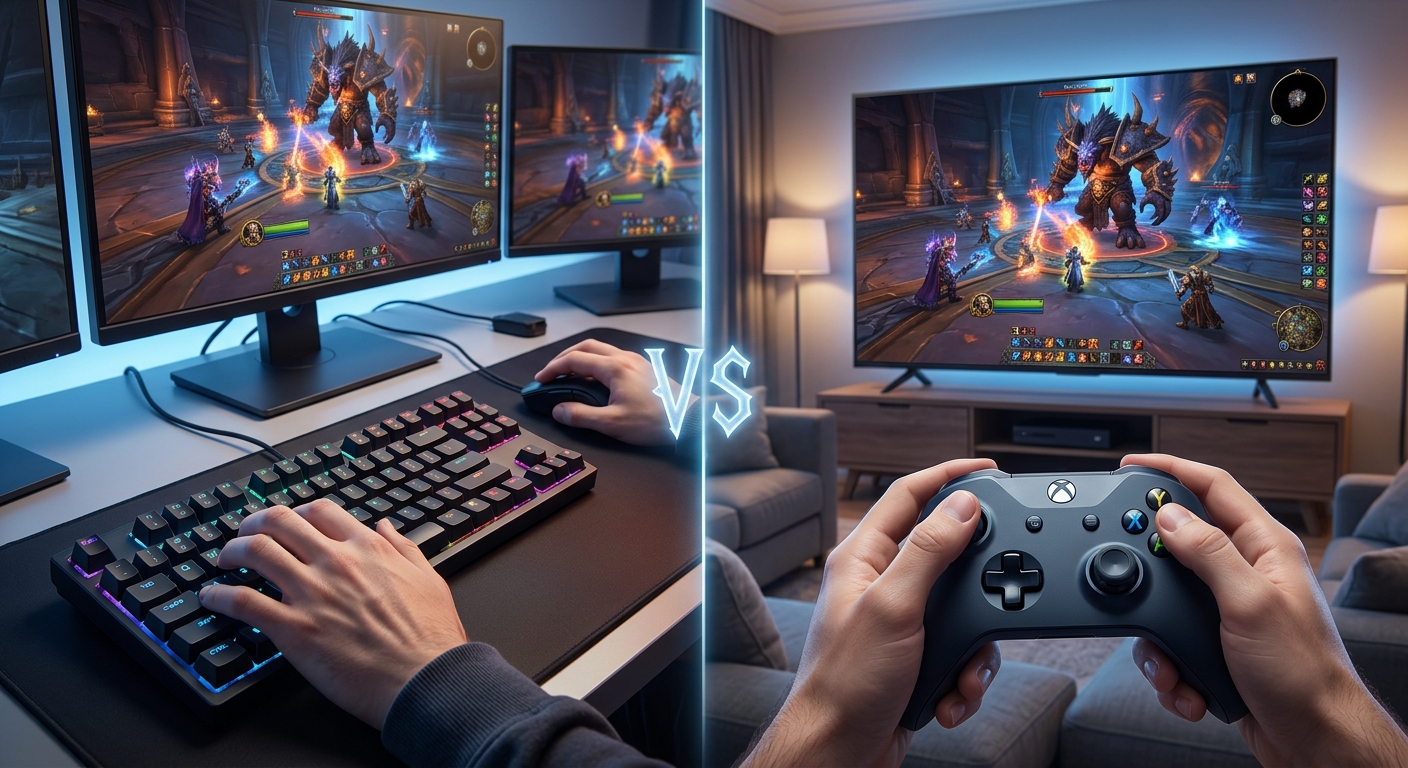
World of Warcraft has been a keyboard-and-mouse MMO for nearly two decades, but Blizzard is now openly asking how players would feel about playing the game with a controller and a dedicated controller-friendly interface. That simple question has triggered a surprisingly intense debate across the community: is this the next logical step for accessibility and modern design, or a threat to the depth and clarity of the PC experience that made WoW famous?
This article unpacks the current discussion around controller support, why a dedicated UI matters, what players are worried about, and how Blizzard might support new playstyles without sacrificing what long-time PC fans love.
Why Controller Support Is Back in the Spotlight
World of Warcraft has long been playable with a controller through third-party addons and workarounds, but it was never officially designed for that style of play. Blizzard has gradually introduced features that make controller play more practical, and now developers are directly asking the community how they feel about a fully supported controller UI for the MMO.
Several trends are converging:
- Accessibility and inclusion are increasingly central in game design, with major studios recognizing that diverse control schemes help players with different physical needs enjoy their games. Microsoft, for example, emphasizes customizable inputs and alternative controllers as part of its accessibility guidelines.1
- Modern devices like Steam Deck and gaming laptops encourage couch-style or handheld play, where controllers are often more comfortable than a full keyboard-and-mouse setup.
- Other MMOs and action-RPGs have proven that complex games can work well on controllers with thoughtful UI and control schemes.
Blizzard’s question about a dedicated controller UI isn’t coming out of nowhere; it’s the next step in a broader industry shift toward letting players choose how they interact with a game.
What a Dedicated Controller UI Could Actually Mean
Many players already use controller addons in WoW, so what is Blizzard really talking about when it raises the idea of a dedicated controller interface?
Key Elements of a Controller-Focused UI
A true first-party controller UI for WoW would likely involve:
- Radial or grid-based action bars that group abilities into easily reachable sets instead of long horizontal rows.
- Context-sensitive prompts (for interacting, looting, or mounting) that appear near the character or target instead of requiring precise cursor clicks.
- Larger, more readable elements such as tooltips and health bars, optimized for players sitting farther from the screen.
- Smart targeting systems that prioritize enemies or allies logically when using a stick or D-pad instead of a mouse.
- Menu navigation tailored to a controller, with clear focus states and quick shortcuts rather than relying on mouse hover.
Most of these concepts are familiar to players who have tried MMOs or ARPGs on consoles. The difference here is that WoW was built first and foremost as a PC game, so any new controller interface has to coexist with a deeply entrenched mouse-and-keyboard UI.
The Community Split: Hopes vs. Fears
Blizzard’s openness to controller support has generated two strong, often conflicting reactions: excitement about inclusivity and modernization, and anxiety that the classic PC experience will be watered down.
| Perspective | Primary Hopes | Primary Concerns |
|---|---|---|
| Accessibility-focused players | More options for people with motor limitations; easier setups; fewer addons. | Implementation might be shallow or incomplete, still requiring complex workarounds. |
| Traditional PC players | Potentially better UI customization overall if Blizzard invests in modernizing. | Fear of “console-ized” menus, larger UI elements, and reduced information density on PC. |
| Hybrid / casual players | Ability to swap between couch play and desk play seamlessly. | Worry that neither controller nor PC interface will be truly polished. |
The Accessibility and Comfort Argument
Supporters of a controller UI emphasize the benefits for players who struggle with traditional controls. Official accessibility guidelines across the industry, including those referenced by the Game Accessibility Guidelines project and platform holders like Xbox, highlight customizable controls, multiple input options, and reduced input complexity as key pillars of accessible design.1,2 A well-integrated controller mode can:
- Reduce finger travel and repetitive strain from high APM (actions per minute).
- Offer comfortable couch play on TVs or handheld devices.
- Help players with mobility or dexterity challenges enter content that might otherwise be physically exhausting.
For many, the opportunity to raid, run dungeons, or simply quest comfortably with a controller is worth supporting, even if they personally stick to keyboard and mouse.
The Fear of a “Console First” Design Philosophy
On the other side, some long-time PC players are wary. They’ve seen PC titles simplified when ported to consoles, and they worry that WoW could follow that path. Common concerns include:
- Cluttered or oversized UI elements that take up more screen space to accommodate controller readability.
- Simplified combat design, where encounters and rotations are tuned around fewer buttons or slower reaction times.
- Menu navigation being slowed down if everything is redesigned with controllers as the primary input.
These fears aren’t entirely unfounded: when games target multiple platforms, UI compromises sometimes happen. However, WoW’s design choices remain under Blizzard’s control, and the game is still deeply rooted in PC culture.
Design Challenges: Translating a PC MMO to a Controller
Even if the community broadly supports controller options, the actual implementation poses serious design challenges. WoW was built around dozens of keybinds, a precise cursor, and dense visual information.
Mapping Complex Rotations to Limited Buttons
Many WoW specializations have 20 or more abilities that players might use in combat, plus numerous utility spells. A typical console controller, by comparison, offers:
- Face buttons (A/B/X/Y or equivalents)
- D-pad
- Two analog sticks with click inputs
- Four shoulder buttons/triggers
Developers must rely on modifier layers (e.g., holding a trigger to swap what face buttons do) and contextual actions (e.g., the same button interacting, interrupting, or looting depending on target) to make this work. Some modern games, including console versions of complex action-RPGs, show that it’s possible to preserve depth with fewer physical buttons through smart design.3
Information Density and Screen Real Estate
Raids and high-end dungeons involve tracking health, buffs, debuffs, timers, boss abilities, and positional cues. Keyboard-and-mouse players commonly use addon-heavy interfaces to surface this information densely in a small space.
A controller UI must respect several constraints:
- Readability at a distance, since many players will sit farther away from a TV or monitor when using a controller.
- Limited cursor precision, especially if the cursor is controlled via a stick rather than a mouse.
- Clarity of focus, so players always know which enemy, ally, or UI element is currently targeted.
Striking the right balance between density and clarity is crucial. A good solution might involve different default layouts or scaling presets tailored to monitor vs TV play.
How Blizzard Could Protect the PC Experience
Many of the most passionate objections from PC players could be addressed if Blizzard commits to clear separation and strong customization between PC-centric and controller-centric interfaces.
Separate Layouts, Shared Engine
One promising approach is to treat controller support as a distinct UI profile rather than a complete replacement. In practice, that could mean:
- Dedicated controller UI toggles in settings that load a different layout only when a controller is active.
- Custom keybind and action bar sets for each input mode, so players can fine-tune both without compromising either.
- Per-character or per-spec profiles, enabling some characters to be controller-focused while others are keyboard-oriented.
This strategy is common in games that support multiple input types on PC: they detect the active input and switch hints and focus behavior dynamically.
Maintaining Advanced Options for Power Users
WoW’s strength on PC is its depth of customization. To reassure veteran players, Blizzard can:
- Maintain granular options for UI scaling, layout, and visibility of different frames.
- Ensure that addon compatibility remains a priority, so third-party solutions can keep evolving alongside official tools.
- Provide advanced keybinding and macro options for players who want maximum control and complexity.
So long as power users retain their ability to tailor the interface to high-end raiding or Mythic+ play, most concerns about “dumbing down” the UI will be less pressing.
Benefits for Blizzard: New Audiences and Platform Flexibility
Controller support is more than just a quality-of-life feature; it can open strategic doors for World of Warcraft.
- Attracting new players: Many gamers are more comfortable with controllers and may avoid keyboard-heavy titles. Official support lowers the entry barrier.
- Preparing for new platforms: While WoW remains a PC MMO, strong controller support would make any future experimentation with living room devices or cloud gaming more viable.
- Future-proofing for accessibility standards: Industry expectations and best practices around accessible design are rising. Controller support, remappable inputs, and alternative control schemes are increasingly seen as standard rather than optional extras.1,2
By investing in a robust controller mode, Blizzard can align WoW with broader industry trends without committing to any specific platform expansion.
Possible Implementation Roadmap
If Blizzard moves ahead with a dedicated controller interface, the rollout is likely to be iterative. A plausible roadmap might include:
- Experimental features on the PTR (Public Test Realm) to gather feedback on basic controller support and UI layouts.
- Accessibility-focused updates such as enhanced target cycling, customizable input profiles, and optional rotation helpers for casual or mobility-limited players.
- Expanded UI presets for different play environments, like “Desk Mode” vs “Couch Mode.”
- Continuous refinement based on metrics and community feedback, especially from high-end content where mistakes are more punishing.
Blizzard has historically used test realms to validate major system changes, and community feedback is often incorporated into final designs. An iterative process would allow the team to test controversial features—such as simplified rotation tools or auto-targeting—before making them default options.
FAQ: WoW and Controller Support
Will keyboard and mouse be required if a controller UI is added?
There’s no sign that keyboard and mouse support will be removed or de-emphasized as a requirement. Controller support is being discussed as an additional way to play, not a replacement, and any official UI will still need to function well with WoW’s established input methods.
Could raids and Mythic+ dungeons be fully viable on controllers?
In theory, yes, but it depends heavily on implementation. With smart targeting, clear UI design, and customizable bindings, high-end content can be playable on controllers—as seen in other complex games. However, some players may still prefer keyboard and mouse for the highest difficulty levels due to precision and speed.
Does controller support mean combat will be simplified?
Not necessarily. Blizzard can preserve complex rotations and mechanics while offering tools that map those abilities efficiently to a controller. Optional helpers or accessibility features may exist, but they don’t have to replace traditional skill-based gameplay.
Will UI changes affect addon users?
Major UI updates always require addon authors to adjust, but Blizzard can mitigate disruption by maintaining stable APIs where possible and communicating changes early. As long as the underlying UI framework remains flexible, addon ecosystems tend to adapt quickly.
Is full controller support a step toward a console release?
Controller support certainly makes a console version more technically feasible, but it does not guarantee one. From a design standpoint, however, preparing for more diverse input methods helps keep WoW adaptable to future platforms and devices.
Balancing Tradition and Change
World of Warcraft’s potential move toward a dedicated controller UI highlights a broader tension in long-running live games: how to modernize and become more inclusive without alienating the players who built the game’s legacy. For accessibility advocates and players who prefer controllers, this is a promising development that could make Azeroth more welcoming than ever. For purists, the key question is whether Blizzard can add new options without erasing the finely tuned, information-rich PC experience.
The most likely path is a compromise: robust controller support, cleanly separated UI profiles, and an ongoing commitment to PC-first depth. If Blizzard can pull that off, WoW may emerge stronger—simultaneously honoring its roots and embracing a more flexible, player-driven future.
References
- Xbox Accessibility Guidelines — Microsoft. 2023-08-15. https://learn.microsoft.com/en-us/gaming/accessibility/xbox-accessibility-guidelines
- Accessibility in Games — Game Accessibility Guidelines. 2022-11-10. https://gameaccessibilityguidelines.com
- Final Fantasy XIV Online: Control & User Interface Guide — Square Enix. 2024-02-01. https://na.finalfantasyxiv.com/uiguide
- Gaming Accessibility in 2024: Trends and Best Practices — International Game Developers Association (IGDA). 2024-03-20. https://igda.org/resources/gaming-accessibility
Similar Articles






Read full bio of medha deb