
Thick As Thieves: How Warren Spector’s New Heist Sim Refocused on Co-op
Why immersive sim pioneer Warren Spector’s new stealth heist game ditched PvPvE to double down on single-player and two‑player co‑op.
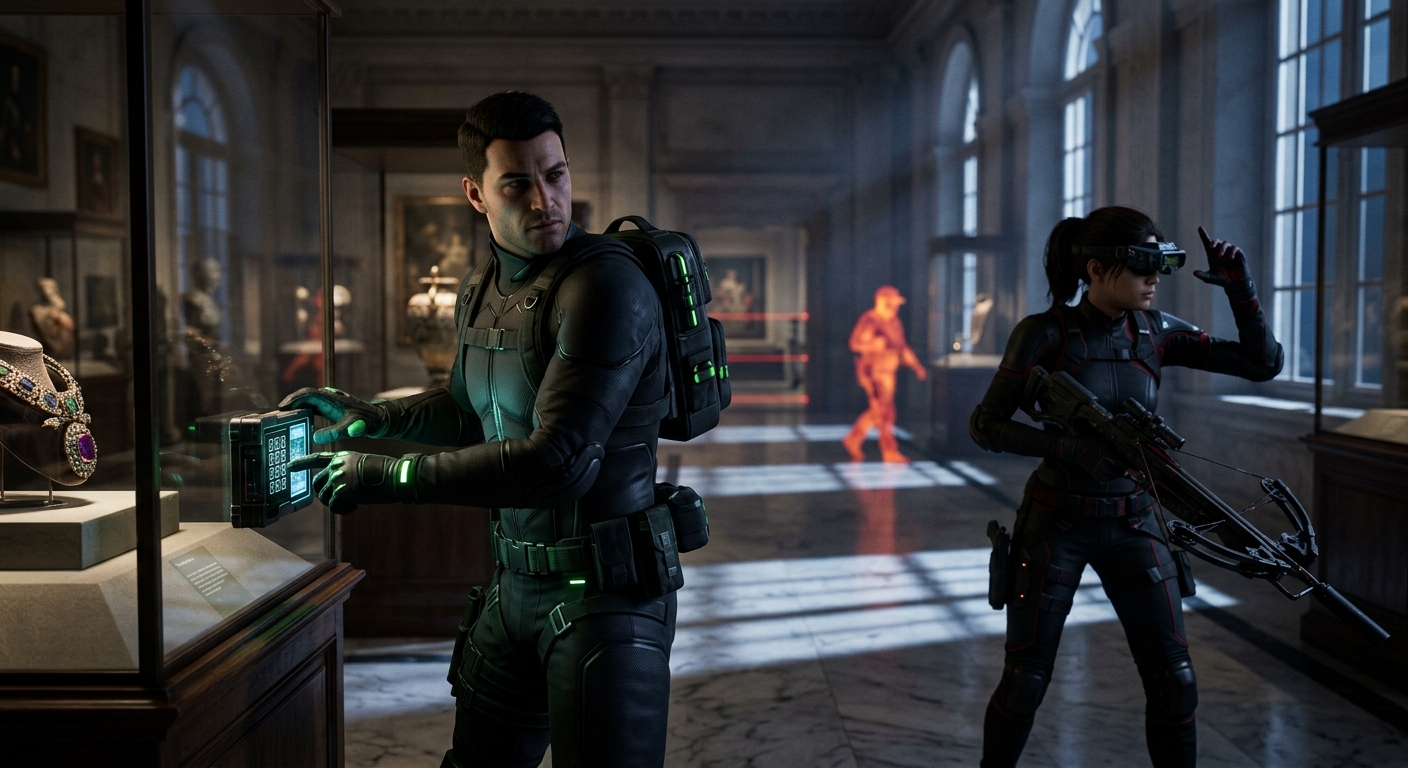
Thick As Thieves, the upcoming stealth-heist game from OtherSide Entertainment and immersive sim veteran Warren Spector, has undergone a major design shift. Originally pitched as a multiplayer PvPvE extraction-style experience, it has been reworked into a game that centers on single-player and tightly integrated two-player co-op. That change not only reshapes the way players will experience its magical 1910s metropolis, but also says a lot about where the immersive sim genre is heading.
From Competitive Heists to Focused Stealth Sandboxes
When Thick As Thieves was first revealed, it emphasized asymmetrical multiplayer and PvPvE—players racing against rival thieves while also contending with guards and systemic AI responses. Over development, however, the team found that designing for human-versus-human competition was pulling focus away from what the studio is best at: authored stealth scenarios, choice-driven problem solving, and reactive narrative outcomes.
According to OtherSide’s public development updates, internal playtests consistently showed that solo and co-op sessions were more enjoyable and more in line with the studio’s immersive sim roots. That insight prompted a substantial pivot: multiplayer is still present, but it is framed as co-operative heists between two thieves rather than a competitive extraction mode with multiple opposing teams.
Why PvPvE Was a Tough Fit
On paper, combining stealth and PvPvE sounds compelling. In practice, it can introduce conflicting design pressures:
- Pacing mismatch: Stealth thrives on slow, deliberate planning; PvPvE tends to reward fast, aggressive play.
- Readability issues: It is harder for players to understand the consequences of their actions when unpredictable humans and complex AI systems share the same space.
- Systemic complexity: Immersive sims already juggle physics, AI perception, and branching narrative; adding competitive balance multiplies that complexity.
By stepping away from an extraction-style model, OtherSide can tune levels, tools, and AI solely around stealth problem-solving rather than kill-or-be-killed showdowns with other players.
What the New Vision of Thick As Thieves Looks Like
The revised vision for Thick As Thieves revolves around two core experiences:
- Single-player: A thief navigating intricate missions alone, free to experiment without worrying about others’ agendas.
- Two-player co-op: A duo of thieves coordinating abilities, routes, and timing to pull off high-stakes heists together.
Instead of multiple squads vying for loot, the campaign is now framed as a focused set of missions that can be completed either solo or with a single partner in crime. This keeps the design scope contained while maximizing the depth of each scenario.
Immersive Sim DNA in a Magical 1910s City
Thick As Thieves fits squarely in the lineage of immersive sims like Thief and Deus Ex, series that Spector helped define. These games are characterized by systemic design, where a small set of consistent rules and interactive objects produce a wide variety of solutions. Academic and design commentary often emphasize this balance between simulation and player expression as central to immersive sim appeal.
Set in a stylized 1910s metropolis infused with magic and industrial technology, Thick As Thieves leverages that philosophy through:
- Layered level design with rooftops, alleys, vents, and interiors interconnected in non-linear ways.
- AI guards and civilians that respond to sound, light, and suspicious behavior rather than scripted paths alone.
- A toolkit of gadgets, spells, and skills that can be repurposed in unconventional ways to bypass obstacles.
This emphasis on systemic play aligns with broader trends in game design research, where emergent problem-solving is seen as a driver of engagement and replayability.
Designing Stealth Around Two Players, Not Twelve
Refocusing on a maximum of two human players fundamentally changes how missions can be authored. Instead of designing around chaotic lobbies or large teams, OtherSide can craft scenarios that explicitly anticipate solo and duo play.
The Co-op Advantage for Stealth
Stealth games have historically been solo experiences, but smaller-scale co-op can actually strengthen the genre. With just two players, designers can build mechanics that rely on communication and timing without overwhelming the experience. Examples of co-op stealth patterns that Thick As Thieves is well positioned to support include:
- Asymmetric roles: One thief specializes in infiltration and lockpicking while the other handles distraction, hacking, or magical support.
- Multi-point coordination: Simultaneous lever pulls, synchronized guard takedowns, or timed power outages.
- Risk sharing: One player scouts and marks threats while the other carries the loot, making extraction a joint responsibility.
Academic work on cooperative play notes that well-structured coordination tasks can enhance social connection and perceived competence when the difficulty is properly tuned. A two-player ceiling simplifies that tuning, making it more likely that each heist feels fair and rewarding.
Balancing for Solo vs. Co-op
Of course, designing missions that work equally well for one player and for two is non-trivial. To keep the experience satisfying in both modes, a game like Thick As Thieves can rely on several levers:
- Dynamic objectives: Optional side rooms, safes, or high-risk vaults that become more feasible in co-op but remain possible solo.
- Scalable AI density: Slightly fewer or less coordinated guards in solo, with more overlapping patrols in co-op.
- Adaptive failure conditions: Allowing a downed co-op partner to be rescued or revived rather than triggering instant mission failure.
This approach reflects a broader shift in stealth game design from brittle, fail-state-heavy missions to more forgiving, story-consistent consequences for mistakes.
Narrative and World-Building in a Thief’s Metropolis
While the precise plot beats are still under wraps, publicly available descriptions emphasize that players are climbing through the criminal underworld of a dense urban setting. Magic and early 20th-century tech intertwine to create both opportunities and threats.
Key narrative elements likely to define the experience include:
- Factional politics: Rival crews, corrupt officials, and powerful patrons influencing mission choices.
- Reputation systems: How cleanly or violently you complete heists could affect how the world responds over time.
- Character-driven co-op: Banter and dialogue that adapt to whether you’re alone or working with a partner.
This emphasis on social and systemic storytelling aligns with how immersive sims have historically used reactive world states to make player choices feel meaningful and persistent.
Comparing the Original and Revised Visions
| Design Aspect | Initial PvPvE Focus | Current Solo/Co-op Focus |
|---|---|---|
| Core Multiplayer Mode | Competitive extraction-style heists with multiple teams | Two-player co-op heists; solo fully supported |
| Pacing | Faster, pressure-driven, driven by opposing players | Deliberate, methodical, player- and story-driven |
| Design Priority | Balance between teams and systemic AI | Immersive sim depth and flexible problem solving |
| Target Fantasy | Outsmart and outgun other thieves | Plan and execute the perfect heist with a trusted partner |
How Thick As Thieves Fits in Today’s Stealth and Co-op Landscape
The pivot for Thick As Thieves also needs to be understood in the broader context of modern stealth and co-op games. The last decade has seen an explosion of multiplayer-focused titles, but not all of them have successfully blended complex systemic design with competitive play.
Competing for Attention, Not Just Objectives
Players today have a wealth of options for both stealth and co-op experiences, from linear co-op shooters to open-ended stealth adventures. In this landscape, trying to compete directly with large-scale PvP or extraction games may not be the best strategic fit for a smaller studio specializing in simulation-driven design.
Instead, Thick As Thieves can carve out a niche by offering:
- Dense, replayable levels instead of huge but shallow arenas.
- Story-integrated co-op that feels more like a shared campaign than a matchmaking queue.
- High interaction density—every door, light source, and guard route can potentially be manipulated.
Industry analysis from major outlets has frequently noted that immersive sim-style games, while not always mainstream blockbusters, cultivate dedicated audiences who value that kind of depth and systemic freedom.
What Players Can Expect at Launch
Public store listings and official communications currently paint a picture of a compact but focused game rather than an endlessly expanding live service. The campaign length, toolset, and platform support are all aligned around delivering a self-contained stealth experience.
Core Features Highlighted So Far
- Solo and co-op campaign: A full story-driven experience that can be completed alone or with one partner.
- Immersive sim mechanics: Systemic world interactions, multiple routes, and flexible objectives.
- Stealth-first design: Encouragement of non-lethal and clever solutions over brute force.
- Cross-platform availability: Release on PC and current-generation consoles.
Compared with sprawling live-service titles, this more contained scope can actually be an advantage, especially for players who want a tightly curated experience without endless grinds or seasonal resets.
Why the Pivot Matters for Immersive Sims
The decision to drop PvPvE in favor of single-player and co-op is more than a simple mode change. It highlights the ongoing tension in game development between trend-chasing and genre authenticity.
For immersive sims in particular, the strengths of the genre—deep systems, narrative reactivity, and experimental play—are easier to realize when design complexity is focused rather than dispersed. Several postmortems and retrospectives on immersive sims have pointed out that scope creep and conflicting feature sets can dilute what makes these games special.
By narrowing its ambitions around a smaller player count and a more traditional campaign structure, Thick As Thieves positions itself as a spiritual successor to classic stealth sims while still embracing modern co-op expectations.
Practical Tips for Future Players
If you are planning to dive into Thick As Thieves once it launches, a few mindset shifts can help you get the most out of its design.
Play Like a Problem-Solver, Not a Soldier
- Experiment freely: Try interacting with objects in unconventional ways; many solutions are systemic, not scripted.
- Embrace failure: Treat detection or botched attempts as opportunities to improvise rather than reasons to reload instantly.
- Observe first: Spend time studying patrols and environment cues before committing to a plan.
Make the Most of Co-op
- Communicate constantly: Voice chat or quick signaling can turn a chaotic mess into a clean operation.
- Divide responsibilities: Let one player specialize in recon and the other in execution to avoid both trying to do everything.
- Respect different playstyles: Some players love ghosting; others prefer controlled chaos. Negotiate a shared goal upfront.
Frequently Asked Questions
- Is Thick As Thieves still a multiplayer game after dropping PvPvE?
- Yes. While the game no longer features competitive PvPvE modes, it fully supports online two-player co-op throughout its campaign.
- Can the entire game be completed solo?
- Public information indicates that every mission can be played alone. Co-op is optional, not mandatory, though some objectives may be easier with a partner.
- Does removing PvPvE mean less replay value?
- Not necessarily. Immersive sims typically derive replayability from multiple routes, builds, and reactive systems rather than from competitive matchmaking. Different approaches, choices, and co-op dynamics can still encourage repeat playthroughs.
- Will there be PvP modes in the future?
- The pivot messaging has emphasized a focus on single-player and co-op. There has been no firm indication that traditional PvP modes will be added later, and the design appears centered on this new direction.
- How story-driven is the experience compared to classic immersive sims?
- While exact narrative details remain limited, the involvement of Warren Spector and OtherSide’s messaging around reactive storytelling suggest that story and player-driven outcomes will be key pillars, similar to other immersive sims he has worked on.
References
- Immersive Sims: A History of Systems-Driven Games — GDC Vault / Austin Walker & others (panel). 2018-03-21. https://www.gdcvault.com/play/1025000/Immersive-Sims-A-History
- An Architectural Approach to Level Design — S. Smith & B. Worch, Game Developers Conference. 2010-03-11. https://www.gdcvault.com/play/1012641/An-Architectural-Approach-to-Level
- Cooperative Game Design: Lessons from Left 4 Dead — M. Booth, Game Developers Conference. 2010-03-11. https://www.gdcvault.com/play/1014345/Cooperative-Game-Design-Lessons-from
- Stealth Gameplay: Past, Present, and Future — Game Developers Conference (panel with various designers). 2013-03-29. https://www.gdcvault.com/play/1017843/Stealth-Gameplay-Past-Present-and
- The Future of Immersive Sims — Rock Paper Shotgun. 2020-02-17. https://www.rockpapershotgun.com/the-future-of-immersive-sims
Similar Articles






Read full bio of Sneha Tete