
Windrose Gunpowder Guide: Crafting, Looting, and Progression
Learn every reliable way to get gunpowder in Windrose, from early-game pirate raids to late-game crafting loops with sulfur, ash, and Millstones.
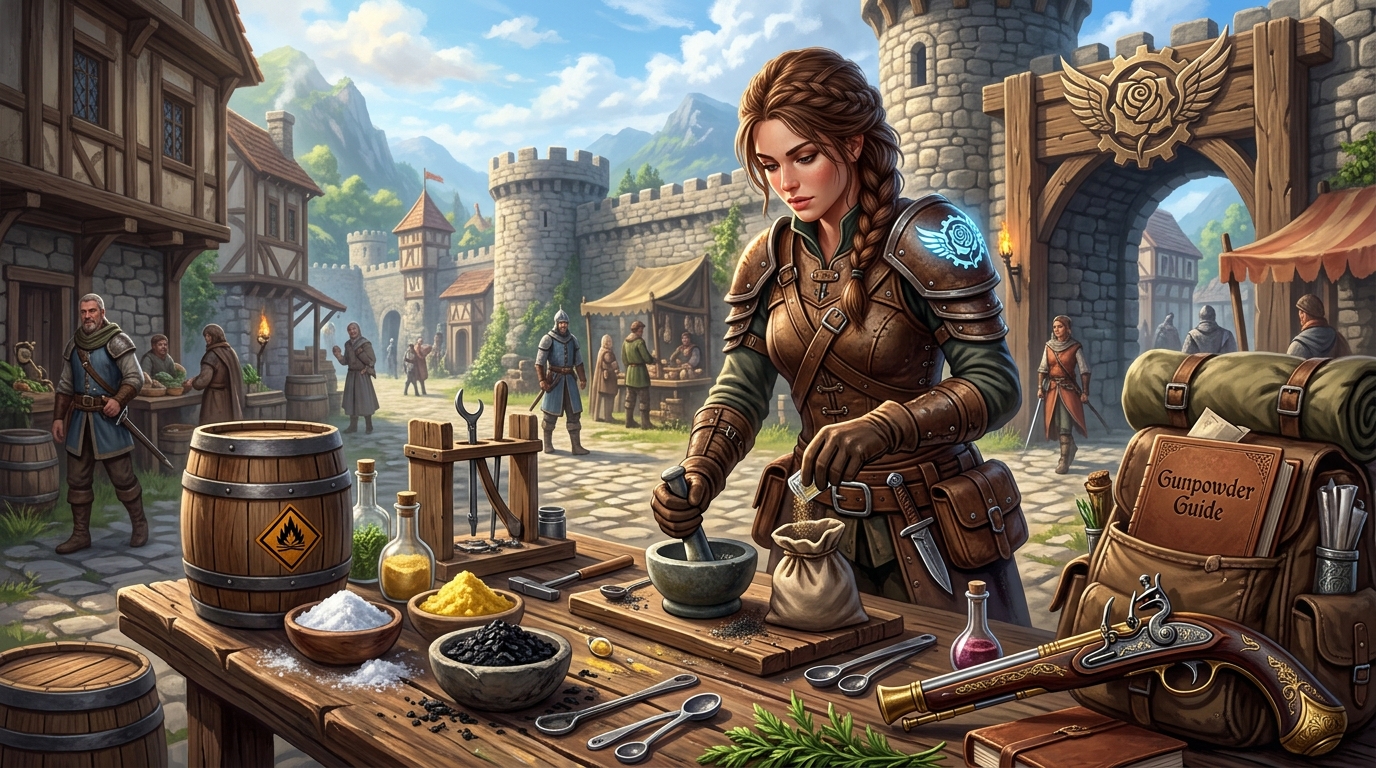
Gunpowder is one of the most important resources in Windrose. It fuels your firearms, powers explosives, and dramatically changes how you approach combat once you have a steady supply. However, it is deliberately gated behind exploration and crafting systems so that it feels like a true mid‑game milestone rather than a starter resource.
This guide explains the full lifecycle of gunpowder in Windrose: how to get it early by looting pirate strongholds, how to unlock the ability to craft it later on, and how to turn it into a renewable resource by building a smart production chain with sulfur, ash, and Millstones.
Why Gunpowder Matters in Windrose
Windrose is a survival and exploration RPG where progress is tied more to discovering new locations and completing quests than to grinding endless enemy spawns. In this kind of design, resource gates like gunpowder play several roles:
- Power spike: The shift from melee and basic ranged weapons to firearms is a noticeable jump in damage and control.
- Combat flexibility: Guns let you thin out groups before they close in, snipe key enemies, and make certain encounters safer.
- Economic value: Ammunition consumes both gunpowder and metal, encouraging careful shot management and crafting planning.
Because of this, you are not intended to have an infinite gunpowder supply from the start. You will begin by relying on looted gunpowder, then gradually transition into crafting it once you unlock the required tools and biomes.
Early Game: Getting Gunpowder Without Crafting
Before you can craft gunpowder yourself, the only practical way to get it is to steal it from pirates and plunder the world. This phase usually covers the starter islands and the early main quests that push you toward more dangerous waters.
Main Sources of Looted Gunpowder
In early game, treat gunpowder as a bonus reward from combat and exploration. You will most often find it in:
- Pirate camps: Blackbeard or other pirate factions frequently guard supply chests and caches that may contain gunpowder.
- Chests in ruins and caves: Points of interest marked with “?” on your map can lead to ancient ruins or hidden lairs that sometimes hold gunpowder among other loot.
- Enemy drops: Certain pirate enemies have a chance to drop small amounts of gunpowder when defeated.
While drop rates and chest contents can vary, it’s safe to approach early gunpowder as a scarce, semi-random resource. Use it for tough encounters or boss-like fights instead of standard mobs.
Tips for Efficient Early Loot Farming
If you want to maximize your early gunpowder stash without wasting time, focus on patterns rather than random wandering:
- Prioritize pirate encampments: These tend to give the best ratio of combat time to loot, especially once you learn the layout and weak points of each camp.
- Fully clear points of interest: When you commit to a ruin, cave, or camp, search every chest and container; the game rewards thorough exploration.
- Use your ship to chain islands: Plot routes that hop between known POIs, clearing them in circuits so you are always moving toward new loot.
Many survival games, including Windrose, use exploration-based progression rather than pure grinding. Research on open-world game design notes that players generally find exploration-driven progression more satisfying, as it aligns rewards with discovery rather than repetitive combat tasks.1 In other words, the game is intentionally nudging you to sail, scout, and clear new locations to earn valuable resources like gunpowder.
The Road to Crafting: What You Must Unlock First
Eventually, looted gunpowder will stop being enough, particularly when you start relying on firearms or bombs. To gain control over your supply, you must unlock the infrastructure that makes crafting gunpowder possible.
Quest Progression Requirements
You cannot skip ahead to crafting; several key story quests and exploration milestones must be completed first. While the exact quest names may vary with updates, expect the following broad requirements:
- Complete early rescue and ship-upgrade quests: These give you a stronger ship and expose you to tougher enemy factions and biomes.
- Defeat a major antagonist: A named pirate captain or equivalent boss often gates the next biome and new crafting options.
- Reach the Foothills biome: This mid-game region is where crucial ores and crops appear, including materials tied to the Millstone.
By the time you hit this milestone, you should also have upgraded your tools at least once, giving you access to higher-tier ore and new crafting stations.
Why the Foothills Matter
The Foothills biome is more than just a new region; it is effectively a tier upgrade for your entire resource economy:
- Iron ore: Needed both for better tools and for construction of mid‑tier stations like the Millstone.
- Sulfur access: Some sulfur nodes spawn here, making it easier to gather in quantity once you have the right pickaxe.
- Corn discovery: Finding corn in the wild often unlocks the Millstone recipe, which is the cornerstone of gunpowder crafting.
In many crafting-focused games, new biomes act as gates for higher-tech production chains. Game design research suggests this allows developers to control pacing, preventing players from rushing into endgame equipment too early and preserving a sense of progression.2
Core Ingredients: Sulfur, Ash, and the Millstone
Once you are in the right biome and have advanced the main quests, you can start focusing on the three pillars of gunpowder production: sulfur, ash, and the Millstone workstation.
Sulfur: The Limiting Ingredient
Sulfur is typically the hardest part of gunpowder to obtain in bulk. It appears as mineral nodes that may look like stone with streaks or patches of yellow. These nodes can spawn in:
- Coastal jungle zones: Some early sulfur nodes exist here, but they are often inaccessible without proper tools.
- Foothills: More reliable and accessible sulfur sources, once you have an upgraded pickaxe.
Expect to need at least an iron pickaxe or equivalent to mine sulfur. This is a deliberate design choice that ties gunpowder production to mid‑tier tool upgrades. It mirrors real survival situations where access to higher-tech materials requires more advanced tools and infrastructure.3
Ash: A Byproduct of Your Smelting Operations
Ash is far easier to stockpile. You will most commonly obtain it from:
- Charcoal Kiln output: Burning wood into charcoal often produces ash as a byproduct.
- Grinding charcoal: Some recipes allow you to process charcoal into additional ash at a Millstone or similar station, though this can compete with other uses for charcoal.
Because you already burn large amounts of wood to make charcoal for metal smelting, ash tends to accumulate almost passively. The main optimization is ensuring you have enough wood income to sustain both metal production and ash creation.
The Millstone: Turning Raw Materials into Gunpowder
The Millstone is the key structure that transforms sulfur and ash into gunpowder. You will usually unlock it by:
- Reaching a mid‑game biome like the Foothills.
- Discovering corn, which triggers the Millstone recipe unlock.
- Crafting Millstone parts using stone and other base materials, then assembling the final structure with wood and metal.
While exact numbers may vary by patch, a typical Millstone construction and gunpowder recipe flow can be summarized as:
| Item | Required Station | Materials (Typical) |
|---|---|---|
| Millstone Parts | Workbench | Stone x15 |
| Millstone | N/A (placeable) | Millstone Parts x1, Wood x15, Iron/Metal components (varies) |
| Gunpowder | Millstone | Sulfur (e.g., 10–25) + Ash (e.g., 20–25) |
The numbers above are illustrative and based on common patterns from similar guides and builds. Always check your in‑game recipe book or workstation menus for the exact requirements in your version.
From Scarcity to Abundance: Building a Gunpowder Farm
Once you can mine sulfur and generate ash reliably, you can transition from hoarding every looted gunpowder piece to running a semi-industrial production line. The goal is to avoid being bottlenecked by any single resource.
Step-by-Step Production Loop
- Secure a base near key resources: Ideally, build or expand a base within sailing distance of both sulfur nodes and dense forests.
- Stabilize wood income: Plant trees if the game allows, or establish regular logging runs to fuel your charcoal kilns.
- Run charcoal continuously: Treat charcoal production like a background task. It yields both charcoal (for metal) and ash (for gunpowder).
- Schedule sulfur mining trips: Make periodic trips to sulfur-rich areas with an upgraded pickaxe, filling your hold before returning to base.
- Batch craft gunpowder at the Millstone: Once you stockpile enough sulfur and ash, craft gunpowder in large batches for efficiency.
This loop mirrors real-world resource management principles, where it is often more efficient to handle production in batches and to co-locate facilities near crucial raw materials to reduce transport time.4
Balancing Metal, Charcoal, and Gunpowder
One of the trickiest balancing acts in Windrose is deciding how to allocate your charcoal and related resources. Charcoal is needed for:
- Smelting metal ingots for weapons, tools, and armor.
- Possibly converting to additional ash for gunpowder.
To avoid starving one part of your economy, consider the following priorities:
- Keep enough charcoal for metal: Upgraded tools and weapons often give better returns than a marginal increase in gunpowder stock.
- Use ash from byproduct first: Favor ash created as a side effect of your usual charcoal runs before you grind extra charcoal into ash.
- Increase wood intake if needed: If both gunpowder and metal demand are high, the real bottleneck may simply be your wood supply.
Practical Combat Strategy: When to Spend Gunpowder
Even once you can craft gunpowder, it is still wise to use it strategically rather than indiscriminately. Ammunition costs compound: each bullet often requires gunpowder and metal. To get the most value out of every shot:
- Open fights with firearms, finish with melee: Use guns to take out high-value targets or thin dangerous groups, then switch to cheaper melee or basic ranged weapons.
- Save ammo for elite enemies and bosses: Tough enemies with dangerous abilities are ideal targets for gunpowder-fueled attacks.
- Consider terrain and positioning: Firing from higher ground or choke points increases the effective value of each bullet by reducing wasted shots.
This selective usage is in line with risk–reward balancing found in many survival games, where high-damage tools are offset by significant resource costs.5
Common Mistakes to Avoid
As you progress through Windrose’s gunpowder tech, keep these pitfalls in mind:
- Rushing sulfur too early: Without an upgraded pickaxe, you will waste time chasing sulfur nodes you cannot mine.
- Ignoring ash: Treat ash as a serious resource. Throwing it away or neglecting kiln operation will slow your gunpowder economy later.
- Over-committing to firearms: Building a playstyle that depends entirely on guns can backfire if you hit a resource dry spell.
- Underusing looted gunpowder early: Hoarding every early grain of gunpowder and never using it can make some early fights harder than they need to be.
Quick Reference FAQ
FAQ: Windrose Gunpowder
Can I craft gunpowder at the very start of Windrose?
No. Early in the game, gunpowder is limited to loot from pirate camps, enemy drops, and chests. Crafting only becomes available after you reach a mid‑game biome like the Foothills, unlock the Millstone, and obtain the right tools for mining sulfur.
Where is the best place to find gunpowder without crafting?
Your most reliable early sources are pirate encampments and points of interest like ruins or caves. Focus on clearing Blackbeard-type camps and looting every chest or cache inside them, as these locations often contain small stacks of gunpowder.
What do I need to craft gunpowder in Windrose?
You need three things: access to sulfur nodes (and a strong enough pickaxe to mine them), a steady supply of ash (usually from charcoal kilns), and a Millstone workstation, which is unlocked after reaching a mid‑game biome and discovering corn. Once those conditions are met, you can combine sulfur and ash at the Millstone to craft gunpowder.
Is it worth grinding extra charcoal into ash just for gunpowder?
It depends on your stage of progression. Early on, it is usually better to prioritize charcoal for metal smelting and rely on ash produced as a byproduct. Once your metal needs are met and your wood income is stable, converting additional charcoal into ash can be a good way to ramp up gunpowder production.
How much gunpowder should I keep in reserve?
A good rule of thumb is to maintain enough gunpowder for at least one or two major expeditions or boss fights, with a buffer for emergencies. As your production scales up, you can increase your reserve, but avoid draining all stockpiles at once—sudden difficulty spikes or new zones may demand more ammunition than expected.
Summary
Gunpowder in Windrose is intentionally designed as a mid‑game resource that reshapes how you approach combat and progression. At first, you will rely on raiding pirate camps and looting chests to get just enough for critical fights. As you advance through the main questline and reach the Foothills biome, you unlock the infrastructure needed to produce gunpowder yourself: sulfur mining, ash generation, and the Millstone.
By building a smart production loop—steady wood intake, continuous charcoal runs, scheduled sulfur expeditions, and batch crafting at the Millstone—you can transform gunpowder from a rare treasure into a managed resource that supports your firearms, explosives, and late‑game strategies. Used wisely, it becomes one of the most powerful tools in your arsenal for surviving and thriving across Windrose’s dangerous seas.
References
- Guidelines for Designing Engaging and Immersive Video Games — U.S. Department of Education, Office of Educational Technology. 2017-01-30. https://tech.ed.gov/games-guidelines/
- Game Design Workshop: A Playcentric Approach to Creating Innovative Games (4th ed.) — Fullerton, T. CRC Press. 2018-03-27. https://www.routledge.com/Game-Design-Workshop-A-Playcentric-Approach-to-Creating-Innovative-Games/Fullerton/p/book/9781138098770
- Survival Analysis and Game Mechanics: Challenges and Opportunities — Drachen, A. et al., in Game Analytics, Springer. 2013-12-03. https://link.springer.com/chapter/10.1007/978-1-4471-4769-5_2
- Optimization of Resource Management in Strategy Games — Gebhardt, A. Proceedings of the 2019 IEEE Conference on Games. 2019-08-20. https://ieeexplore.ieee.org/document/8848098
- The Ecology of Games: Connecting Youth, Games, and Learning — Salen, K. (Ed.). MIT Press. 2008-01-25. https://mitpress.mit.edu/9780262693646/the-ecology-of-games/
Similar Articles








Read full bio of medha deb